





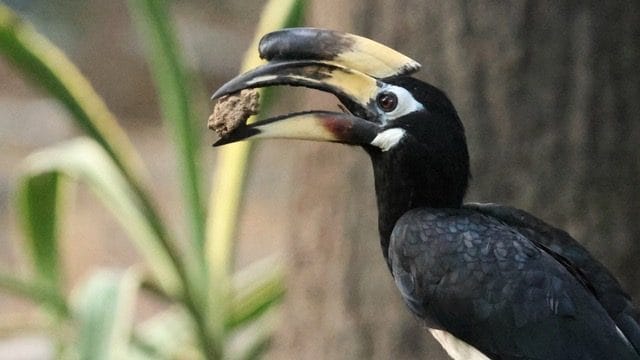


The Mausi Ma Hornbill series, first reported on 12 May, is coming to a close. In an earlier column, I wrote about the mysterious Oriental pied hornbill, or OPH, in Delhi’s Lodhi Garden. The bird is usually found in the Terai area. She—it was a female bird—aggressively took over feeding and nurturing at multiple nests of Indian grey hornbills, chasing away the parents. Such inter-species engagement stunned scientists and nature lovers globally. In a collective moment, the OPH was anthropomorphically named Mausi Ma.
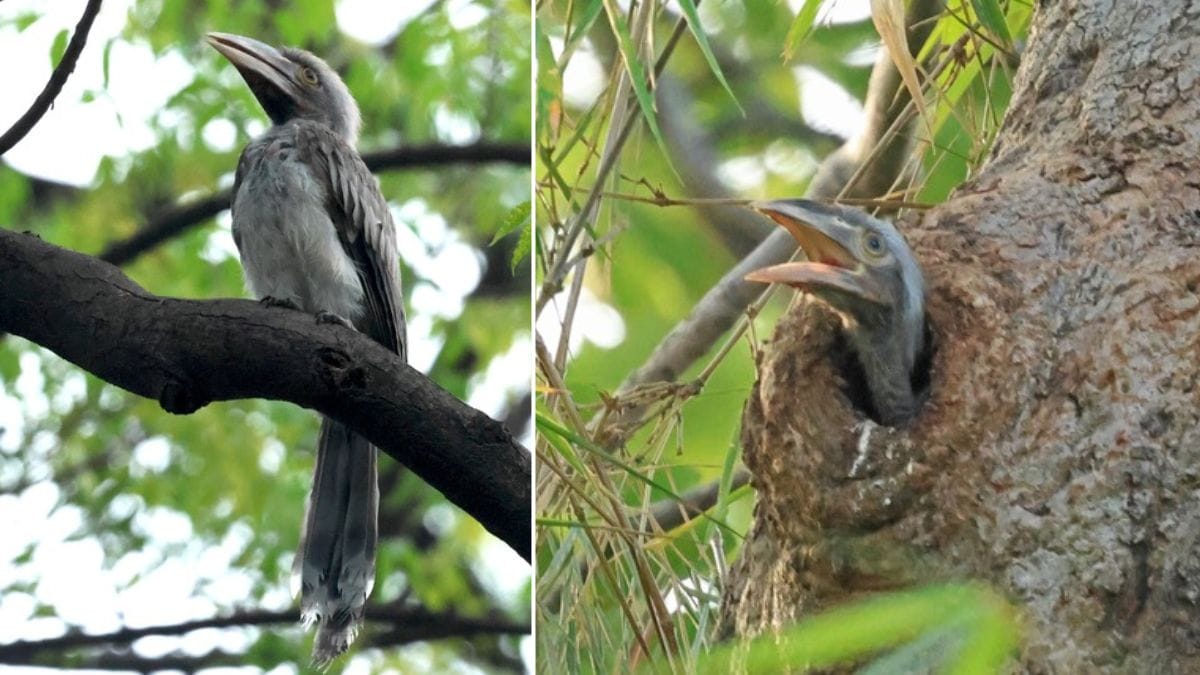
Birders, including me, have stayed focused primarily on three nests—all holes in the trunks of tall trees. When hatching her one or more eggs, a female hornbill seals herself inside the chosen hole, moulting in the process. The male feeds her through a narrow slit in the mud seal. When the hatched chick is old enough to be left alone, the mother breaks the seal and steps out. Then, she also feeds the chick. About 40 days after the mother leaves, the chick almost tumbles out of the nest. Many fall on the ground, or on branches or bushes nearby.
What would happen when the chicks encountered Mausi Ma for the first time, face-to-face? Would she attack them, because they would not look like her, or would the mysterious chemicals that drove her to co-parent them continue to ooze generously?
Chicks hatch, chicks fall
The first chick I saw was from what was labelled Nest 7 by fellow birders. Early morning, as we foraged ripe, sunshine-yellow bounty from the monkey fruit tree, a grey movement in one of the branches caught our attention. We identified it as a chick because it was without the signature hornbill casque and looked like a dishevelled bundle of grey fluff. It struggled to balance itself. We never saw it meet Mausi Ma.
Nest 2 offered birders the most insights. The first chick was named Tiger, because he was bold. He and Mausi Ma seemed to have become fond of each other. Next, from the same nest tumbled out another, younger chick. She was nicknamed Kitty.
“I didn’t want this whole thing to become all about boys,” said well-known birder Pankaj Gupta, who named her.
Kitty, unfortunately, is small and weak. Her survival is still in question. Her parents couldn’t locate her, despite the frantic efforts of both World Wildlife Fund (WWF) volunteers, Gupta and Capt Anil Singru (Retd), who has also been monitoring the saga. When Kitty’s father finally saw her, he sat next to her briefly. Her mother fed her one flying termite.
“As if by mistake,” Gupta said, aghast.
Kitty was even taken away by a wildlife rescue organisation, whose vet suggested she be put back where she was found. She is back now, but with moderate parental attention, who knows for how long?
Also read: Pigeons are not the problem. Our bajra charity is
Should you go near a nest?
In Nest 1, where all the drama started, two eggs hatched one after the other. The first chick died, its carcass in the nest attracting flies at the mouth. The parents discarded its carcass. The second chick is out, caught on video. It seemed to be strong and has not been seen since. Of the five chicks I followed, four have survived. If Kitty doesn’t make it, the number drops to three. Sixty per cent of them might experience hornbill adulthood.
“At some point,” said Gupta, “we have to force ourselves to let nature be.”
Which brings us to the big question posed by the hornbill saga: Is standing around trees with nests any way to let nature be? Not really. But the saga was an exceptional event in recent birding history, brought to the forefront by citizen science and the celebration of nature’s mysteries. Scientists from afar asked for meticulous observations, compelling the WWF to run a volunteer unit.
The nests being quite high, they were probably not as disturbed as many other species with lower nests might have been. Yes, Mausi Ma has given us the exception of a lifetime.
However, such intense presence must not become the new normal around nesting species.
An annual debate is how close up to nests should anyone go? What if the bird abandons its nest entirely? Several Indian groups on social media ban all photos of nests and chicks entirely, to reduce the incentive to take photos.
My own belief is that everyone should stay away from nests. We should let nature take its course.
Our love of birds should not eclipse the fact of their being species unlike ours, and living independently of us for the most part. Let us keep it that way.
Bharati Chaturvedi is an avid birder. She is the founder of the environmental non-profit organisation, Chintan India. She tweets at @Bharati09. Views are personal.
(Edited by Prasanna Bachchhav)