






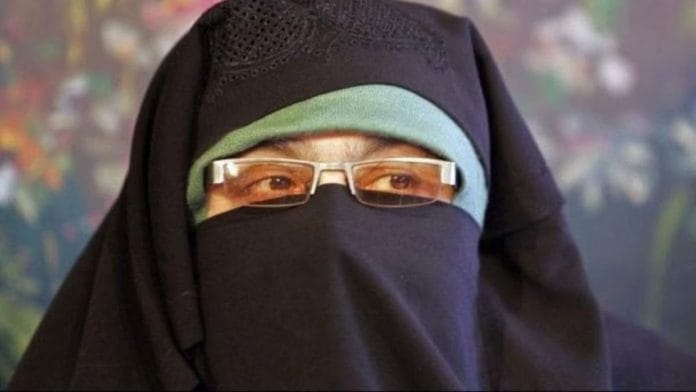



Kashmiri separatist Asiya Andrabi’s son wrote a message after she was given life imprisonment in March. Some described it as a plea on behalf of his mother, but he framed it not as an appeal, but as a reminder of what he called a systematic effort to suppress political dissent.
The irony was difficult to ignore. Andrabi’s son Ahmad was sent abroad to study and build a life for himself, while the organisation she founded, Dukhtaran-e-Millat, drew many young people into a cycle of agitation and violence—some radicalised, others losing their lives in the process.
For those who don’t know, for one instance, Andrabi was a central figure in the “Quit Jammu and Kashmir” 2010 campaign, mobilising support through her network during periods of unrest that left over a hundred people dead. Many of them were young.
Asiya Andrabi’s religious vision
I was surprised by the relative absence of international coverage around it. There was little in the way of sustained coverage or opinion—beyond a handful of pieces in international outlets, some written by her son, and others, such as Al Jazeera. Some present Andrabi as a figure who spent her life advocating for women’s rights.
I remember pausing at that claim, trying to make sense of it. The organisation she founded operated during the early years of militancy in Kashmir and issued threats against women who did not wear a burkha or purdah (veil). Some women were attacked with acid.
To describe such a figure as a defender of women’s rights shows how narratives are constructed and what they choose to omit. I am writing this column because someone had to call a spade, a spade. For the sake of our next generation, the community I belong to, we deserve to know the truth beyond simplistic and us v/s them story.
Andrabi was not simply an activist or a separatist leader. Her politics went beyond dissent into an explicit endorsement of violence. She openly admitted in her interview to The Guardian that she supports attacks on Indian police and soldiers, as well as inflammatory rhetoric directed at political leaders, including the assassination of the Indian Prime Minister.
What set her apart from other separatist voices was the framework she operated within. She saw the Kashmir issue not from a political angle, but for her, it was rooted in a religious vision that sought to reshape the separatist movement itself.
Moreover, anyone who believes she is fighting for justice or self-determination needs to look more closely at what she is actually advocating. This is not a vision of a just or equal society but one shaped by a theology, where rights and freedoms are defined by a rigid interpretation of religion.
In such a system, there is little space for individual liberty. Women, in particular, would be expected to conform to imposed moral codes — something already reflected in the kind of threats issued against women without a burkha by Andrabi’s organisation. And her vision leaves no room for a Jammu and Kashmir that belongs equally to all its people — across religions, identities, and beliefs. It imagines a space defined by exclusion, not coexistence. A society not very different in spirit from Pakistan, but perhaps even more rigid in its ideological purity.
Also read: Minorities are backing UDF again. Will it break LDF’s streak in Kerala?
Exclusionary politics
As Indian Muslims, we need to ask ourselves whether we can stand behind any idea that denies equality to us within India. If the answer is no, then we should oppose and reject, with the same conviction, figures like Asiya Andrabi, who advocate against a similar vision for others.
More to it, people like Andrabi who present themselves as defenders of justice for Muslims, reveal a very different reality when you look closely. I remember first coming across her while researching caste dynamics among Kashmiri Muslims. It was striking to read how someone who speaks so strongly about Muslim identity and rights reportedly opposed her own son’s marriage because the girl belonged to a darzi (tailor) family.
That stayed with me.
It exposes a contradiction we often ignore. It is easier to speak about a community’s interest in public, to take strong positions against the “other,” but much harder to confront inequalities within. It’s another thing to claim to stand for a just society and to practice that in real life.
And that is the ground reality of many such figures. They speak the language of justice outwardly, but inwardly, the same structures of exclusion remain untouched.
(Edited by Ratan Priya)
It is mystery as to how the terrorist Asiya Andrabi was given a free hand in the past. It looked as if the terrorist was more powerful than the state. Nara e Takbir, Allahu Akbar. Death to India’s enemies.