






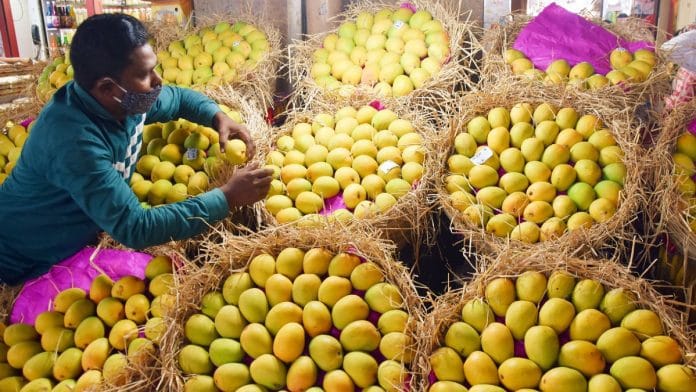


We may look forward to the mango season with delight and anticipation. Yet, the mood is sombre among Alphonso farmers. A recent report suggests that Alphonso production in Sindhudurg is down 85-90 per cent this season. Production is down in Ratnagiri by roughly 70 per cent, and in Raigad, by 60 per cent.
The farmers are haggling with the Maharashtra government over compensation amounts, and may reach a compromise at some point. But the Alphonso crisis represents the proverbial canary in the climate-change coal mine, with estimates suggesting that climate change could shave 3-10 per cent off GDP by the end of the century. This requires a serious policy response on climate adaptation.
The climate contract
Each cultivar—a plant variety bred to hold on to specific traits each time it is grown—has a climate contract. It demands certain conditions to flourish. The Alphonso mango needs 300 hours of direct sunlight in October to trigger flowering, colder conditions for flowering and fruiting, and subtropical or tropical climates, with optimal temperatures between 24 and 30 degrees Celsius, for the fruits to mature. Every farming year has fluctuations: a hot February, a late monsoon, or a stray hailstorm. The relevant question is whether the current changes are just fluctuations around a stable mean, or whether the underlying process itself has shifted. The evidence is increasingly suggesting the latter.
First, Konkan summer temperatures have shifted upward to 33 degrees Celsius in February and March. The monsoon has become more erratic and delayed, and arrives in sudden bursts instead of the steady drizzle. An increase in sea temperatures has led to cyclones, which are now rapidly intensifying in a historically calm region. Storms such as Tauktae and Biparjoy used to be once-in-a-generation events. They are now becoming the new normal, arriving at exactly the moment when the Alphonso is most vulnerable. The plant cultivar is now facing a climate it has not evolved for.
While our focus today may be the Alphonso, the climate contract is being rewritten across the Indian landscape: wheat in Punjab, coffee in Coorg, apples in Himachal, and paddy in the deltas. Each of these confronts a serious threat to its viability under status-quo farming techniques, even as the changing climate opens possibilities yet to be explored.
Also read: India’s east coast handles a higher volume. But the west coast has better economic outcome
Public policy in climate adaptation
What has the climate contract got to do with economics and public policy, you might ask. Once you accept that the underlying process has changed, the policy response has to fundamentally change, too. Traditionally, India has resorted to a policy of compensation, either directly through fiscal transfers or through crop-insurance type products that make payments after a pre-specified event. But both of these break down if the change is structural instead of a mere fluctuation. If we keep following the same practices under different climatic conditions, we will keep debating compensation amounts every year. In the new normal, compensation does not make for a sustainable strategy. We need a shift in the way we have been organising our production, infrastructure, and consumption. This is the central objective of climate adaptation.
One could argue that farmers (or other private sector companies) are incentivised to figure this out themselves and plant cultivars that are more resistant to climate change. Markets have solved parts of this problem before. The private sector can develop new plant varieties or hybrid seeds and earn money from them. Farmers’ cooperatives can fund things together. Policy merely needs to ensure that the incentives for individuals and firms to innovate remain clear.
But there are some parts of the job the market is unlikely to take on. For example, evaluating which cultivar to switch to requires knowledge of what the climate will look like in a specific village. This, in turn, requires field trials to run consistently across agroclimatic zones for several years and databases that record the flowering of plants against weather logs, among other things. The state has a role to play in funding activities that can develop, certify, and rapidly multiply climate-resilient mango cultivars, along with other agricultural products.
Finally, climate-resistant farming depends on open data. Figuring out which mango trees survive a heatwave needs a lot of information. Every reading from a weather station, result from a farm experiment, and soil test from a village needs to be recorded. Currently, a lot of this data either doesn’t exist, sits locked away in some government office, or is recorded in formats that don’t talk to each other. The data must be collected properly, stored in a standard format, and made free for anyone to use, from scientists trying to breed a tougher crop to officers advising farmers to agriculture startups building apps. Any serious plan to adapt to climate change has to start by treating farm and weather data the same way we treat roads, electricity, or the internet: as essential infrastructure the nation depends on.
The plight of farmers in Konkan is not national news. But it is a warning for Indian agriculture under a changing climate. Adapting to climate change requires measures such as seed libraries, soil databases, and 20-year farm experiments. The longer we mistake compensation for adaptation, the more harvests will fail, because the climate they were built for is fast changing.
Renuka Sane is managing director at TrustBridge, which works on improving the rule of law for better economic outcomes for India. She tweets @resanering. Views are personal.
(Edited by Prasanna Bachchhav)
Insightful and very well explained.
Thanks Renuka.