



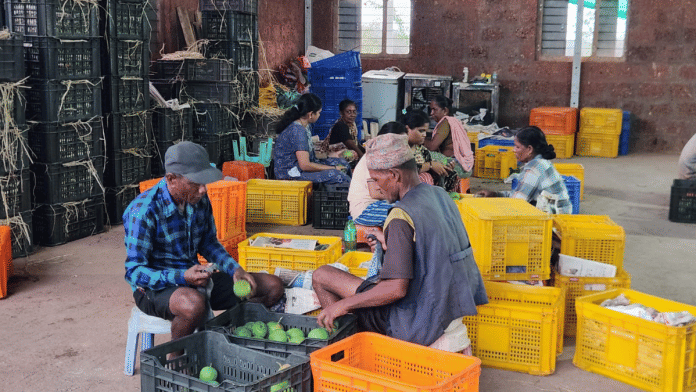
Devgad (Sindhudurg): In the sweltering heat of April, Suresh Kelkar’s warehouse in Devgad, Konkan would be filled with the aroma of Alphonso mangoes. Workers would be plucking mangoes from the adjacent orchard and sorting them in the warehouse.
Not this year though. This April, the warehouse is empty, crates are half-filled and the mango trees, which should have been laden with fruits, barely have mangoes on them.
“In my 40 years of experience, for the first time we have encountered such a crisis. Almost 95 percent of the first flowering got destroyed. The entire effort got wasted and it is a tremendous crisis for us. This year, the entire production is around just 10-15% of what it usually is,” Kelkar told ThePrint.
This mango season, production has dropped 70-90 percent, and resulted in supply to the market being squeezed to 10-20 percent of the normal, according to government estimates. This is expected to push up the prices of this variety of mango across states.
This is mainly due to extended monsoon, harsh winter, resultant accelerated pollination, and ineffective pesticides.
The situation pushed the farmers of Konkan to take to the streets in a rare protest for financial aid from the government.
The protest was led by farmer leader Raju Shetti who demanded that farmers should get Rs 5 lakh per hectare as compensation and complete farm loan waiver.
The government did announce compensation for mango farmers, but it is just Rs 22,000 per hectare, an offer farmers rejected.
“We just got assurances from the government initially but when we staged a protest, Guardian Minister Nitesh Rane gave us his word. Since assembly session was going on, the government made announcement of compensation, which is absolutely low and we reject it,” said Nilesh Pednekar, a member of the Amba-Kaju Vyapari and Bagaydari sanghatna, Devgad, which is the organisation that participated in the protest last month.
Maharashtra’s coastal belt of Konkan is famous for its Alphonso or Hapus mangoes. Along with mangoes, farmers here grow other cash fruits like cashews, jackfruits, kokum among others.
The land here has a thick, fertile layer, with well-drained sandy loam and red laterite soil, conditions that are most suitable for the cultivation of mangoes and cashews, lifelines of the local economy.
Devgad in Konkan is particularly famous for its Alphonso because of its peculiar taste and aroma—the correct blend of acid and sugar makes Devgad mango stand out.
To earn higher prices, many traders sell their mangoes in the name of Devgad Alphonso. The practice became so rampant that the government granted GI (Geographical Indication) tag to address the issue.
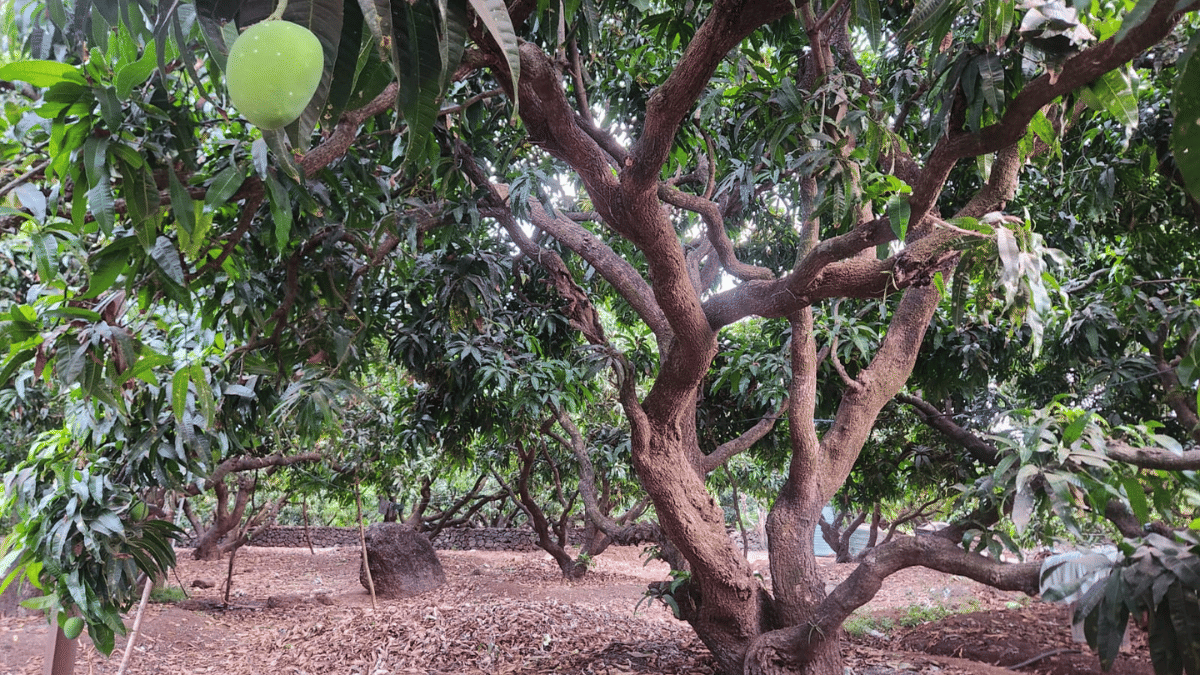
The period from February to May is the mango season in Maharashtra. But this year it has been severely impacted. And amongst the two Konkan districts—Sindhudurg and Ratnagiri—Devgad Taluka is the worst hit, with many farmers saying their production is hit by upto 70-90 percent
Kelkar said last year at this time, he had 3000-4000 crates of mangoes and he was expecting 5000-6000 crates of mangoes this year but now, he says, the production will be only 50 percent. One crate has 25 kgs of mangoes.
Also Read: Indian mangoes land in America and become ‘ticking time bombs’
The mango economy
Mango trade and the economy surrounding it is one of the biggest lifelines of the Konkan region, especially Ratnagiri and Sindhudurg. Average Alphonso production in Ratnagiri and Sindhudurg alone is 225,000 tonnes annually. According to estimates, in Sindhudurg district alone, 2.5 lakh to 3 lakh people are dependent on mango trade.
Konkan farmers generally grow mangoes and cashew and are seen as rich farmers who make decent profits every season.
According to the economic survey 2025-26, a total of 1.67 lakh hectares of land in Maharashtra is under mango cultivation, out of which 1.23 lakh hectare is in Konkan.
In Konkan, Ratnagiri and Sindhudurg districts are considered major Alphonso growing areas, with 68,550 hectares under the mango crop in Ratnagiri and 34,760 hectares in Sindhudurg.
According to the minutes of the State Level Bankers’ Committee meeting held on 23 March, non-performing assets (NPAs) as a share of total agricultural advances stand at 6 percent in Sindhudurg till December 2025, compared with 34 percent in neighbouring Kolhapur in western Maharashtra and 24 percent in Chhatrapati Sambhajinagar in the Marathwada region.
And that is why it is glaring how Konkan farmers have suffered this year.
According to government estimates, Konkan district of Sindhudurg has suffered 85-90 percent production loss for Alphonso mango, while in Ratnagiri, production is down by about 70 percent. In Raigad (which also grows Alphonso variety among others), the production is down by 60 percent, while in Thane (non-Alphonso variety), the production is down by 60 percent.
‘India is number one producer of Alphonso mangoes. For generations, Konkan farmers have been cultivating them. Climate change is a reality,’ says Agriculture expert Budhajirao Mulik.
In Thane and Palghar districts, Pairi mangoes are also grown. And in Marathwada, Kesar mangoes are grown, especially in Chhatrapati Sambhajinagar and Beed.
Renowned Agriculture expert Budhajirao Mulik, who also is the founder of Dr Budhajirao Mulik College of Agricultural Engineering and Technology, told ThePrint the climate crisis has become a reality and is here to stay for a variety of reasons.
The government should intervene to provide relief to mango farmers, he said.
“India is the number one producer of Alphonso mangoes. For generations, Konkan farmers have been cultivating them. Climate change is a reality. What is needed, since agriculture is a state subject, is the state government pass an Act that can help farmers,” said Mulik, a recipient of the Krishiratna award by the state government.
He added that like in several developed and developing countries, the law should ensure farmers earn returns linked to their cost of cultivation, including labour, and guarantee fair prices for their produce, protecting them from both natural and man-made calamities.
Climate woes
Chandrakant Goim (47) is a small farmer in Ilaye village in Devgad. He has 450 mango trees—aged 3 to 25—in his 9.5 acre orchard. Normally, he would produce 700-800 crates of mangoes but this year so far he could take out only 30-40 crates.
This year, he says, he will hardly earn Rs 1.5 lakh, while he has already spent Rs 7-8 lakh on the orchard. Normally, he gets Rs 15-16 lakh for the season.
Goim, who has been in this business for the last 30 years, blames the erratic weather condition. He says such a kind of season was unprecedented.
‘This year, there was no October heat and the monsoon continued till November 10, 2025. And within eight days, winter set in, resulting in bumper unnatural flowering,’ says a farmer.
He explains that once the southwest monsoon retreats by September, the 20-25 days of heat in October sets the tone for the season and the flowering begins in November.
The tree needs 300 hours of direct sunlight in October for the flowering to begin. It also requires dry winds and low temperatures, but the difference between the day and night temperature should be around 10 degrees Celsius. And humidity should be less than 40 percent, farmers say.
“This year, there was no October heat and the monsoon continued till November 10, 2025. And within eight days, winter set in, resulting in bumper unnatural flowering. The temperature difference was 15-16 degrees, which collapsed the flower because of dew,” Goim explained.
It is not just the erratic weather, but farmers complained of ineffective pesticides as well. Every year, farmers have to manage a pest called “mango hopper’ that thrives on leaves and flowers of the mango. And hence spraying of pesticide becomes necessary. This year, the tree was attacked by these pests.
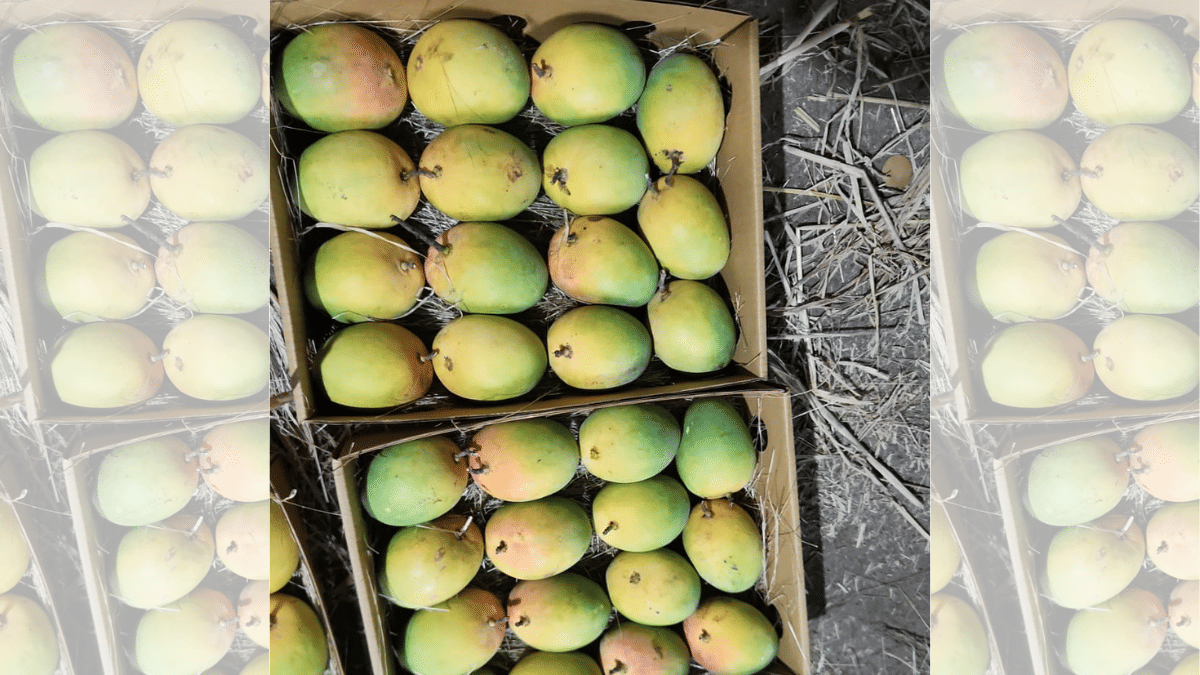
But somehow, farmers say, the pesticide did not work on the first flowering and the pest attacked the tree. Because of this, leaves blackened and mangoes didn’t come in the first flowering, the farmers said.
Another problem was accelerated pollination.
“The first flowering happens on 30 percent of the tree, then another 40 percent and so on and so forth throughout the season. But this time, 100 percent flowering happened in the first phase itself,” said Kelkar.
Goim added that pollination begins normally when the tree gets the October heat, with 15 percent female flowers and the rest male flowers. But this time, the female flowers were not even one percent, resulting in low yield.
“That is why the first flowering failed. And the expense increased because we had to spray pesticide all over our trees as flowering happened 100 percent. And the second flowering did not set well because the tree expended its energy in the first flowering itself and so the second one was very limited, which is why mango yield is low,” said Goim.
This means that housewives like Manjusha Gokhale, a resident of Goregaon, has to switch to Pairi mango instead of Hapus. Gokhale says, though her husband has no issues eating other varieties of mangoes, her young kids, love only Alphonso
“The prices are too much at the moment. I have started consuming Pairi, Kesar. These are no replacement, however, I have no other option,” Gokhale said.
Financial constraints
For Goim and other farmers like him, they say that from June onwards, the maintenance and preparation for the next season starts. On an average, farmers invest Rs 20-30 lakh during the season, bigger farmers invest more depending on their orchards’ size, and they need to at least break-even in order to prepare for the next season.
However, many say, they would be struggling to even breakeven this year.
Vidyadhar Joshi, a mango farmer and trader, who manages 1,400 trees, explains the farmers’ predicament.
He says if he spends Rs 50 lakh on one season, for instance, he needs to at least earn Rs 50 lakh to put it in the next season, which starts immediately. “And whatever I get over that is the income, which many farmers fail to understand,” Joshi said.
“I have seen mango production dipping, and it is quite natural but such a situation (like what has been seen this year) is unheard, unseen. You at least break-even every year. But this year, I won’t even break-even. Many even take advantage of Devgad name but let me tell you, in Devgad there is no mango,” he said.
He normally produces 6000-7000 crates of mangoes and also supplies to Mumbai, Pune Agricultural Produce Market Committee (APMCs) and other big towns in Maharashtra.
This time, he says, he could hardly manage 2000-odd crates. “Better than the rest, but not the best.”
He has also tied up with an exporter. “But, I don’t even have enough spare mangoes to give to my exporter company. So, this time around I won’t be sending mangoes for export, a big loss for me,” Joshi said.
Because of the supply shortage, even the Vashi APMC is suffering heavily. The APMC gets around 60 percent of their mangoes from Konkan, while the rest comes in from Gujarat, Karnataka, Andhra Pradesh.
Sanjay Pansare, director of the APMC Vashi fruit market, told ThePrint that normally 50,000-60,000 crates of mangoes arrive at the market by this time. However, only about 20,000 crates came in this year.
“Because of this, the prices of mangoes for buyers also increased by 25-30 percent. Normally, at this time last year, the rate was Rs 1000-3000 per box. But now, the rate went up to Rs 2000-4000 per box. And people would pay accordingly,” Pansare said.
He said that the regular Hapus customers would buy Hapus or wait for the prices to come down but they would not shift to other varieties.
Saroj Patil, a resident of Dadar, buys mangoes every Gudi Padwa, Maharashtrian New Year. However, this year was an exception.
“Every Gudi Padwa, I offer mangoes as my offering to God. But this year, I could not do it. At retail, I could not find Alphonso mangoes, while at APMC, they were selling at an exorbitant price of Rs 3,000 per dozen. I had to break the tradition, what can I do?” Patil told ThePrint.
And that is why farmers protested in Devgad.
Nilesh Pednekar said around 4000 -5000 people had gathered for the protest where the farmers blocked the Mumbai-Goa Highway on 23 March.
Meanwhile, during the latter days of the assembly session, Chief Minister Devendra Fadnavis announced a compensation of Rs 22,000 per hectare for the farmers.
There are around 100 trees in a hectare, so at this rate, farmers would get Rs 220 per tree, “This money is not even sufficient to give the salary of one of my workers and I have around 20 workers working in the field for me,” said Kelkar.
Earlier this month, Guardian Minister Nitesh Rane, who is also a local MLA, released a statement to the media, acknowledging mango farmers face a crisis this year.
“Despite the season being on, mango farmers are suffering. The aid that the government provided has angered the farmers. I have informed the CM that based on the aid provided, Rs 220 per tree is miniscule.
“Konkan farmers have never asked for any help but now that they have, the government should stand with the farmers. The CM has asked the officials of the finance department on how to increase this aid and help the farmers. In the coming days, our Mahayuti government will stand firmly with the farmers,” said Rane.
ThePrint reached out to Rane through calls and texts, but there was no response. The story will be updated if and when a response is received.
(Edited by Ajeet Tiwari)
Also Read: Delhi’s mango lovers brave the heat, buy Rs 4,000 buffet. It turned into a sour affair
Alphonso’s are overrated. These are the kind of farmers which we should gives subsidies to instead of a certain farming groups run by certain fraudsters.