




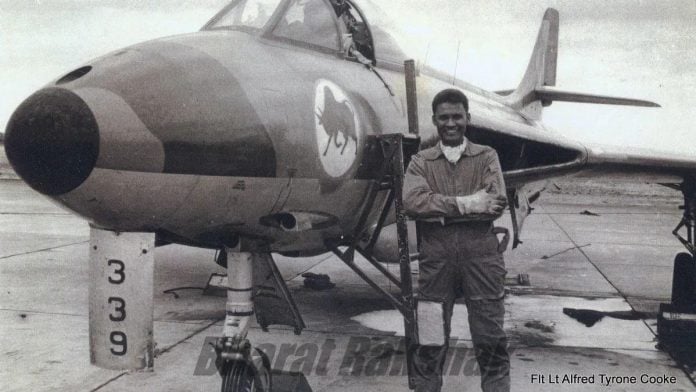

Alfred Tyrone Cooke had one objection to a painting of his most famous day: the Hawker Hunter was too high.
The painting showed his aircraft chasing a Pakistani Sabre during the air battle over Kalaikunda on 7 September 1965. Cooke had spent considerable time helping the artist, Deb Gohain, reconstruct the aircraft’s positions, but on this detail he was quite certain. His wingtip, he told him, had been only about six to ten feet above the ground. When Cooke landed after the battle that morning, his Hunter had vegetation lodged underneath it.
On 18 September 2026, Cooke took off for Valhalla in Delhi, a day before No. 14 Squadron, the Bulls, was to celebrate its Platinum Jubilee. He had served in the Indian Air Force (IAF) for barely seven years and had left it nearly six decades earlier. Yet few flight lieutenants in IAF history have had their names remain so firmly attached to a Squadron, an aircraft and one morning in war.
Cooke’s fascination with aeroplanes began long before he joined the air force. He grew up in Agra during the Second World War, when military aircraft were a familiar sight in the skies around the city. Hurricanes, Spitfires and Mustangs were among the aircraft he remembered seeing as a boy, and he later recalled wanting to become a fighter pilot from an early age. He went on to La Martiniere College in Lucknow, a school that would produce an unusually rich crop of IAF officers and fighter pilots.
He was commissioned on 19 December 1961 with the 80th Pilots Course. Within four years, he was at war.
By September 1965, Cooke was flying the Hawker Hunter with No. 14 Squadron. The Bulls had been equipped with Hunters only a few years earlier. Among the men who had prepared Cooke for combat was Squadron Leader O N “Piloo” Kacker, a demanding instructor whose low-level combat training Cooke would remember decades later. Kacker had made the pilots practise hard at very low heights. Cooke credited that training with giving him the confidence to throw the Hunter around close to the ground when the real thing came on 7 September.
The Bull who took on four Sabres
Kalaikunda had already been attacked once that morning when a second formation of Pakistani Sabres approached the airfield. Cooke and his wingman, Flying Officer Subodh Chandra Mamgain, were on combat air patrol and were directed toward the raiders. Four Sabres of the Pakistan Air Force’s No. 14 Squadron were involved in the second attack, three operating at low level and another above them.
Cooke went after the three below.
What followed has been reconstructed in considerable detail, particularly by Squadron Leader Sameer Joshi, using Cooke’s account, the surviving gun-camera evidence and Pakistani material. Cooke shot down the Sabre flown by Flying Officer Afzal Khan and badly damaged the aircraft flown by Flight Lieutenant Tariq Habeeb. He also engaged Flight Lieutenant Haleem’s Sabre. By then he had fired away his ammunition. That did not end his participation in the fight. When another Sabre became involved with Mamgain, Cooke went after it despite having nothing left to fire.
His official Vir Chakra citation records this extraordinary final part of the action. After exhausting his ammunition, Cooke again got behind an enemy aircraft and continued to keep it on the run.
The official score credited to him was one Sabre destroyed. Claims of further losses and damage have been debated ever since, and the evidence on some of them is not conclusive. What survives on Cooke’s gun-camera film, however, is enough to show him engaging several different Sabres during the combat. One aircraft was certainly destroyed, others were engaged, and at least one was badly damaged. Then there was the Hunter itself when it returned to Kalaikunda, carrying evidence of just how low the fight had gone.
Cooke was awarded the Vir Chakra.
Also read: India’s defence atmanirbharta needs a dose of realism—and a lot more drones
Vir Chakra for Param Vir Chakra action?
I have long found that award difficult to understand. It is difficult not to set Cooke’s action alongside that of another great IAF fighter pilot, Flying Officer Nirmal Jit Singh Sekhon, six years later over Srinagar. Sekhon took off with six Sabres overhead, engaged them at tree-top height and, according to his citation, damaged two before he was shot down. A Pakistani pilot who flew in that action would later acknowledge that Sekhon had put up a brave fight. He was awarded the Param Vir Chakra posthumously.
The two actions were not identical, nor does gallantry lend itself neatly to comparison. But the parallels are hard to miss: the odds, the height at which the combat was fought, the results achieved against attacking Sabres and, unusually in both cases, evidence from the other side. Cooke faced four Sabres, destroyed one, engaged others and continued after his ammunition was gone. The difference in the decorations was considerable.
In my view, what Alfred Cooke did over Kalaikunda on 7 September 1965 merited the Param Vir Chakra. It is still not too late to make amends.
The combat became the defining episode of his IAF career, but that career itself was surprisingly short.
By 1967, Cooke had decided that he would migrate overseas and had put in his papers. He had been selected among the pilots who were to convert to the newly arriving Su-7. Once his decision to leave became known, his place on the conversion went to Flight Lieutenant O J D’Sena. Cooke formally left the Air Force in December 1968 and eventually settled in Australia.
He had been a commissioned officer for just seven years.
That brevity is easy to miss because of the size of the reputation that followed. There was no Squadron command, no Wing Commander or Group Captain rank, no senior appointment and no second war in uniform. Cooke left as a Flight Lieutenant and remained Alfred Cooke of 14 Squadron for the rest of his life. No later rank ever displaced it.
Nor, by most accounts, was he an especially retiring personality. Those who knew Cooke remembered a man with high standards and little hesitation in letting somebody know when they had fallen short of them. He could be abrupt. He was immensely confident in his flying and had firm opinions about how an aeroplane ought to be flown.
Also read: Is the China-Pakistan arms nexus exporting authoritarianism? The case of the JF-17
‘My Vir Chakra belongs to the squadron’
The correspondence with Deb Gohain over the Kalaikunda painting provides another glimpse of him. Gohain initially addressed the decorated veteran with the expected military deference. Cooke quickly put a stop to that. No “Sir”. He was Alfred Tyrone Cooke. What followed were long conversations and video calls in which the two worked through the geometry of a battle fought decades earlier, Cooke correcting positions, heights and relative movements until he thought they had it right. They remained friends afterwards.
Australia became home, and he built his life there with his family, but the connection with India and the armed forces did not disappear. In April 2023, Cooke led the Indian contingent of Army, Navy and Air Force veterans at Brisbane’s ANZAC Day march. The weather was miserable, and it rained, but the veterans marched. Cooke, then in his eighties, was at their head wearing his medals.
And flying was not his only enthusiasm. Alfred loved to dance. Well into old age, he was still going every week to a sports club for its weekly dance.
In 2015, fifty years after Kalaikunda, he returned to India with his family. He visited La Martiniere again, alongside Denzil Keelor, when the Chief of the Air Staff honoured the school’s veterans of the 1965 war. He also returned to the Bulls.
This time he brought something with him. Cooke handed his Vir Chakra to No. 14 Squadron.
“My Vir Chakra belongs to the squadron,” he said.
He even tried to arrange for the monthly Jangi Inam associated with his gallantry award to be transferred to the Squadron. The medal made it back to the Bulls. The money ran into bureaucracy.
It is perhaps fitting that this is where the story ends. The Vir Chakra had already been home with the Bulls for eleven years.
Anchit Gupta is a military aviation historian. He tweets @anchitgupta9. Views are personal.
(Edited by Saptak Datta)