



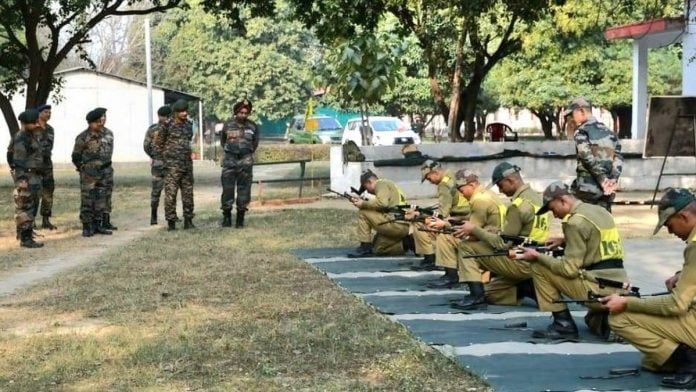
On 4 November, the government announced that the Union Cabinet had approved “a pathway for all Agniveers to be absorbed in Defence Forces”. The announcement came just as the first batch of Agniveers, roughly 18,000 of them, were nearing the end of their four-year term. It’s quite the about-turn.
When the Union Cabinet unveiled the Agnipath scheme on 14 June 2022, it was a radical overhaul of recruitment for personnel below officer rank in the Indian Army, Navy and Air Force. Youth aged 17.5 to 21 (with a one-time relaxation to 23 for the 2022 cycle due to Covid) could join as Agniveers for a four-year tenure that included training. Per the initial directive, only 25 per cent of each batch would be absorbed into the regular cadre, based solely on merit. The rest would exit with a lump-sum Seva Nidhi package, without pension or gratuity.
The dominant public message in 2022 was that the framework was the necessary path forward and that rollback was off the table.
Also Read: Theatre commands aren’t the answer to India’s military problem. Joint planning is
A start full of conviction
The government projected three core benefits when the Agnipath scheme was launched: a younger force whose average age would fall from around 32 to 24-26 years within six to seven years; a long-term reduction in the defence pension bill, which had already crossed Rs 1.19 lakh crore in the 2022-23 budget; and the benefits to society when disciplined, well-trained youth returned from the armed forces.
The other benefits included meritocracy—in which merit would take centre stage in deciding absorption into the armed forces—as well as a shift to recruitment on an “All India, All Class” basis. This would also help dilute the traditional class- and region-based composition of many Army regiments. Defence Minister Rajnath Singh described it as a “golden opportunity” for youth and a transformative reform for national security.
Not all viewed it that way, and the scheme’s launch triggered widespread protests among aspirants. They saw the scheme in terms of loss of job security. But even in the face of agitation, senior military and political leadership presented the design as settled and necessary.
At a joint services briefing on 19 June 2022, Lt Gen Anil Puri, Additional Secretary in the Department of Military Affairs, categorically rejected any rollback: “Why should it be rolled back? It is the only progressive step to making the country young… We are tinkering with Desh ki Raksha. There is no space.”
He cited high-altitude health casualties, the Kargil Review Committee and Arun Singh Committee recommendations, and the need for a better mix of youthful energy (josh) and experience (hosh). He confirmed that all future recruitment below officer rank would occur exclusively through Agnipath and that the scheme was a long-pending reform.
It seemed, at that time, that the matter was decided.
Army Chief General Manoj Pande called it a “transformational reform” that would not affect operational readiness and described it as a win-win for youth, the Army and the nation. In interviews, he stated there was “no rollback of the Agnipath scheme”, although he did note that “there will be feedback and the scheme will be tweaked as required”. Navy Chief Admiral R. Hari Kumar termed it “long overdue” and in the best interests of the forces, stressing that the armed forces are not an employment scheme. IAF leadership similarly defended operational readiness and the youthful profile. National Security Adviser Ajit Doval characterised the decision as the product of decades of deliberation, not a knee-jerk reaction, and ruled out rollback as well.
The big change
So, what explains the overhaul of the scheme now?
The decision was reportedly based on a performance assessment of Agniveers that yielded “positive feedback” on skills, motivation, physical fitness and technological prowess.
Under the original scheme, only 25 per cent of Agniveers were to be offered regular employment on merit. Now, the remaining 75 per cent will also be offered an opportunity for permanent absorption after another engagement period of two years. The final decision would be based on their willingness and certain objective assessment criteria. In theory, after those four plus two years, all willing Agniveers could be enrolled as regular soldiers in the armed forces.
Chief of Defence Staff, General NS Raja Subramani, told the media: “When the ‘Agnipath’ scheme was first introduced, we emphasised that it was not set in stone. We stated that we would evaluate the performance of the Agniveers and conduct continuous reviews.”
The founding assumptions about the benefits of a younger age profile for the armed forces, a reduced pension bill and trained soldiers returning to civil life were not discussed during the press interaction.
A major shift in tone
The contrast is stark. In 2022, the public framing from serving leadership treated the four-year tenure and 25 per cent retention as the settled model required for a younger force and fiscal sustainability. Limited language about future refinements existed, yet the emphatic rejection of rollback and the description of the scheme as the “only progressive step” conveyed finality.
In 2026, the same institutional leadership presents the original design as flexible, subject to continuous review, and modifiable.
Whether this constitutes a planned course correction or an ad-hoc response to operational, political or retention realities is a matter of interpretation; the shift in tone and substance is unmissable.
What becomes of the original objectives?
The claimed objectives, as originally stated, are now placed under strain by the revised pathway.
First, the reduction in the pension bill. The original fiscal case rested on 75 per cent of each intake exiting after four years without lifelong pension liability. Contemporary reporting and official framing repeatedly linked the scheme to containing a pension outlay that had become a major budgetary pressure on operational readiness. If most Agniveers now serve six years and then receive a further opportunity for regular enrolment subject mainly to willingness and selection criteria, the proportion entering the pensionable cadre could rise substantially. Savings would be delayed and diluted; the long-term structural relief that was presented as a major justification becomes less certain.
Second, the emphasis on a younger force. The projected drop in average age assumed a continuous high turnover of short-service personnel. If the majority of recruits complete four or six years of service and then become eligible for full careers, the age profile of the force could become older rather than younger. A six-year “probation” (for most) before regular status makes for an older soldier at entry level in the regular cadre.
Disciplined youth returning to civil society was another assumed benefit. The ‘youth’ would now return at a much later stage, after having served four or six years in probation, followed by 15-20 years of coloured service.
Don’t ignore the merits
Tensions over the Agnipath scheme do not erase its potential merits.
Retention of 25 per cent on merit creates a competitive incentive structure: performance, discipline and adaptability during the initial tenure can be rewarded with permanent service. All-India, All-Class recruitment expands the talent pool beyond traditional catchment areas and class compositions that have long characterised many Army regiments. Over time, this can strengthen national integration, reduce regional imbalances in representation, and draw in youth more attuned to contemporary technology and urban skill sets. The Seva Nidhi package and any associated skill certification provide a structured exit for those who wish to leave.
Positive feedback reported by the CDS on the first batch’s motivation, fitness and technological proficiency suggests that the short-service model has not produced the operational collapse some critics feared. A performance-tracked, centralised database offers, in principle, a more objective basis for selection than purely seniority-driven systems.
With the change in policy, there is likely to be significant collateral damage for those who wished to leave after their initial engagement. Returning Agniveers had been promised reservations by state and central governments in various government jobs, including in central and state paramilitary forces. The CDS stated at his press conference that such an arrangement is no longer necessary.
Agniveers who decide to leave face a stark choice—start from the bottom rung in the military or fend for themselves on the civilian street.
Also Read: India’s Zorawar talk is stuck in wars of the past. Look beyond the mountain tank
Armed forces are not meant for tinkering
Armed forces in a democracy survive and thrive on the basis of a social contract. Simply stated, the contract requires the soldier to go above and beyond in defending what the State represents. In return, the State promises to take care of the soldier, or his family, if he falls in battle.
Armed forces human-resource policy is not an ordinary administrative lever. It affects the social contract. Things such as unit cohesion, professional ethos and camaraderie are directly affected by recruitment policies.
Introducing a scheme that upends decades of recruitment practice, presenting it as non-negotiable, and then altering its core retention arithmetic after the first cohort has served four years invites scepticism about the quality of prior deliberation and consultation.
The armed forces are too serious a profession for perpetual tinkering. Human-resource policies of this magnitude require thorough deliberation within the services as well as with external stakeholders. Data-based, realistic modelling of operational and fiscal effects is an essential requirement. Also, where feasible, controlled piloting must be tried before full-scale rollout.
Once introduced, the programme needs a period of stability so that training pipelines, unit culture, selection systems and career expectations can settle. Continuous minor adjustments based on incoming data are different from major structural shifts that reopen fundamental questions about tenure, retention and pension.
The first batch of Agniveers has nearly completed their term, offering real performance evidence. That evidence should inform refinement. It should not, however, become the occasion for an open-ended conundrum in which every cohort risks facing a different set of rules.
Stability, predictability and institutional ownership are themselves operational requirements. The test of the revised Agnipath pathway will be whether it is allowed to run long enough for its benefits to take shape.
The revised Agnipath scheme should treat Agniveers as core manpower, not temporary recruits. The marriage ban should be relaxed, allowing marriage during service with simple intimation. This is needed now that the pathway to permanent absorption is open to all with the new two-year extension. Personal stability also strengthens operational readiness. Full death, injury and casualty benefits at par with those of regular soldiers should be extended from Day 1, including ex-gratia, disability cover, family pension and ECHS. Service carries equal risk, so it must carry equal dignity and social security.
Group Captain Ajay Ahlawat is a retired IAF fighter pilot. He tweets @Ahlawat2012. Views are personal.
(Edited by Asavari Singh)