



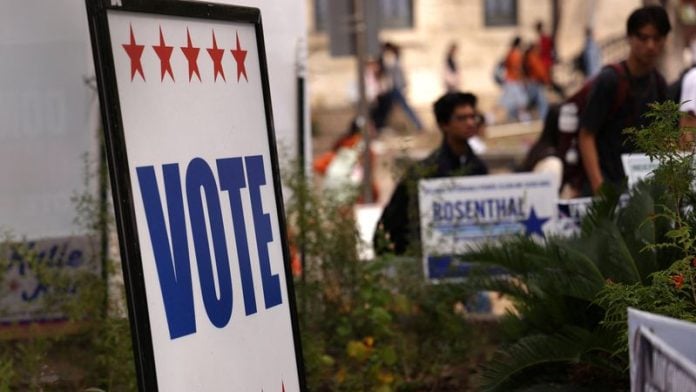
During the last few days, when Indians read and heard about President Donald Trump’s “defeat” in the US midterm election, many of them were confused. Will Trump now be removed from the US presidency? This confusion for some Indians is natural as in India, a midterm election usually happens only when a government falls before completing its full term. And a midterm election usually results in the formation of a new government. In the US, that is not what a midterm election means. Trump is not going anywhere even after this defeat. It is important to note that it is not Trump who has got defeated, it is his party, the Republican, who got defeated in the elections held on 3 November 2026.
Midterm elections are held halfway through a president’s four-year term. This time, elections were held for 435 House seats, 35 Senate seats, and 36 governorships. The House of Representatives is the lower house of the US Congress, and its members are elected directly by voters in their districts for just two years. The Senate is the upper house. Its members serve six years, and about one-third of them face voters every two years. Governors are the heads of the state governments, much like chief ministers in India, and are elected by the people of each state. The election is called “midterm” because the House vote always falls in the middle of a presidency. Trump began his second term in January 2025 as the elections were held on 5 November 2024, so this election came at its halfway point.
The results were a big blow for the Republicans. Democrats secured control of the Senate with 54 seats and won 240 seats in the House. Republicans hold 44 Senate seats, and a couple of races are still being counted. The House needs 218 seats for a majority. Before the election, the outgoing House had 218 Republicans, 214 Democrats, one independent and two vacancies. In the Senate, Republicans had held a 53-47 edge.
Democrats flipped at least 27 House seats, while Republicans failed to flip a single one. In the Senate, Democrats flipped at least seven seats in Kansas, Iowa, Texas, Ohio, Maine, North Carolina, and South Carolina. Texas has not elected a Democrat to a state-wide office in over 30 years. Democrats also did well in the governors’ races. In Texas, Democrat Gina Hinojosa defeated Republican Governor Greg Abbott. Voters said they were unhappy about high prices, the war in Iran and corruption in government. Trump said he was not personally defeated and accepted the results, saying the voters “didn’t like the candidates.”
Also read: US midterms a signal for India—build bipartisan ties & work on policies, not personalities
What next for Trump?
While Trump will continue to be the President of the US, a big change will be in how decisions are made in Washington. Until now, Trump’s party controlled both houses of Congress, so his proposals passed easily. From January 2027, when the new Congress takes charge, the Democrats will control both houses. No law can be passed without their assent. Every bill, including the budget, will need their approval. But the president can veto the bills passed by the house and Trump has already threatened to veto laws passed by the Democrats. If the president vetoes a bill passed by the house, it can be overridden only with a two-thirds vote in both houses. Even when the Democrats now hold the majority both in the House and the Senate, they do not have the two- third majority needed to override the President veto on a bill. There is a serious possibility of a deadlock in the offing in US law making, with each side blocking the other.
The Senate approves the president’s top appointments, such as Cabinet members and judges. With Democrats in charge, the president may find it much harder to get his picks approved.
Congress also has the power to investigate. Party leaders have signalled that Trump’s last two years will be dominated by investigations of members of his administration and deeper scrutiny of how he has enriched his family. Impeachment, the process to remove a president, has not been ruled out either. However, removing a president needs a two-thirds vote in the Senate, which is very difficult.
Trump will still have powers. He still remains head of the government, he can issue executive orders, run government departments and conduct foreign policy. But new laws and spending plans will be difficult to push through.
In short, even with this defeat, Trump will continue to be the US president until January 2029 as he himself has not been defeated. What the American voters have done is take away his party’s control over Congress. For the next two years, he will have to deal with an opposition that can block his laws, question his officials and investigate his government. His powers have been substantially curtailed, and that is the most prominent significance of this election. A system of check and balance of power may be in action in the US in the remaining part of Trump’s presidency.
Sanjay Kumar is a Professor at the Centre for the Study of Developing Societies (CSDS) and an election analyst. Arindam Kabir is currently working as a researcher with Kumar on the project “Women in Indian Politics”. Views are personal.
(Edited by Aamaan Alam Khan)