





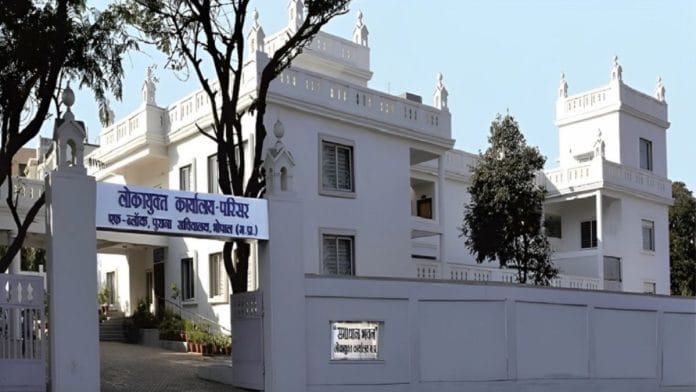


New Delhi: The Supreme Court on Monday struck down a 2011 notification issued by the Madhya Pradesh government exempting the Lokayukta’s Special Police Establishment (SPE), which usually investigates complaints of corruption, cheating, bribery, and misuse of public office by government servants, from disclosing information under the Right to Information (RTI) Act.
A bench of Justices J.K. Maheshwari and A.S. Chandurkar said, “The SPE cannot be termed an ‘intelligence and security’ organisation for the purposes of Section 24(4) of the RTI Act, 2005.”
“The statutory scheme under which the SPE stands constituted, coupled with the jurisdiction conferred on the Lokayukta or the Up-Lokayukta, clearly indicates that the SPE cannot be termed to be an ‘intelligence and security’ organisation when it assists the Lokayukta or the Up-Lokayukta in matters specified by Section 7 of the Act of 1981,” the court also said in its 32-page judgment.
The 1981 Act is the Madhya Pradesh Lokayukt Evam Up-Lokayukt Adhiniyam, 1981, governing the functioning of the Lokayukta and Up-Lokayukta in Madhya Pradesh. Section 7 of this law specifically empowers these authorities to investigate allegations of corruption and misconduct against public servants, and the SPE acts as the investigating agency.
Under the RTI Act, the Lokayukta is a statutory investigative authority vested with powers of enquiry when it comes to allegations of corruption, misconduct and malfeasance by public servants, the court noted. The SPE has essentially served as an investigative arm under the Lokayukta, but was exempted by the Madhya Pradesh government in 2011 from the rigours of the RTI Act, under Section 24(4) which excludes ‘intelligence’ and ‘security’ organisations from giving information.
The case dates back to 2017, when a First Information Report was registered against a police inspector, Kamta Prasad Mishra, by the SPE, Bhopal, for accepting a bribe of Rs 10,000. After investigation, a chargesheet was filed before the special court at Katni, which prompted Mishra to seek copies of documents and other correspondence which served as the basis for the Madhya Pradesh home department’s decision to grant sanction for his prosecution in 2020 by the State Information Commission, which cited Section 8(1)(h) of the RTI Act to shield disclosure of information that could impede the investigation.
The Madhya Pradesh High Court ruled in Mishra’s favour, in December 2021, asking the authorities to furnish the information he had sought. The SPE, however, challenged the decision before the top court, citing a 2011 notification issued by the state government that exempted the SPE and the State Bureau of Investigation from disclosing such information under Section 24(4) of the RTI Act.
Also Read: What the Supreme Court said about property decisions by guardians on behalf of minors
Why the SC set aside the notification
Although Section 24(4) of the RTI Act exempts ‘intelligence and security organisations’ established by the state government, the court said that SPE cannot investigate any offences or classes of offences related to ‘intelligence’ and ‘security’.
Interestingly, the Madhya Pradesh government had argued that the probe’s disclosure could impede the process of investigation. However, the court rejected this argument, saying that the chargesheet was already filed. “It is, thus, clear that organisations referred to in the Second Schedule to the Act of 2005 are specifically concerned with ‘intelligence’ and ‘security’, having been constituted by the Central government with that object in mind,” the court said while referring to intelligence organisations mentioned under the RTI Act.
On the other hand, the SPE has limited jurisdiction to investigate offences punishable under the Act of 1988, Sections 409, 420 and Chapter XVIII of the Penal Code, the court said, referring to offences like criminal breach of trust and cheating.
Referring to the official website of the Madhya Pradesh Lokayukt, the court said the Lokayukt Organisation itself states that the SPE is an “organisation that functions to prevent/check corruption”. Calling the state government’s 28 May 2011 notification “excessive” the court also turned down its contentions that the objective behind Section 24 of the Act of 2005 would be defeated if the state government was compelled to furnish information sought to be exempted by virtue of that provision.
Relying on Section 207 of the Code of Criminal Procedure, 1973, the state government also said that at the initial stages of investigation, materials collected by the investigating agency could not be sought by an accused.
Making it clear that the SPE cannot be excluded from disclosing information under the RTI Act, the court also turned to the statement of object and reasons given in the Madhya Pradesh Lokayukt Act, 1981, which said that currently there is no “mechanism in place to investigate into allegations of corruption, etc., against high-ranking individuals such as the Chief Minister, other elected officials and senior officers under the control of the state government and in order to maintain ethical standards in public life. In fact, there has been a need for a long time to establish an independent mechanism for this purpose, the court pointed out.
The court said the SPE, while assisting the Lokayukta in carrying out its functions, could not be treated as an ‘intelligence and security’ organisation. Simply put, the court made it clear that the SPE has the power to investigate corruption-related offences under the Prevention of Corruption Act and some offences under the IPC, but it cannot carry out intelligence or security functions.
(Edited by Nardeep Singh Dahiya)