


New Delhi: The possibility of communal tension and a fresh law and order problem were among the key reasons cited by the Odisha government while rejecting the premature release plea of life convict Ravindra Kumar Pal alias Dara Singh, after the Supreme Court repeatedly pressed the state to take a decision on an application that had remained pending for years.
The State Sentence Review Board (SSRB), which considered Australian missionary Graham Stuart Staines’ killer’s case at a special meeting on 31 August, refused to recommend his premature release, citing concerns over the possible social consequences of setting him free.
According to the proceedings of the board meeting, around 200 to 250 people associated with the Dara Sena had gathered outside the Kendujhar District Jail on 15 August and raised slogans demanding Singh’s release.
The board considered the incident while assessing the possible law and order consequences of his release and concluded that it could have wider societal ramifications, including the possibility of communal disturbances.
Singh’s convictions in three separate murder cases was another factor before the board. The state’s 2022 premature release policy provides for consideration of eligible life convicts for release, subject to prescribed conditions and exclusions.
The latest decision came after a prolonged process in which the Odisha government had repeatedly deferred a final decision.
Singh had approached the Supreme Court in 2024, seeking consideration of his premature release under Odisha’s remission policy after spending more than 24 years in prison. The case subsequently went through several rounds of consideration before the SSRB.
In May 2025, the board deferred Singh’s case and sought further reports, with his convictions in three separate murder cases being cited as a factor.
The matter was again deferred in September 2025, when the board sought an opinion from
authorities in Auraiya, Uttar Pradesh, where Singh originally lived. The Auraiya authorities subsequently supported his premature release in February 2026.
There was also a significant change in the assessment at the district level. In March 2026, the Kendujhar administration had recommended that Singh could be considered for premature release, subject to conditions intended to maintain social harmony.
That recommendation was followed by further scrutiny. The 15 August gathering outside the jail then became part of the material considered by the board before it rejected the plea.
The state’s eventual decision, therefore, came after the remission application had remained under consideration for several years, with different authorities providing reports at different stages.
Supreme Court repeatedly sought decision
The delay had also become a point of concern before the Supreme Court. Dara Singh’s petition had initially focused on the failure of the authorities to take a decision on his remission request. The court repeatedly granted the state time to complete the process and pass an order.
On 19 August, a Bench of Justices Manoj Misra and Vijay Bishnoi noted that the matter had been adjourned repeatedly to enable the state to take a decision. The court was told that a report from the Kendujhar jail was still awaited. It directed the SSRB to take a decision and inform it of the outcome.
On 8 September, the Bench questioned why the matter continued to remain pending and indicated that the competent official could be summoned if a decision was not taken.
The Odisha government eventually placed its 31 August decision before the court 17 September, informing the Bench that Singh’s remission plea had been rejected.
The Supreme Court did not deliberate on the validity of the reasons cited by the state.
Instead, it allowed Singh to amend his existing petition so that he could specifically
challenge the rejection. “You take whatever grounds you want to take to challenge it. Amend your petition and then argue,” Justice Misra told Singh’s counsel.
The Bench granted Dara Singh’s legal team two weeks to amend the petition and
directed the state to provide a copy of the proceedings. On 17 September, the matter was adjourned for three weeks.
The next stage of the case will, therefore, focus not merely on the delay in deciding Singh’s remission plea, but on whether the grounds recorded by the state for rejecting it can withstand judicial scrutiny.
The 1999 gruesome killings
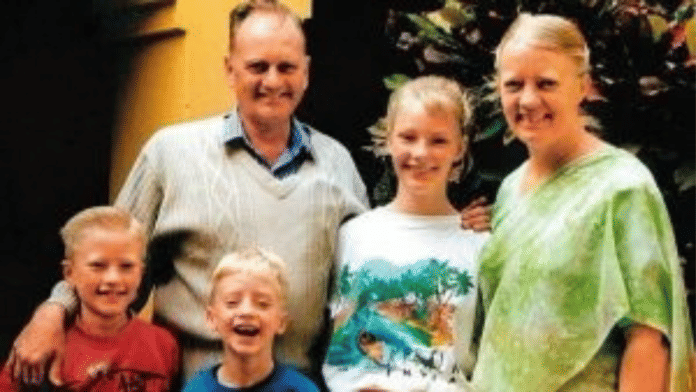
On the night of 22 January 1999, Australian missionary Graham Stuart Staines and his two sons, Philip Staines (10) and Timothy Staines (6), were sleeping inside a station wagon at Manoharpur village in Odisha when a mob set the vehicle on fire.
The Supreme Court’s 2011 judgment records that the mob prevented the occupants from escaping, resulting in the deaths of all three.
Dara Singh accused of planning and coordinating the attack. He mobilised the mob of 50-60 people and led them to the victims’ vehicle. He also prevented the family from escaping by blocking the vehicle’s doors, along with the mob.
Singh was subsequently arrested and tried in connection with the killings. A special CBI court convicted him and sentenced him to death in 2003.
The Orissa High Court, in 2005, commuted the death sentence to life imprisonment. The Supreme Court upheld that decision in 2011, holding that the case did not meet the threshold for imposing capital punishment under the “rarest of rare” doctrine. Singh was also convicted in two other murder cases in Mayurbhanj district.
One concerned the killing of Catholic priest Father Arul Doss at Jamubani Church in Mayurbhanj district in 1999. The other involved the murder of garment trader Shaikh Rahaman. Singh was sentenced to life imprisonment in both cases in 2007, with the
convictions subsequently upheld on appeal.
Singh has now spent more than 26 years in prison.
His remission case has also acquired another dimension following the premature release of Mahendra Hembram, a co-convict in the Staines murder case, in April 2025.
The immediate issue before the Supreme Court is now whether the Odisha government’s 31 August rejection can be sustained. Singh’s amended petition is expected to challenge the state’s reliance on the 15 August gathering, apprehensions of communal disturbance and his convictions in multiple murder cases.
The court’s next consideration will thus be the legality of the reasons recorded by the state, after years of proceedings over whether Staines’ killer Singh’s request for premature release should be considered in the first place.
Aditya Edara is a TPSJ alum, currently interning with ThePrint.
(Edited by Viny Mishra)
Also read Graham Staines murder: SC gives Odisha panel till 19 Aug to decide Dara Singh’s early release plea
This was in fact a case that merited capital punishment. Rarest of the rare.