



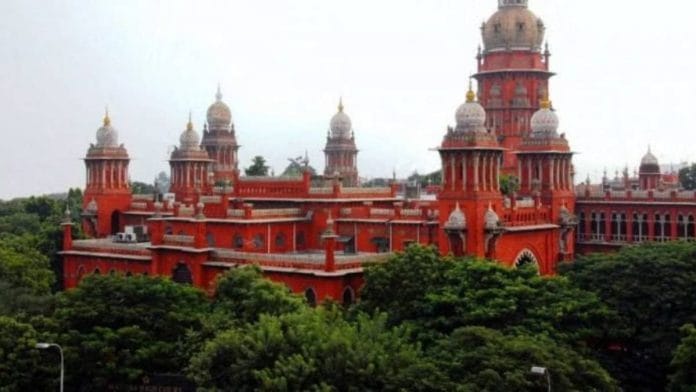
New Delhi: The Madras High Court this week upheld the decision of the Tamil Nadu Assembly Speaker to accept the resignations of six AIADMK legislators who later joined Chief Minister C. Joseph Vijay’s TVK, holding that the pendency of disqualification proceedings did not prevent them from quitting the assembly.
A division bench of Chief Justice Sushrut Arvind Dharmadhikari and Justice G. Arul Murugan, however, directed the Speaker to conclude the pending anti-defection proceedings within two months, making clear that the resignations would not bring those cases to an end.
“The acceptance of resignations does not render the pending disqualification proceedings academic or infructuous,” the bench said in a 109-page judgment. The court directed the Speaker to prepare and publish a timetable for the proceedings within seven days. It also said the legislators should not be allowed more than two opportunities or adjournments on flimsy grounds to delay the cases.
The judgment came on petitions filed by AIADMK official whip Agri S.S. Krishnamurthy and Desiya Makkal Sakthi Katchi (DMSK) president M.L. Ravi, challenging the acceptance of the resignations and seeking action on the pending disqualification complaints.
Senior advocates V. Giri and S.R. Rajagopal appeared for Krishnamurthy in the connected petitions, while T. Sivagnanasambandan represented Ravi. Advocate General Vijay Narayan appeared for the Speaker and assembly authorities. Senior advocate Menaka Guruswamy represented the legislators.
Fractured mandate, floor test
The dispute arose after the Tamil Nadu assembly elections held on 23 April returned a fractured mandate. The TVK emerged as the largest party with 108 seats, followed by the DMK with 59 and AIADMK with 47.
Vijay was invited to form the government and asked to prove his majority by 13 May. The AIADMK official whip directed all party MLAs to attend the assembly and vote against the confidence motion.
However, 25 AIADMK legislators defied the whip and supported the motion. The party subsequently initiated disqualification proceedings against them under the Tenth Schedule of the Constitution, which deals with defection by elected legislators.
Six of these MLAs later resigned and joined the TVK. They were S. Jayakumar, Maragatham Kumaravel, P. Sathyabama, Dr. Esakki Subaya, Dr. C. Vijaya Bhaskar and M.R. Vijaya Bhaskar.
The first three resigned on 25 May, followed by Esakki Subaya on 26 May. C. Vijaya Bhaskar and M.R. Vijaya Bhaskar resigned on 16 and 29 June, respectively.
The AIADMK challenged the Speaker’s acceptance of the resignations, arguing that he should have decided the disqualification complaints first. It also questioned the speed with which the resignations were accepted, alleging that the process had allowed the legislators to escape the consequences of defection.
Also Read: How Madras HC invoked ‘disclosure’ principle while refusing to revisit microplastics labelling order
Separate processes
Rejecting the argument that the Speaker was required to wait until the disqualification proceedings concluded, the bench held that resignation and disqualification operate under separate constitutional provisions.
Article 190(3)(b) governs the resignation of an MLA, while the Tenth Schedule provides for disqualification on grounds of defection. The Speaker’s role in examining a resignation is limited to determining whether it is genuine and voluntary, the court said. He is not required to conduct a detailed inquiry into the political motives behind it, it elaborated.
The bench said the Speaker had interacted individually with the legislators and ascertained their intentions before accepting their resignations. It found no constitutional infirmity in the decision.
“The Speaker of Tamil Nadu Legislative Assembly was not required to undertake a roving or detailed inquiry into the alleged motives behind them,” the court held, concluding that the resignations were genuine and voluntary.
The judges drew on the Supreme Court’s ruling in Shrimanth Balasaheb Patil v. Karnataka Legislative Assembly (2020), which held that a resignation can be rejected if it is not voluntary or genuine, but the Speaker cannot consider extraneous factors when deciding whether to accept it.
The court also rejected the argument that accepting the resignations would make the disqualification proceedings pointless. An allegation of defection does not become an established finding merely because a petition has been filed, it said.
The pending cases must therefore be decided on their merits, and the Speaker’s eventual determination will carry the consequences prescribed under the Tenth Schedule.
Speaker to finish proceedings in two months
While upholding the resignations, the bench said prolonged delays in deciding disqualification complaints raised concerns about public confidence in legislative institutions. It observed that an expeditious and fair decision would address questions arising from the defections that followed the floor test.
The court said a direction to decide the cases within a fixed period did not amount to interference with the Speaker’s constitutional role. Rather, it would facilitate the discharge of that responsibility.
The Speaker must publish a timetable covering replies by the legislators, objections from the complainants, completion of pleadings and final arguments. The court also directed him to give a reasoned decision after considering the submissions of the parties and following the principles of natural justice.
If the deadline is not met, an interested party may approach the High Court for further directions. The ruling leaves the resignations intact while requiring the Speaker to address the pending disqualification proceedings. It does not itself declare the legislators disqualified or clear them of the allegations.
(Edited by Nardeep Singh Dahiya)
Also Read: Madras HC puts end to caste discrimination at Kancheepuram temple, says ‘all equal in eyes of God’