



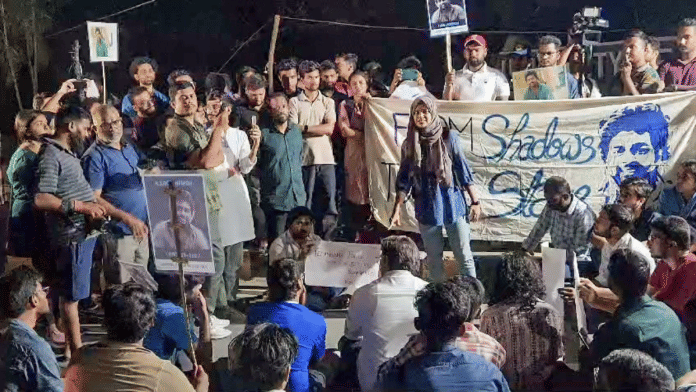
New Delhi: The Karnataka High Court has quashed criminal proceedings against 15 students who were booked for allegedly participating in a protest in Bengaluru following the death of University of Hyderabad student Rohith Vemula in 2016.
Justice H. P. Sandesh, in an order dated 30 September (and made public on 5 October), said the material in the charge sheet did not make out a case warranting continuation of proceedings against the students. The court particularly noted that the charge sheet did not state which provision of the law governing public assemblies had been violated.
Rohith Vemula, a research scholar at the University of Hyderabad, died by suicide in January 2016, triggering protests across the country and a wider debate over caste discrimination and treatment of students. The Bengaluru protest took place the following month.
According to the prosecution, the 15 students had gathered around 11.30 am on 10 February 2016 near Capital Hotel on Raj Bhavan Road, raised slogans and displayed flags after Rohith Vemula’s suicide. The police alleged that they had assembled without prior permission and obstructed the movement of traffic. They were subsequently arrested and released.
What the police case said
The Cubbon Park Police filed a charge sheet against the students for offences under Sections 283 (causing obstruction on public road), 341 (wrongful restraint), 143 (being part of an unlawful assembly) and 144 (joining or continuing in an unlawful assembly armed with a deadly weapon) read with Section 149 IPC (liability of members of an unlawful assembly for acts done in pursuit of its common object).
The students subsequently approached the high court under Section 482 (the high court’s inherent power to prevent abuse of the court process and secure the ends of justice) of the CrPC seeking quashing of the proceedings pending before the VIII Additional Chief Metropolitan Magistrate, Bengaluru.
The petitioners relied on the Licensing and Controlling of Assemblies and Public Processions (Bangalore City) Order, 2009, under which permission was required for a congregation of more than 250 people assembling at one place for a meeting or protest, among other specified purposes.
The court noted that the prosecution’s own charge sheet stated that the students had brought together 100 to 150 people. It also pointed out that the charge sheet did not identify the particular provision of the 2009 order that the accused had violated.
The court found the prosecution had failed to establish an “unlawful” assembly on the material placed before it.
Common object argument
The students also relied on the Supreme Court’s judgment in Charan Singh & Others v State of UP (2004), arguing that mere presence in an unlawful assembly does not make a person liable under Section 149 IPC unless the requisite common object is established.
The high court referred to its own earlier decision in Mohammed Tafseef & Others vs State of Karnataka (2017), where it had applied the same principle in a similar case and quashed the proceedings. Justice Sandesh said the present case was also similar, noting that the only allegation against the 15 petitioners was that they were proceeding towards Raj Bhavan to submit a representation.
The court also took note of the fact that although the charge sheet referred to a gathering of 100 to 150 students, only the 15 petitioners had been made accused.
The high court ultimately held that this was a fit case to exercise its inherent powers under Section 482 CrPC. It allowed the petition and quashed the proceedings against all 15 petitioners.
(Edited by Viny Mishra)
Also read: Rahul pushes Cong govts on Rohith Vemula law, even though Telangana Police closed suicide case