





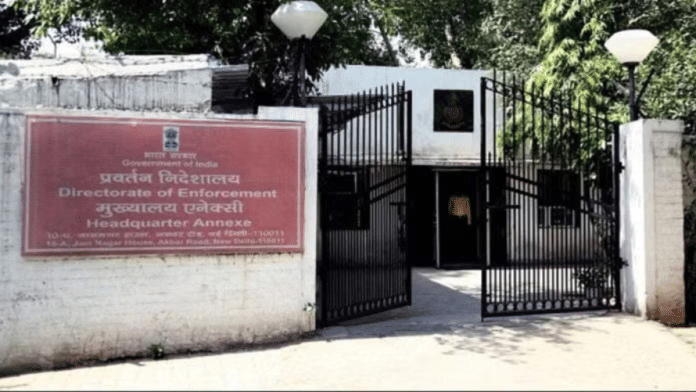


New Delhi: In an unusual move, the Enforcement Directorate (ED) has sought the Supreme Court’s direction to the trial court to defer pronouncement of its order on a charge in a money laundering case related to one of the many coal block allocation cases.
ED does not want the special court in the Rouse Avenue district court to proceed with the matter until the apex court decides a crucial legal question—the foundation of its allegations: whether the allocation letter acquired by the accused company for coal mining constitutes proceeds of crime under the Prevention of Money Laundering Act (PMLA).
This critical question has arisen in four appeals filed in related but separate coal block allocation cases that are pending in the SC since January this year. They challenge the Delhi High Court’s two orders—of October and November, 2025—that held the allocation letter was one of the core essential elements to initiate the offence of money laundering, whereby it acted as a conduit to derive the proceeds of crime.
The high court had overturned a contrary finding by the trial court. However, the Supreme Court stayed the operation of the high court findings on the proceeds of crime.
ED’s plea to defer the PMLA proceeding in the trial court relates to the allocation of the AmarKonda Murgandangal coal block to M/s Jindal Steel & Power Limited and M/s Gagan Sponge Iron Private Limited. The predicate offence, based on which the ED’s case commenced, was registered by the CBI in June 2013, and the trial is still pending.
According to ED’s plea in SC, the case in trial court is at the stage of order on charge. Its request to defer the pronouncement was turned down by the court below, prompting ED to move SC.
The trial court refused to entertain the ED’s request, pointing out that no superior court had stayed the proceedings before it.
According to the ED, the outcome of the appeals, in the SC, concerning proceeds of crime will directly bear on the outcome of the case before the trial court. It said the trial court judge declined to follow judicial discipline, saying halting the proceedings on a speculative ground was unwarranted.
Going by the ED’s allegations, the two companies had committed the offence of cheating and misrepresentation to secure the allocation of the coal block by the Ministry of Coal in their favor.
The prosecution complaint filed in July 2018 accused them of deriving and obtaining proceeds of crime, including the coal block allocation letter. This was procured as a result of criminal activity related to the scheduled offence registered by the CBI.
Hence, it argued, the allocation letter would come within the ambit of “proceeds of crime,” besides the money that was exchanged as part of the conspiracy.
ED’s supplementary complaint further claimed that the Jindal group entered into a web of transactions for routing money through various shell companies and engaged in the sale and purchase of M/s JSPL shares in high volumes at an exorbitant premium.
This mechanism led to the generation of over Rs 59 crore.
The two high court orders under examination before the SC had held that the allocation letter in the scam was obtained as a result of criminal activity related to a scheduled offence, which is cheating and criminal conspiracy. It examined the term “proceeds of crime” with a wider lens to conclude that the allocation letter was attained through misrepresentation and suppression of material facts.
It said: “The allocation letter was one of the core essential elements to initiate the offence of money laundering, whereby it acted as a conduit to derive the proceeds of crime. Furthermore, the allocation letter was obtained through misrepresentation and suppression of material facts. If these facts had been revealed truthfully, the allocatee companies would not have received the letter, which constitutes criminal activity related to the scheduled offences under the PMLA, 2002.”
Taking note of the petition, a bench led by Chief Justice Surya Kant Friday asked the trial court not to proceed in the matter till 29 July. It gave a similar order in the CBI case.
This is an updated version of the report.
(Edited by Varnika Dhawan)