





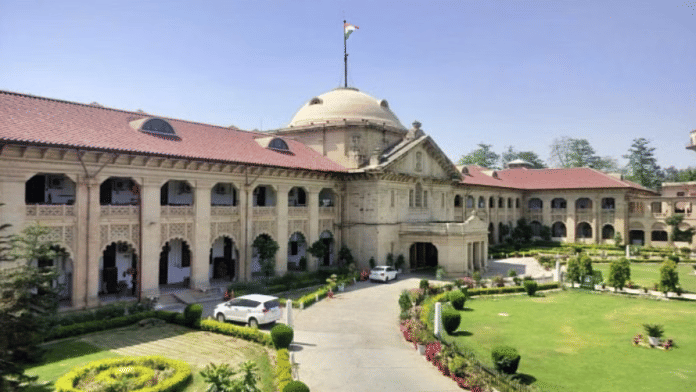


New Delhi: Ruling that an Internal Complaints Committee (ICC) report at the Harish Chandra Research Institute failed to follow mandatory procedure, the Allahabad High Court has referred back a complaint under the Sexual Harassment of Women at Workplace (Prevention, Prohibition and Redressal) Act, 2013 (POSH Act) for a fresh inquiry.
The court emphasised that although complaints related to the incidents were filed beyond the limitation period under the POSH Act, the issue could not be rejected outright on delay alone, and required proper consideration in light of the Act’s object.
It noted that the ICC had not recorded statements, denied opportunity of cross‑examination and failed to conduct oral hearings—all clear departures from the principles of natural justice.
Justice Saurabh Shyam Shamshery quashed the ICC’s report and the subsequent order of censure, and remitted the case back to the institute for a fresh investigation.
Also Read: CEO, HR of Delhi digital marketing firm questioned over intern’s sexual harassment allegation
Background of the case
An associate professor of Astrophysics at Harish Chandra Research Institute faced multiple complaints of sexual harassment filed by female Ph.D. students and postdoctoral fellows who were working under him at the institute in Allahabad between 2013-2016.
These complaints were formally lodged before the Internal Complaints Committee (ICC), a mandatory committee that every workplace must constitute under the POSH Act 2013. The Act requires setting up of an ICC to receive and investigate complaints of sexual harassment.
The ICC concluded that the associate professor was guilty of misconduct, citing serious allegations including unwelcome advances, sexually coloured remarks, and even an admission of sending pornographic material via email. The ICC recommended suspension, denial of promotions and restrictions on supervising female students.
The governing council of the institute, however, imposed a lesser penalty of censure, and barred the associate professor from taking female students or postdoctoral researchers. This 2017 order was challenged before the high court.
Course of the law
The associate professor argued that the ICC had acted beyond its jurisdiction by entertaining complaints filed years after the alleged incidents, between 2013 and 2016, without any recorded reasons for condoning delay.
He stated that the POSH Act clearly stipulates that complaints must be filed within three months of the incident, extendable by another three months for sufficient cause. He further contended that the outcome of inquiry was not based on any material or specific consideration.
The institute countered that the seriousness of allegations justified relaxation of limitation, stressing that the POSH Act’s purpose is to protect women at workplaces.
The court’s analysis was meticulous. The high court did acknowledge that there was delay but instead of dismissing everything outright, the court stated that “complaints cannot be rejected at threshold without specific consideration”.
It reiterated that the POSH Act is a special statute enacted in pursuance of the Supreme Court’s directions in Vishaka v. State of Rajasthan, and therefore its provisions must be followed strictly.
The court held, “It has been consistently held in various judgments of this court and Supreme Court that principle of natural justice be followed and that ICC shall have power as vested in Civil Courts under Code of Civil Procedure so far as summoning and enforcing attendance of any person and examine him in Court is concerned.”
It added, “However, there is no reference in ICC report, whether statements of complainants were recorded before Committee or not and if statements were recorded, whether a copy of same was provided to petitioner or not. There is no reference whether petitioner was asked to cross-examine the complainants or was provided any opportunity of oral hearing.”
The court found that procedure adopted by ICC was defective and unsustainable. Therefore, it remitted the case back to the ICC at the institute for a fresh investigation, but with very clear directions. The court also directed the ICC to get back within eight weeks with a clear decision on whether it intends to investigate the complaints further or not.
Alfreza Ahmed is an alum of ThePrint School of Journalism, currently interning with ThePrint.
(Edited by Nardeep Singh Dahiya)