



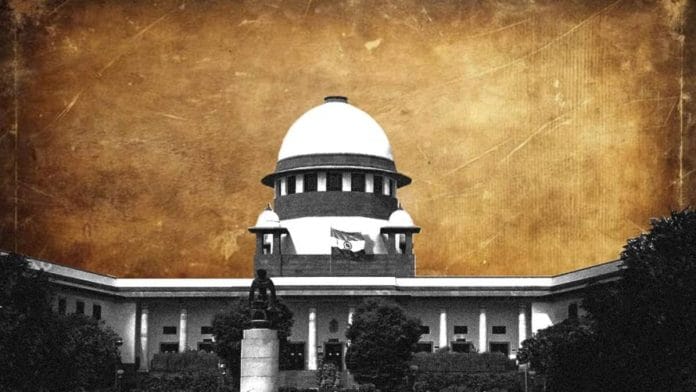
New Delhi: The Supreme Court Tuesday heard a petition seeking Standard Operating Procedure (SoP) for a 24×7 judicial roster. The petition argued that its objective was to ensure better access to courts, especially in emergency matters pertaining to life and liberty when fundamental rights are violated. Asking all High Courts to share their views on it, a bench of CJI Surya Kant and Justices Joymalya Bagchi and V. Mohana sought to streamline the procedure for urgent hearings outside of regular court hours.
The Public Interest Litigation (PIL) was filed by Advocate Maheravish Rein, who while appearing in person, argued that even though remedies exist within the constitutional scheme, “the present institutional framework of courts largely restricts access to judicial remedies to designated court hours, working days and limited vacation benches”.
As a result, she submitted, individuals facing urgent violations of liberty and fundamental rights often encounter significant practical difficulty in obtaining immediate judicial protection during nights, weekends, public holidays and court recesses. She also argued that litigants have to wait for the following morning to approach courts, if their fundamental rights are violated after court hours.
“In circumstances involving illegal detention, imminent demolition of homes, deportation proceedings, custodial violence or other executive actions affecting life, liberty and dignity, the absence of a structured and institutionalised mechanism ensuring continuous judicial accessibility may result in irreversible consequences before affected persons are able to approach constitutional courts,” her petition states.
At present, Article 145 of the Constitution already empowers the Supreme Court to make its own rules for practice and procedure, on the President’s approval. These rules decide how the court works day-to-day, how appeals are filed, fee is charged, bail is granted, and past judgments are reviewed.
Under the Supreme Court Rules, 2013, the Chief Justice of India exclusively holds the administrative authority to constitute special benches and allocate cases as the “Master of the Roster”. Under the 2013 Rules, these are the CJI’s exclusive prerogative and individual judges cannot take up matters independently unless officially assigned by the CJI.
Further, Supreme Court Rules already allow urgent mentioning and circulation before the CJI. Similarly, the Chief Justice of each High Court is the master of that court’s roster, regulating urgent filings and constitution of special benches, but practices vary widely.
In 2018, Supreme Court Justices A.K. Sikri and Ashok Bhushan ruled that the CJI is the sole “Master of Roster”. They affirmed the CJI’s exclusive authority to constitute benches and assign cases, rejecting senior advocate Shanti Bhushan’s plea that the power should be shared collectively by the Collegium.
The PIL by Advocate Maheravish Rein notes these and thus argues for the creation of a uniform SoP.
Even though a codified SoP does not exist as of date, the Rules do detail the procedure for urgent mentions and there have been many instances where the apex court has presided over matters beyond the usual working hours of 10 AM to 4 PM to adjudicate on urgent and extraordinary matters. The PIL, however, seeks a uniform formal structure for functioning of courts in non-working hours.
Pleas by Yakub Memon, Surendra Koli
Perhaps what is regarded as the most famous midnight hearing, a three-judge bench of the Supreme Court had assembled pre-dawn for considering death-row convict Yakub Memon’s 14-day window after rejection of mercy plea. Menon was convicted in 2007 of financing and facilitating the 1993 Mumbai serial bomb blasts.
After then President Pranab Mukherjee rejected his mercy plea, his lawyers approached the top court at 3.20 AM as his hanging was scheduled for the next morning in a Nagpur jail. The top court, around 5 AM, ultimately rejected his plea noting that he was given ample opportunity to exhaust his legal options over a multi-year process. His death sentence was then executed.
For Surendra Koli, first convicted and then acquitted in the 2005-2006 Nithari killings in Noida, an emergency intervention by the Supreme Court at 1:30 AM on 8 September, 2014, led to the suspension of his imminent execution, hours before the death sentence was to be executed.
Following the apex court’s rejection of his mercy petition, a local court had ordered Koli’s death sentence to be executed at Meerut Jail, prompting human rights lawyers to launch a midnight legal manoeuvre based on a new Supreme Court ruling that death row convicts have a right to an open-court review hearing.
Senior Advocate Indira Jaising rushed an urgent appeal to the residence of then Justice H.L. Dattu, resulting in a middle-of-the-night stay order that reached prison authorities at 3 AM, just as preparations for the hanging were underway.
As fate would have it, this temporary arrangement bought his legal time crucial time, leading the Allahabad High Court to commute his death sentence to life imprisonment in 2015 due to excessive executive delays. Ultimately, this midnight intervention altered the trajectory of the entire case, culminating in Koli’s complete acquittal by the Supreme Court on 11 November, 2025, after the judiciary threw out his final conviction citing a severely botched police investigation.
Babri, bail & Delhi riots
Another famous off-hours hearing dates back to 1992. When the Babri Masjid was demolished in Ayodhya, an emergency hearing was convened at the residence of then Justice M.N. Venkatachaliah—who passed an immediate midnight order directing that an absolute status quo be maintained at the disputed site.
In 1985, after prominent industrialist Lalit Mohan Thapar was arrested under the Foreign Exchange Regulation Act (FERA), the then Chief Justice E.S. Venkataramiah was woken up at his residence in the middle of the night, where he conducted a hearing and granted Thapar instant bail.
In 2020, a bench of Delhi High Court Justice S. Muralidhar and A. Bhambani in a 12.30 AM hearing directed Delhi Police to rescue and provide safe medical passage to over 20 critically injured victims trapped in a local hospital during the Delhi riots. Concluding past midnight at Justice Muralidhar’s residence, the bench issued orders that fundamentally prioritised immediate humanitarian aid over bureaucratic protocol during the peak of the communal violence. Hours after this midnight intervention, during the usual court session, Justice Muralidhar sharply criticised Delhi Police for failing to act against hate speeches by politicians, remarking: “(we) can’t let another 1984 happen in this country under [our] watch”.
He was transferred on the same evening to the Punjab and Haryana High Court, leading to widespread public debate regarding judicial independence.
Also Read: Indian courts are operating like a lottery. They need smarter case scheduling
Eviction, Setalvad & Shiv Sena
The initial legal battle that led to the landmark Olga Tellis v. Bombay Municipal Corporation case, one of the most landmark public interest judgements in India, began with an urgent midnight intervention. In July 1981, the then Chief Minister of Maharashtra ordered the sudden, forceful eviction and deportation of thousands of pavement dwellers from Bombay. To prevent the imminent morning demolitions, journalist Olga Tellis championed the residents’ cause, prompting renowned lawyer Indira Jaising to make an extraordinary, late-night emergency call to a Bombay High Court judge. The court granted an immediate stay of execution that night, which halted the evictions and set off a historic constitutional battle.
The definitive final judgment was delivered by the Supreme Court in July 1985, but this midnight intervention successfully saved vulnerable citizens from immediate homelessness and ultimately established the landmark legal precedent that the “right to life” under Article 21 includes the right to a livelihood and guarantees the right to a fair hearing before eviction.
In July 2023, the Supreme Court formed a three-judge bench and held a hearing at 9:15 PM for hearing the bail plea of journalist and rights activist Teesta Setalvad, accused of fabricating evidence in the 2002 Gujarat riots. Earlier in the day, the Gujarat High Court had rejected her bail plea and ordered her to surrender immediately. After Setalvad’s lawyers rushed to the Supreme Court seeking urgent relief, a two-judge Bench of the Supreme Court, late evening, could not agree on granting interim protection and directed that the matter should be heard by a larger Bench. Then, CJI Dr D.Y. Chandrachud constituted a three-judge bench post 9 PM which eventually stayed the Gujarat High Court order and granted her interim bail.
Similar special hearings have also happened for the Maharashtra government twice: in 2019 and 2022.
In November 2019, following an impasse in government formation after the Assembly elections, the then Governor lifted President’s Rule in the early hours of 23 November, 2019 and administered the oath of office to BJP’s Devendra Fadnavis as Chief Minister and NCP’s Ajit Pawar as Deputy Chief Minister.
The Opposition coalition of Shiv Sena-NCP-Congress moved the Supreme Court, which conducted a special hearing on Sunday. Two days later, the Supreme Court ordered an immediate live-telecast floor test without a secret ballot to ensure transparency and check horse-trading, which led to the resignation of Devendra Fadnavis before the floor test could take place as he did not have adequate votes.
Next, in June 2022, when Eknath Shinde led a mass rebellion of MLAs within the undivided Shiv Sena, effectively reducing the ruling Uddhav Thackeray-led Mayahuti government to a minority. Governor Bhagat Singh Koshyari subsequently ordered an immediate floor test to prove the government’s majority.
This led to the Uddhav Thackeray faction rushing to the Supreme Court and seeking an urgent stay on the Governor’s order. A vacation bench of the Supreme Court held a four-hour hearing starting at 5 PM. At around 9 PM that night, the Supreme Court refused to stay the floor test, ruling that a trust vote was the only definitive remedy to check political defections and horse-trading. Within minutes of the court’ order, Chief Minister Uddhav Thackeray announced his resignation on live television, bypassing the floor test altogether.
(Edited by Amrtansh Arora)
Also Read: We’re not ready for ‘One Case One Data’. Court records are too unorganised for digitisation