






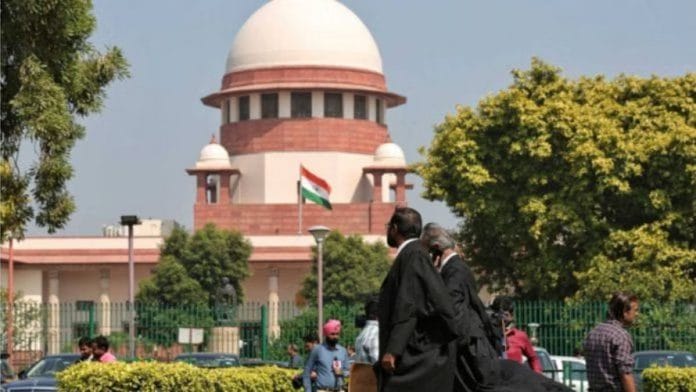


In January of this year, the district court in Kalpetta, Wayanad went fully paperless with the stated objective of having every new case filed, scrutiny conducted, hearing held, and order issued managed digitally for the first time in India. This week, the Chief Justice of India announced an initiative that would assume such a digital case management as the new modus operandi for courts across India.
The One Case One Data (OCOD) project is reported to link case information across the Supreme Court, high courts, district courts and taluka courts within a single interconnected case management system. The initiative is greatly required and recognises information as critical infrastructure for digitalisation of justice delivery.
This new system would be an addition to the digital initiatives that already exist. The National Judicial Data Grid (NJDG) website visualises macro statistics such as the number of cases pending, institution and disposal rates, breakdowns across case types and stages updated daily across all courts. The eCourts services database holds case status information related to cases in district courts and high courts, primarily through logged metadata, accessible to litigants and advocates. What OCOD (along with the accompanying announcement for Su Sahay, a litigant-facing AI chatbot) promises is different: A judge at any level will be able to see the complete background of a case, including who various respondents were, what written submissions were made, and what evidence was presented or government records linked. These documents will be digitally retrievable across courts rather than depending purely on versions provided by advocates during appeals or received through the manual process to call for lower court records.
But the question OCOD must grapple with is what will be found in the retrieved judicial data.
In a large share of the 64 lakh cases pending at high courts and the 93,000 odd cases pending at the Supreme Court, significant portions of the records may not be readable by any digital system at all. Court records have been digitised in waves; while the most recent cases may have been immediately scanned or natively e-filed, many others were scanned from paper files after they were disposed. Despite best efforts, such scans—for both pleadings and daily order sheets—may be drafted in a variety of Indian languages or in the case of older files, handwritten. They may also include abbreviations or shorthand intelligible only to the registry or staff who made those entries. Where the paper itself may be damaged during storage, printed in a small font or have fading ink, even optical character recognition (OCR) struggles. No artificial intelligence tool, no matter how capable, can reliably extract or interpret from it without the contextualised human intelligence that created the original documents. As a system, OCOD will have to reckon with such files.
Also read: 4000 Indian courts have done away with typing. An AI revolution is on
Archiving errors
Another problem is the attached metadata, or the structured fields that describe each case: Names of parties, the legislation(s) under which it was filed, the nature of relief sought, and eventually, the outcome granted.
First, case records may be missing within the eCourts architecture. DAKSH’s analysis of eCourts data found that fields were often left blank at the high court level; more than 70 per cent of writ and bail cases observed were populated ‘NA’ for the act under which the case was filed, and above 80 per cent respectively for case outcomes. When metadata is present, it is often inconsistently entered across courts: The same case type can be recorded in five different ways across five districts, rendering cross-court analysis, AI-assisted research, and litigant-facing updates unreliable. Sometimes, final orders are missing for certain cases. In other instances, case records relating to certain case types are missing. In an initial study of bail cases before magistrate courts, DAKSH observed that there were no case records under these case types on eCourts for some judicial districts. In such instances, seeking to retrieve earlier documents or case updates will provide no results. A system that links these fields across all levels will highlight the full scale of this inconsistency and reveal its dependence on human understanding. This is a valuable takeaway, but only if it is accepted as a call to fix the foundations, not to outsource them to an AI model making its best guess.
Also read: DY Chandrachud is right about using tech in courts. Learn from Germany’s IBM AI assistant
Steps forward
Merely retrieving digitised case files may not go far enough. Here are a few proposed models that will make OCOD easier to implement.
- a Single Source for Law: A modified India Code that would contain not just central and state legislation, but also delegated legislation (such as notifications, circulars, and guidelines) in fully up-to-date, annotated, and machine-readable formats and
- an Integrated Database of Judgments (IDOJ): a free and open-access “digital record room of decisions of all courts in India” with unique identifiers, neutral citations, norms and mark-up language to locate sections, universal features, and authenticated text. This models examines what an AI-ready reference corpus for Indian courts could be, both in design and functionality.
When a court’s official research tool draws on validated and accessible databases of legislation and judgments, the risk of confidently citing or accepting a case reference that does not exist or a statute no longer in force drops significantly. Such a database offers a tangible, verified source to compare against, rather than pattern-matching across whichever training data an AI model was exposed to.
OCOD is a significant step forward toward a judiciary that treats each case as a unified and cohesive data object to be built up across each hearing and at every level. Easy retrieval of this information is fundamental to transforming judicial data into real digital public infrastructure. But it will only deliver on that promise if there is a realistic attempt to address underlying data challenges, such as scans that cannot be easily read, fields that are empty or inaccurate, and records with too many inconsistencies to be automatically linked.
Smita Mutt researches data and technology in courts at DAKSH, a Bengaluru-based civil society organisation that works on judicial reforms. Views are personal.
(Edited by Theres Sudeep)