



New Delhi: The kin of 32 individuals who died in the Karur stampede last year will not get government appointments in Tamil Nadu, with the Madras High Court calling them “side-door entries” who violate the fundamental right to equality for thousands of other citizens seeking to enter government service.
The core of the high court’s reasoning rests on the principle that public employment is not “largesse” to be distributed at the discretion of the state. The bench concluded that it had full sympathy for the victims, but the law must be applied strictly and fairly to all. In quashing the appointments before the individuals received their first salary, the court aimed to prevent any “vested interest” from taking root in a process it deemed unconstitutional.
The judgement was pronounced on 27 July, but its copy was made available on the high court website only late on Wednesday. The Tamil Nadu government has now challenged the order before the Supreme Court.
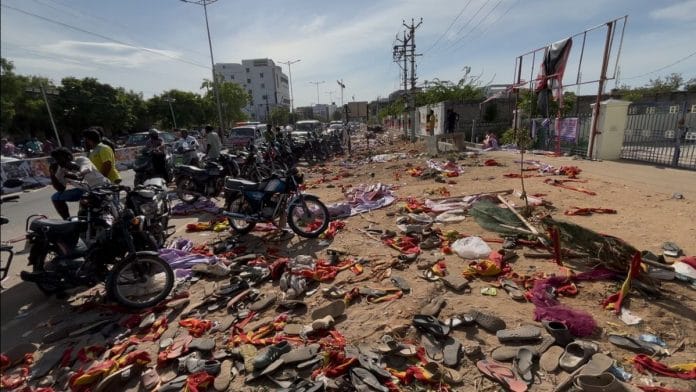
The tragedy at Velusamypuram in Karur District occurred when a stampede broke out, killing 41 and injuring 100, during a political rally hosted by actor-turned-politician C. Joseph Vijay of the Tamilaga Vettri Kazhagam (TVK) on 27 September 2025.
After forming the government in Tamil Nadu, the TVK government issued an order on 6 July 2026, granting appointments to 32 named individuals from the victims’ families. This decision was based on recommendations from district collectors and the revenue secretary, who suggested providing jobs on “compassionate grounds” due to the magnitude of the tragedy. The government had already provided an ex-gratia assistance of Rs 10 lakh to every affected family.
On his first visit as the state’s chief minister, black-attired Vijay broke down while personally handing over government appointment orders to 32 members of the victims’ families.
These appointments were immediately challenged through Public Interest Litigations (PILs) arguing that granting jobs as a form of tragedy relief was a direct violation of Articles 14 and 16 of the Constitution of India, which mandate equality before the law and equal opportunity in public employment.
Justices C.V. Karthikeyan and R. Sakthivel of the Madurai bench of the Madras High Court agreed. They pointed out a harsh reality: every government department has a “wait list” of individuals seeking compassionate employment because their own family members—who were public servants—died in harness. Thousands of candidates were awaiting their appointment via the Tamil Nadu Public Service Commission as well. By granting 32 jobs to the Karur victims’ kin outside this established system, the state was effectively overlooking the needs of those already in the queue.
Also Read: Tamil Nadu government approaches Supreme Court, challenges Madras HC’s cow slaughter ban order
The requirement of indigence
A critical factor in the court’s decision was the lack of evidence regarding the financial status of the beneficiaries. Under established legal principles, compassionate appointment is intended only to help a family “tide over the sudden financial crisis” caused by the death of a breadwinner.
The court noted that the government order did not specifically state that these families were in ‘indigent circumstances or penury’, especially considering they had already received Rs 10 lakh in ex-gratia payment.
The TVK-led government defended the jobs as a “humane act” performed under the executive powers of the state via Article 162, questioning the maintainability of a PIL in service matters. The high court rejected these arguments, asserting that any exercise of executive authority must remain “within the confines of the Constitution”.
The court expressed concern that allowing such appointments would “open the floodgates” for similar claims following other tragedies, such as fireworks factory accidents or road mishaps involving government vehicles. If every tragedy resulted in guaranteed government jobs, the merit-based system of public service would collapse. Instead of “throwing away” public employment, the bench suggested that the government should have focused on “training in skills and entrepreneurship” for the victims’ families.
The court also noted that while compassionate appointment is offered on humanitarian grounds, it remains an exception to the general rule of equality.
(Edited by Nardeep Singh Dahiya)
Also Read: Madras High Court says convicts with pending appeals can be granted leave under 1982 Rules