





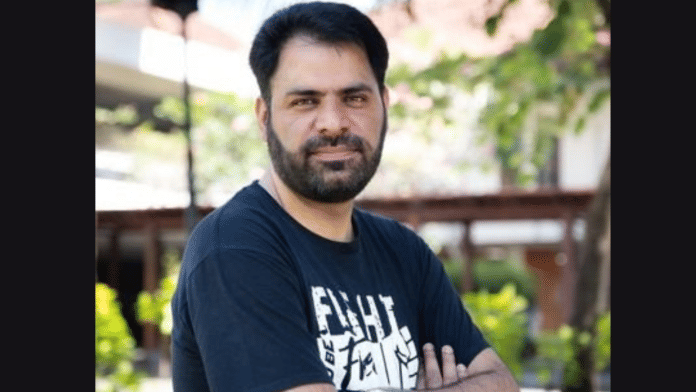


New Delhi: Observing that the fundamental rights of an accused may even trump the stringent restrictions imposed under the Unlawful Activities (Prevention) Act in case of long incarceration combined with no likelihood of conclusion of trial in the near future, the Delhi High Court Wednesday granted bail to Kashmiri rights activist Khurram Parvez.
The bench of Justices Navin Chawla and Ravinder Dudeja also observed that Parvez deserved special consideration because he is infirm, having lost his leg in a landmine blast in 2004.
“The appellant’s rights under Article 21 of the Constitution of India need to be balanced and may even trump the restriction imposed under Section 43D(5) of the UAPA,” the court said. The section sets exceptionally stringent conditions for granting bail to individuals accused of terror-related offences.
While granting bail, the court imposed a long list of conditions, including a prohibition on uploading, sharing or disseminating any “anti-national material” on any social media platform or otherwise. A special NIA court had previously denied bail to Parvez in December 2024.
A programme coordinator of the Jammu Kashmir Coalition of Civil Society and Chairperson of the Asian Federation Against Involuntary Disappearances, Parvez was arrested by the National Investigation Agency (NIA) in November 2021 as part of an investigation into the overground workers (OGWs) module run by a Pakistan-based handler of the Lashkar-e-Taiba.
The NIA had alleged in its chargesheet that Parvez was part of the conspiracy to recruit OGWs for Lashkar in the guise of human rights activism and that he had personally recruited one Muneer Ahmad Kataria and facilitated his contact with the Lashkar handler named Hyder alias Ali or Yusuf.
Additionally, the NIA accused Parvez of maintaining a dossier named “High-Ranking Perpetrators” which contained information on officers and security personnel involved in militancy operations in Jammu & Kashmir.
Moreover, the NIA alleged that data retrieved from his email revealed that he was in contact with several Pakistani journalists who wanted to portray India in a bad light and were approaching him seeking footage of the presence of the Indian Army in Kashmir.
“We have taken note of the above allegations and the defence of the appellant, only to highlight that they must be tested against the long period of incarceration of the appellant and the fact that there is no likelihood of the trial ending soon, as also against the yardstick of bail being the rule, while denial thereof being an exception,” the judges observed in their order.
Parvez will, however, remain in jail in a separate case lodged by the NIA in October 2020. He was arrested in the case related to terror funding through hawala channels in Kashmir in March 2023, while already in judicial custody.
“We have argued on the charges as well as bail on several occasions in the other case, and the matter is pending for a second rebuttal by the NIA. We hope for a positive result in the other case as well, which could pave the way for his release from jail,” Parvez’s counsel Swati Khanna told ThePrint.
Arguments in court
Parvez’s team of counsel, comprising senior advocate Tanveer Ahmed Mir, Khanna and others, argued that the case has barely reached the stage of framing charges, while he has been in custody for more than four years. Additionally, they cited 190 witnesses listed for examination by the prosecution, which they said would mean the trial would last longer.
On the other hand, Special Public Prosecutor Rahul Tyagi argued that Parvez is a major flight risk and has sympathisers across the world. He also brought to the court’s notice the allegations of provocative speeches and the many cases against Parvez for giving speeches such as “Burhan (Wani) teray janissar, beyshumaar beyshumaar”, “go back, go back India” and “India go away from Kashmir”, which incited protesters and caused disaffection against the government.
Parvez had challenged the special NIA court’s 2024 order denying him bail, observing that there was prima facie evidence establishing that he had introduced Kataria to Hyder.
In addition, the trial court observed that chats allegedly between Parvez and Kataria showed that he tried to facilitate a bribe to then NIA SP Arvind Digvijay Negi to compromise the investigation and release the digital devices seized during searches.
Negi was later arrested by the NIA for leaking secret and sensitive information to Kataria, who further passed on the information to his handler.
The special court last July allowed Kataria to turn approver in the case, and the revelations he made were submitted by the NIA in a supplementary chargesheet filed days later.
In his deposition as an approver, Kataria revealed that he had been working as an informer for the NIA with Negi since 2019 and had known Parvez since 2015. He stated that Parvez introduced him to Hyder in 2020, terming him as the “Chief Operating Commander of the LeT (J&K module)”. He also told the NIA that Parvez had asked him to approach Negi to secure the release of the seized digital devices. Kataria further deposed that Parvez gave him Rs 1.5 lakh to pay Negi to release the device.
The HC bench termed all such allegations against Parvez as serious but emphasised that the statements were from a co-accused who had turned approver.
“While the above statements raise serious allegations against the appellant, these allegations are based on the statement of a co-accused who has since turned approver and who himself claims to be an NIA informer. His evidence is yet to be tested in a trial,” the judges noted in their bail order.
(Edited by Nida Fatima Siddiqui)