





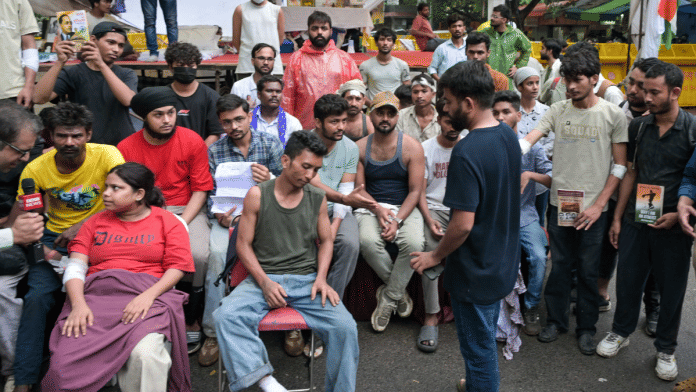


New Delhi: A 27-year-old IIT Patna student, who was injured in police action against student-protesters in Delhi on 20 July, has moved the Supreme Court, seeking not only personal redress but also demanding comprehensive institutional reforms to govern how the State handles public dissent.
In her Interlocutory Application (IA), to be heard with a larger criminal writ seeking an independent enquiry into the police brutality on protesting students, Toshiba Yadav has detailed how she was brutally assaulted by police personnel. She has sought a judicial probe into police conduct on the day.
Yadav, originally from the Auraiya district of Uttar Pradesh and currently pursuing an MBA at IIT Patna, has said in her plea that while she was returning from the ‘Sansad Chalo’ march organised by the Cockroach Janta Party, she was brutally assaulted by police personnel, who were in uniform but did not wear nameplates or identification badges.
She said the alleged assault resulted in a deep scalp laceration (3×3 cm) that required immediate medical treatment and stitches at the nearby Lady Hardinge Medical College.
By placing her own medical reports and injury photographs on record, Yadav positions herself as a firsthand witness to the “grave physical harm” inflicted upon unarmed young citizens exercising their constitutional right to peaceful assembly.
Through this intervention filed via advocate Neha Rathi, Yadav is not merely seeking personal redress but is demanding comprehensive institutional reforms to govern how the state handles public dissent.
She contends that the police response—which allegedly included the use of pellet guns, shock batons, and lathis fitted with nails—was wholly indefensible and violated the fundamental rights of dignity and bodily integrity guaranteed under Article 21.
Her petition highlights a “deeply disturbing” trend of unidentified personnel in plain clothes participating in lathi charges, which she argues is a tactic used to evade accountability.
“…instead of adopting a calibrated, restrained and proportionate approach, the police authorities resorted to the use of force against persons who were, at the relevant time, participating in the demonstration,” it states.
Importantly, she states that the police brutality “did not cease with the indiscriminate use of force against the protesting students” but while resorting to the aforesaid lathicharge, the police personnel “failed to exercise even the basic degree of restraint and sensitivity expected while dealing with women protestors and persons carrying young children”.
She cites several video recordings and visual accounts of the incident allegedly showing female protestors being subjected to physical harassment and assault, including instances where police personnel are seen striking women with lathis to their private and other sensitive parts of the body.
“Such conduct is wholly reprehensible and constitutes a grave affront to the dignity, bodily integrity and personal liberty of the women protestors,” Yadav’s petition notes.
“The indiscriminate use of force against women, particularly in a manner that allegedly targets their private parts, cannot be justified in the name of crowd control or maintenance of public order and raises serious questions regarding the legality, necessity and proportionality of the police action”.
Plus, such use of force, she states, particularly against women and persons carrying small children, is wholly indefensible in law and strikes at the very essence of the constitutional guarantees of dignity, bodily integrity and personal liberty under Article 21.
The same cannot be legitimised as “crowd control”, and constitutes a grossly disproportionate and arbitrary exercise of police power, she said.
SoP with 5 safeguards
To prevent a recurrence of such violence, Yadav has proposed a set of five specific safeguards to the Supreme Court as uniform Standard Operating Procedure (SOP), which would be a publicly accessible set of rules for crowd control based on the principles of restraint and proportionality.
These include mandatory identification being a strict requirement for all personnel – to wear visible name plates, rank badges, and ID numbers during deployments.
Immediate medical aid that ensures every person injured by police action receives documented medical examination and assistance. Mandatory reporting which will require authorities to submit detailed reports justifying any use of force, including the identity of the personnel involved. And specialised training, periodically for police on the legal limits of force and “sensitive policing”.
Ultimately, Yadav wants the court to recognise that disagreement with government policies does not justify “wanton cruelty” by the State. She seeks to ensure that the right to protest, as protected under Article 19, remains a vibrant part of India’s democratic foundation, free from the threat of arbitrary state-sponsored violence.
(Edited by Ajeet Tiwari)
Also Read: CJP protest: SC directs release of detained students with no criminal record, bars coercive action