



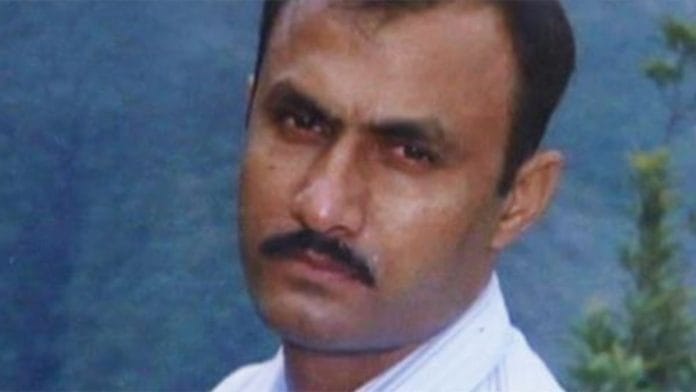
New Delhi: The Supreme Court has agreed to examine the acquittal of 22 accused in the 2005 alleged fake encounter of gangster Sohrabuddin Shaikh, but made it clear that Home Minister Amit Shah’s 2014 discharge from the case will not be reopened.
A bench headed by Chief Justice Surya Kant and comprising Justices J. Bagchi and V. Mohana issued notice on a plea by Shaikh’s brother Rubabuddin challenging the Bombay High Court 7 May judgement that upheld the acquittal of the accused.
CJI Kant said the court was interested in the “fairness” of the trial and the statements of witnesses in relation to the acquittals.
The court expressed serious concern that 92 out of 210 witnesses had turned hostile during the trial, which led to the trial court’s December 2018 acquittal of the 22 remaining accused.
Justice Bagchi asked Shaikh’s counsel, senior advocate D.S. Naidu, that the court hoped the petition was not seeking to reopen para 43 of the Bombay High Court verdict, which addressed the issue of not reopening Shah’s discharge.
CJI Kant added that there was “no question” of it being reopened.
Amit Shah, who was Gujarat Home Minister when the killing took place, was named as one of the accused initially and then discharged from the case on 30 December 2014. The presiding special CBI judge from Mumbai, Brijgopal Harkishan Loya, died on 1 December 2014.
Sohrabuddin Shaikh, his wife Kausar Bi and aide Tulsiram Prajapati were killed in 2005 and 2006 in an alleged fake encounter with the Rajasthan and Gujarat police. A CBI court in 2018 acquitted all 22 accused in the case, including 21 police officials from three states. This year in May, the Bombay High Court upheld the 2018 CBI court verdict.
One of the high court judges who passed the acquittal order in May, Justice Shree Chandrashekhar, was elevated to the Supreme Court later.
The trial court and the high court concluded that while the deaths occurred, the prosecution completely failed to prove who was criminally responsible.
Shah was discharged from the case citing lack of evidence linking him to the “encounter” conspiracy before the trial court framed charges. The high court and Supreme Court upheld his discharge subsequently.
On Shaikh’s family’s plea, the Supreme Court in 2010 ordered the Central Bureau of Investigation (CBI) to take over the investigation from the Gujarat CID.
ThePrint looks at the twists and turns of the case, from the 2005 “fake encounter”, the CBI’s role, the allegations against Amit Shah, judge Loya’s death and subsequent acquittal by the trial court in 2018.
Also Read: Key players in Sohrabuddin Sheikh and Tulsiram Prajapati ‘fake encounters’
The killings
The CBI alleged that Sohrabuddin Shaikh, his wife Kausar Bi, and their associate Tulsiram Prajapati were abducted by a police team from Gujarat and Rajasthan on the night of 22 November 2005 when they were traveling in a luxury bus from Hyderabad to Sangli, for Kausar Bi’s medical treatment and Eid celebrations.
They were allegedly intercepted near Zahirabad, taken to multiple farmhouses in Ahmedabad, and subsequently killed.
Sohrabuddin was shot dead on 26 November 2005, in an incident projected by the police as an “encounter” near Vishala Circle. Kausar Bi’s body was never found, though the CBI claimed she was killed and her remains disposed of in the Narmada river.
Over a year later, on 28 December 2006, Tulsiram Prajapati was also killed in what the police claimed was an “encounter” following his attempt to escape from custody near Himmatnagar.
The investigation, initially handled by Gujarat’s Anti-Terrorism Squad and CID (Crime), was later transferred to the CBI on the Supreme Court’s direction in January 2010, after which the crimes were registered, and chargesheets came to be filed.
After repeated requests made by the family, the case was transferred from Gujarat to Mumbai.
A 22,000-page chargesheet filed in 2013 (after three years of the CBI’s investigation) alleged that Amit Shah, when he was minister of state for home in Gujarat, conspired with top police officers from his state, neighbouring Rajasthan and undivided Andhra Pradesh to kill the trio.
The then home minister of Rajasthan, Gulab Chand Kataria, was also named in the chargesheet.
The CBI had said the killings were the result of a “politician-police nexus”, alleging that politicians were interested in eliminating Sohrabuddin because he was extorting money from the “marble lobby of Rajasthan”.
Furthermore, the trial revealed deep-seated village political rivalry and gang wars dating back to 1996.
However, none of this held up in court. Of the 210 witnesses, 92 turned hostile, one complainant changed his statement, one never turned up in court despite multiple summons, and two witnesses requested to be re-examined a day before the trial court judgment, claiming they had been under pressure earlier.
Of the 22 acquitted, 21 were police officers from Gujarat, Rajasthan and Andhra Pradesh. The 22nd accused was the owner of a farmhouse in Gujarat where Sheikh and his wife, Kausar Bi, were allegedly kept in illegal detention.
Despite the Supreme Court order to ensure that the entire trial takes place under a single judge, the case saw four judges: J.T. Utpat, who was transferred; B.H. Loya, who died in December 2014 in allegedly controversial circumstances; M.B. Gosavi, who presided over the case until being transferred in February 2017; and S.J. Sharma, who finally delivered the verdict in 2018.
Shah’s arrest & discharge, and Judge Loya’s death
A day after the CBI filed its chargesheet in July 2010, Shah appeared publicly in Ahmedabad to declare his innocence and called the charges politically motivated. He then drove to the CBI office in Gandhinagar and surrendered.
He was sent to Sabarmati Central Jail in Ahmedabad under judicial custody, where he spent over three months in jail before the Gujarat High Court granted him bail on 29 October 2010.
On 30 October, the Supreme Court barred him from entering Gujarat to ‘protect the integrity’ of the ongoing investigation and prevention of “tampering of evidence”.
In September 2012, the Supreme Court finally allowed him to return to Gujarat after rejecting the CBI’s plea to cancel his bail entirely.
However, to ensure a fair trial outside his home state, the court ordered that the entire Sohrabuddin Sheikh case be transferred to a special CBI court in Mumbai. This was done by a top court bench of justices Aftab Alam and Ranjana Prakash Desai.
Two years later, the special CBI judge presiding over the case in Mumbai—B.H. Loya—died of cardiac arrest on 1 December 2014.
Judge Loya had travelled to Nagpur to attend the wedding of a colleague’s daughter, and according to official medical and institutional records, he experienced sudden chest pain during the early morning hours at a government guest house and died of a cardiac arrest at the age of 48.
Even though Judge Loya’s family asked for an inquiry commission to probe his death, none was ever set up. The family alleged that Judge Loya had been offered a Rs 100 crore bribe by a senior judicial official to deliver a favourable judgment.
While media reports and petitions subsequently surfaced raising concerns over the timing and circumstances of his death, the Supreme Court officially dismissed all PILs seeking an independent probe on 19 April 2018, ruling the death to be entirely natural. This was done by a three-judge bench of then CJI Dipak Misra, Justices A.M. Khanwilkar and D.Y. Chandrachud.
Following Judge Loya’s death, Judge M.B. Gosavi was appointed to take over the trial in December 2014.
Judge Gosavi heard arguments and officially discharged Amit Shah from the case on 30 December 2014.
In his ruling, the special CBI judge stated that there was a lack of conclusive evidence against Shah and noted that the charges appeared to have a political undertone, concluding that the CBI had involved him for political reasons.
Subsequent legal challenges contesting this order were dismissed by higher courts, and the Supreme Court ultimately reaffirmed that it would not reopen the discharge.
Trial court’s acquittal verdict in 2018
The Special Sessions Court acquitted the 22 accused in December 2018 primarily due to a lack of evidence and credible witnesses.
Out of 210 witnesses examined, 92 turned hostile, including key passengers and drivers of the luxury bus, completely denying any abduction from the bus, which was the foundation of the CBI’s case.
The trial judge found that there was “no iota of evidence” to prove a politician-police nexus or that the seized firearms were actually used in the encounter. Forensic gaps were also critical; cartridges seized from the accused did not match the service pistols.
Furthermore, medical evidence contradicted the prosecution’s claim that an injury suffered by one of the police officers (also accused) was self-inflicted to stage the encounter, instead suggesting it was a genuine injury sustained during a confrontation.
Finally, the trial court held that the accused, most of whom were public servants, could not be prosecuted without previous sanction from the state government under Section 197 of the CrPC, as they were acting in the discharge of their official duties.
HC’s verdict in 2026 upholding the acquittals
On 7 May this year, a Bombay High Court bench of then Chief Justice Shree Chandrashekhar and Justice Gautam A. Ankhad emphasised that a judgment of acquittal “strengthens the presumption of innocence of the accused” and requires a “higher threshold” of manifest illegality or perversity to be overturned, a criteria the prosecution failed to meet.
Therefore, it found no ground to interfere with the trial court judgement.
In its 50-page judgement, the court also disposed of an interim application filed by Harsh Mander, a resident of Mumbai’s Goregaon (East), seeking to challenge the trial court’s discharge of Amit Shah in December 2014.
However, noting that the Supreme Court had already dismissed an appeal against the 2014 trial court order in 2016 and that there was no material connecting Mander to the crime registration, the Bombay High Court said it had “no hesitation to observe” that the application was filed with “an oblique motive and at the instance of some political adversary” of Amit Shah.
In upholding the acquittal, the high court said it could not interfere with a trial court’s decision simply because “another view is possible”.
The court applied the “two-views theory” laid down by the Supreme Court in Mallappa & Ors v. State of Karnataka (2024), noting that when the evidence can lead to two equally plausible conclusions, “following the one in favour of innocence of the accused is the safest course of action”.
The high court noted that the chain of circumstantial evidence was broken at several points, and the prosecution had failed to establish a motive or even the basic presence of the accused at the crime scenes.
About the CBI’s allegations that the killings were the result of a “politician-police nexus”, the high court observed that the prosecution’s theory often “aligned with a particular narrative with strong political overtones” and attempted to foist liability on specific political figures without sufficient evidence.
The court specifically noted that there was “no material much less anything to whisper even about proving even a prima facie element of extortion from (the) marble lobby”.
Ultimately, the court concluded that the interest of public justice did not require interference, as the prosecution’s case was based on hearsay and “parrot-like” statements from unreliable witnesses with criminal antecedents.
(Edited by Sugita Katyal)
Also Read: Hostile witnesses at the heart of CBI’s Sohrabuddin ‘fake encounter’ case falling apart
How shamelessly is Harsh Mander described as a resident of Goregaon East when in reality everyone and his dog knows his antecedents. Sonia’s pet dog in the NAC, ex bureaucrat, Soros bootlicker, anti-Hindu brown sepoy and a lot more. Betrays the author’s prejudice quite clearly.