





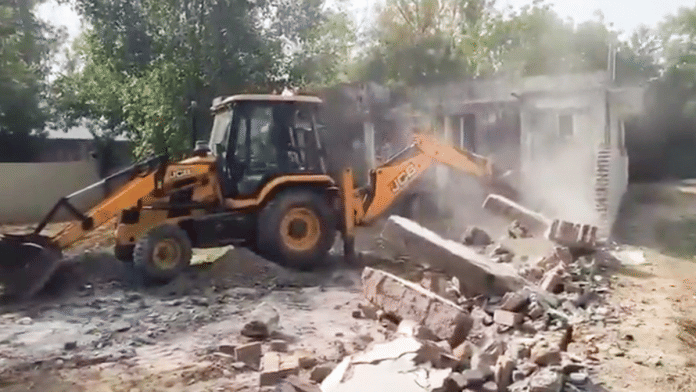


New Delhi: In a strict stance on unauthorised construction and misuse of residential property, the Supreme Court rejected the Uttar Pradesh Awas Evam Vikas Parishad’s proposal to compound illegal portions of houses belonging to Economically Weaker Sections (EWS) in Meerut’s Shastri Nagar Central Market area.
On 14 July, a bench of justices JB Pardiwala and KV Vishwanathan ordered the immediate demolition of unauthorised additions to the existing residential buildings.
With this, the bench sent out a strong signal against unsanctioned construction and indicated its non-tolerance towards civic bodies that fail to act against those violating building bye-laws. The court said the law applies equally to everyone, and disobedience by anyone should not be condoned.
Besides, the bench also ordered the demolition of 44 properties that were originally built as residential, but are now either fully or partially commercial structures. If they are entirely commercial, the court said, they must be demolished at the earliest.
If an additional construction was made to a residential structure for commercial use, then the Parishad shall identify that part of the structure and issue the owner a notice to demolish it within 15 days from the date of the notice.
If the owners fail to act pursuant to the notice, the civic authority has been told to demolish the unauthorised structure and recover all the expenses that may be incurred for the purpose of demolition. The expenses shall be recovered as arrears toward land revenue, the court said.
Importantly, the bench also expanded the scope of the case, which dealt with non-compliance of its 2024 directions to halt commercial activities in buildings that were originally meant to operate as residential. The bench’s 14 July order came on a contempt petition, complaining about the civic authority’s failure to act against the encroachers.
Taking the present case beyond the Central Market area, the bench asked the Parishad’s chairman P Guruprasad to inquire into unauthorised constructions and illegal use of residential premises in other parts of Meerut.
“There could be many areas where people may be using residential premises for commercial purposes, etc. We want the Chairman to undertake a fresh exercise in the aforesaid regard at the earliest, and file his report by the next date of hearing,” the bench said, ordering the chairman to depute teams for an extensive inspection and make sure there is no discrimination insofar as the demolition action is concerned.
The bench gave a specific direction to conduct an enquiry into unauthorised construction, if any, in the outskirts of Meerut, particularly in Uldepur. It even asked the petitioner’s counsel Tushar Jain to assist the court in this regard, while granting him the liberty to conduct his own inquiry.
In its order, the bench took note of the recent incidents in various cities where unauthorised structures have either collapsed or got destroyed in fire incidents, leading to the death of several “innocent young and aged”.
“We want the authorities to ensure that such incidents do not occur, and all steps are taken to protect human life. We once again impress upon the State and all its authorities that if action is not taken today, it will be too late in the day thereafter to proceed in accordance with the law.
“Do not give an impression to the people at large that they will be saved or their illegal constructions will be compounded on mere asking or a mere request. Right action at the right time must be taken, and that is the only way that the State will be able to maintain the Rule of Law,” the court said.
On the 44 properties, the order noted that they, as per the original plans, were for residential purposes. But over a period of time, people started utilising all these structures for running a school, maternity clinics, hospitals, diagnostic centres, banks, etc.
As per an earlier order, the court had taken note of 128 properties in the same area where residents had covered the setback area of their residential premises. Though the Parishad updated the court on the removal of these extensions, the bench gave last opportunity to the authority to demolish any such extra cover.
The bench was clearly against the idea of compounding illegally built areas, observing the current civic law did not approve of it and inaction by a civic agency cannot become a ground to cure illegality.
In a strong deprecation of the Parishad’s suggestion to compound, the bench said: “We make it clear for one and all that mere passage of time or laxity on the part of the authorities in taking timely action will not cure the illegality by itself. Passage of time can never be a ground to compound the illegality or unauthorised construction. What is illegal or what is unauthorised would always remain so and by efflux of time would not become authorised or is liable to be compounded.”
(Edited by Ajeet Tiwari)
Also Read: Builders, politicians, civic officials under lens—what’s the Vasai-Virar illegal buildings case