



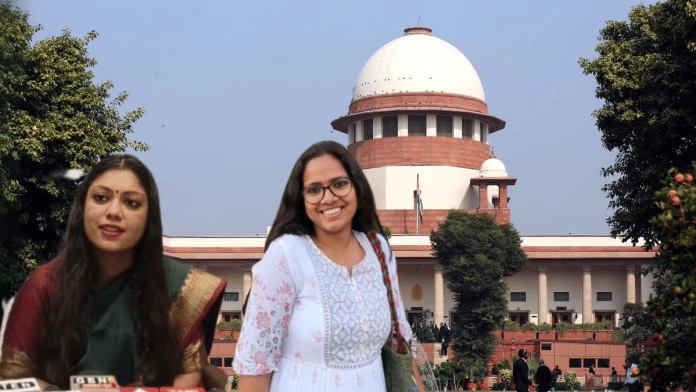
New Delhi: Hours after it stayed the Allahabad High Court order that quashed the NSA detention of law student Akriti Chaudhary—arrested in connection with the Noida workers’ protest case—in its entirety, the Supreme Court Thursday issued a fresh order staying only the penalty imposed on Gautam Buddha Nagar District Magistrate (DM) Medha Roopam.
This means that the Allahabad High Court’s direction of quashing the NSA charge against Chaudhary, remains in force.
A bench of Justices S.C. Sharma and N.K. Singh has essentially stayed paragraphs 27 to 33 of the judgement, which pertain to the high court’s “adverse strictures” against DM Roopam, for signing off on Chaudhary’s preventive detention.
Chaudhary is facing prosecution for allegedly instigating violence that followed a workers’ wage hike protest in Noida on 13 April. The NSA was invoked against her on 2 September. However, this does not mean that the DU graduate will be released from jail, as she has been accused in a total 11 FIRs registered in connection with the protest.
Allahabad HC’s order & UP, Noida DM’s appeals
An Allahabad High Court bench led by Justice Atul Sreedharan had earlier this month quashed the NSA detention of student-activist Chaudhary in connection with the Noida workers’ protest, slamming her arrest and five-month detention as a “concocted story by the state”.
It had dwelled on the bureaucracy’s role in issuing preventive detention orders, strongly criticising DM Roopam for not scrutinising the police material before signing the stringent NSA order.
The bench had awarded Rs 5 lakh compensation to Chaudhary. Fixing personal accountability on Roopam, it had directed that the amount be deducted from the salary of the DM and “all such other officers who may have been responsible”.
Both the Uttar Pradesh government and Roopam had filed appeals against the HC order. The state defended its action to invoke NSA against Chaudhary as well as Roopam’s role, arguing that she was part of a multi-layered process followed to issue detention orders under the stringent NSA law. Roopam’s lawyer toed the same line of argument.
Chaudhary’s lawyer, however, told the bench that the order signed by Roopam lacked application of mind, which the HC too had observed in its judgement. But at the same time, he agreed that a detention order is cleared at multiple levels before being notified and that Roopam could not be singled out.
During the hearing Wednesday, the UP government’s counsel argued that the Allahabad HC had every right to set aside an order, but cannot single out and castigate a civil servant. Chaudhary’s counsel, on the other hand, challenged the grounds for her detention, saying she was in police custody before the violence took place.
“How can you isolate her (District Magistrate) and slap a Rs 5 lakh fine on her,” said the Supreme Court, initially reserving the case for interim orders and asking Chaudhary’s lawyer to file written submissions to appeals by the state and Roopam. Chaudhary’s lawyer said he accepted that the DM was not solely responsible, but read out her order which he said ignored vital facts while terming his client’s ideology as “despicable”.
Can a DM be held personally accountable?
The IAS officer’s case before the top court raises an important legal question: Can an officer, who exercised statutory power, be held personally accountable for a preventive detention order?
Senior advocate Mukul Rohatgi, appearing for the state, argued Wednesday that the High Court judgment was misdirected since it did not carry out an independent examination of the detention order. He also argued that the procedure to issue a preventive detention order is layered and the DM is merely one of the officers part of it.
Explaining this process to the bench comprising Justices S.C. Sharma and N.K. Singh, he said that an advisory body headed by a former High Court judge approved the detention with a reasoned order. “Entire establishment did not go by one person. A High Court judge (heading the advisory board) affirmed it and then it was cleared by the state, then the Centre. Why is this young lady officer being accused of derision? Why impose a fine on her when she was just one link in the chain? Nobody has blamed the advisory committee, comprising a former High Court judge,” argued the senior advocate.
Solicitor General Tushar Mehta, appearing for Roopam, since she too has challenged the High Court order, argued that the IAS officer had framed her subjective satisfaction on objective police inputs. Safeguards were scrupulously followed and instead of examining this aspect, the High Court went into the legality of the arrest, virtually granted bail to Chaudhary and quashed the NSA, said Mehta.
This is an updated version of the report.
(Edited by Gitanjali Das)
Also Read: The human cost of Noida workers’ protest crackdown. Lives upended, jobs lost, studies disrupted
The Supreme Court must haul up these idiots masquerading as Justices of the Allahabad High Court.
No wonder Allahabad High Court has earned the reputation of being a shady place.