



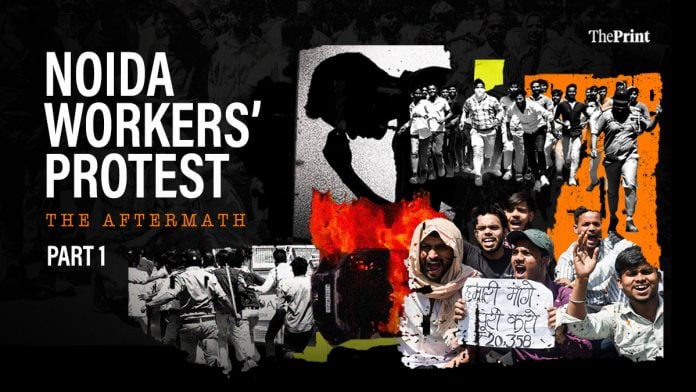
New Delhi: A protest over low wages and rising living costs in Noida left hundreds behind bars and many workers without jobs. Five months later, the cases continue to shape their lives—loss of livelihood, disrupted education and continued incarceration. As courts question aspects of the police’s larger conspiracy case, ThePrint traces the ten days of April that turned a wage protest into a criminal crackdown, and the fallout for those caught in it.
A month and a half in jail may not seem like a very long time, but its repercussions could last a lifetime, Pankaj, a barber, told ThePrint. For 45 days he kept playing the events of 14 April over and over in his head, asking himself where he went wrong.
“I had a day off from the salon where I worked, and I had gone to labour chowk to pick up some gigs,” said Pankaj, a resident of Bihar’s Ara district.
His living expenses had gone up due to the escalating LPG prices during the cooking gas crisis in the country. “A cylinder cost Rs 3,000 in the black market. Even dhabas were charging double the amount for food at that time, so I had gone to make some extra money,” he added.
But a few hours later, he was in handcuffs in an Uttar Pradesh Police vehicle, picked up for alleged involvement in a protest by factory workers in Noida. This protest, demanding better wages and working conditions, had started 8 April, against the Richa Global group. I had nothing to do with it, Pankaj said.
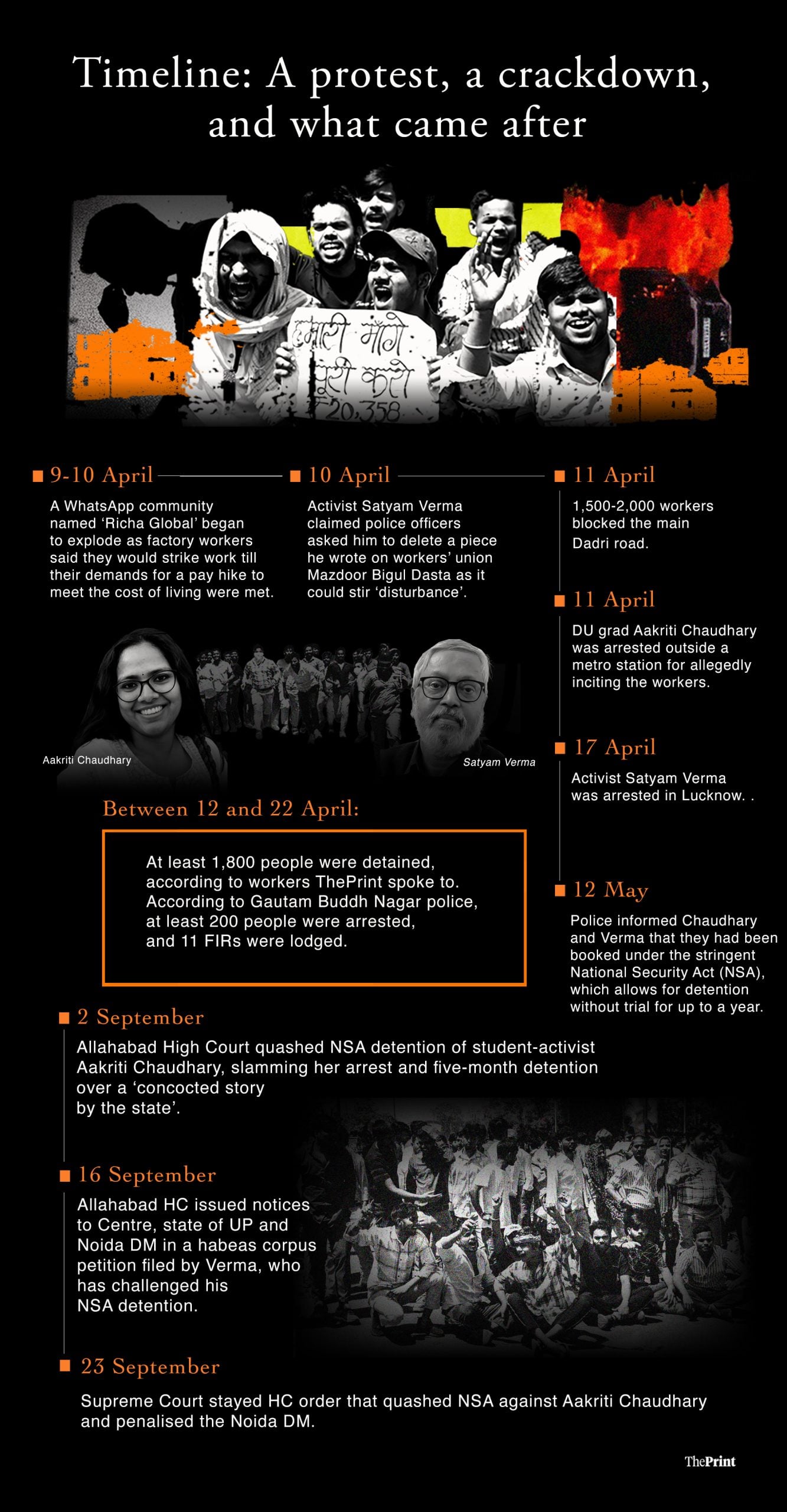
Pankaj was only one of many arrested between 13 and 22 April. According to the Gautam Buddh Nagar police, at least 200 people were arrested after the protests turned violent. Many workers ThePrint spoke to said 1,800 were detained initially.
The police lodged 11 FIRs under sections of the BNS related to rioting, attempt to murder, voluntarily causing hurt, criminal force to deter public servants, trespassing, wrongful confinement, mischief, rash and negligent act, endangering human life, etc., across five police stations part of the Gautam Buddha Nagar commissionerate.
Since then, many have been released, but 11 are yet to get bail. Of these, at least eight are activists and two are workers who continue to be behind bars in the Gautam Buddh Nagar jail. Among them, Satyam Verma and Aakriti Chaudhary (student-activist) were booked under National Security Act (NSA) and sections of the BNS.
While most of the 40,000 workers who participated in the protest were non-unionised factory workers, some were domestic workers in Noida. Police say the protest turned violent when protesters began “stone pelting”, “arson” and “violence”. Many vehicles were set on fire and many workers were wielding sticks, the police alleged.
UP Director General of Police Rajeev Krishna had then said that “provocative elements” and “external elements” involved in the violence were being traced, and “firm legal action will follow” once their identities are established.
Life after bail
It has now been close to three months since Pankaj was granted bail in the case, but when he stepped out of the District Jail of Gautam Buddh Nagar, years of hard work was erased.
“When the police picked me up from labour chowk, they ruined my reputation. People do not know what the case was, or if the allegations were true, but people have already passed judgement on me,” he said.
Not just his reputation, his job at the salon was gone too. “I come from the nai community and both my father and brother work as hairdressers in Delhi, but despite that for two months, I did not get any work here,” he said.
After two months of unemployment, a desperate Pankaj started reaching out to relatives outside Delhi NCR. Finally, in the third month after his release, his brother-in-law found him a job at a salon in Gujarat. “Here in this state, nobody knows me. It is both lonely and liberating,” he said.
For 19-year-old Ashish Kumar, the criminal case and the 1.5 months of incarceration has derailed his future. “I was working in a factory while pursuing a Bachelor’s degree and preparing for government job examinations. Now, I have no job and no chances of landing a government job with this (police) case,” he said.
On the day Kumar was arrested, he was on his way home when he stopped to see “police’s crackdown on the people”. “I was in my home clothes holding a ticket from Noida to my hometown Siwan in Bihar,” he said. He was picked up along with the protesting workers.
Much like Pankaj and Kumar, Mukesh too spends his nights brooding over this dark chapter of his life. “Every week we have to come to court once or twice and being daily wage earners, that means losing hours of work and pay,” he told ThePrint.
His time in jail has also affected his mental well-being. “When the policeman was arresting me, I kept telling him that I have an exam to take, please let me go,” he said. The 20-year-old resident of Varanasi while working at Richa Global, was pursuing a B.Sc in Pharmacy.
Now, Mukesh struggles to look at his own reflection in the mirror and is intimidated by the slightest noise. “I am only waiting to complete my B.Pharma, after that I will never come back to Delhi NCR,” he said.
Where it all began
It all began with rising costs and emptying pockets of workers, recalls Mukesh. “A bunch of people had gone to the HR’s office demanding a raise. They explained that a meagre income of Rs 10,000-15,000 was not meeting the cost of living,” he said. Requests escalated to demands, but when all went unheard, the workers told the HR officials of the factory that they would strike work until their demands were met.
“First a few people stopped work, then workers in large numbers gravitated towards the protest as everyone was genuinely struggling,” he said. Between 9 and 10 April, he found himself in a WhatsApp community named “Richa Global” with at least 1,400 people.
This “WhatsApp group” subsequently became the centre of the investigation, as seen in the multiple charge sheets filed by the UP Police. The police allege in the charge sheet that the WhatsApp group was used to “preplan the conspiracy”.
Between 12 and 22 April, several former workers who ThePrint spoke to said that at least 1,800 people were detained.
What the police said
The police said 11 FIRs across 5 police stations of the commissionerate were filed, and 200 were booked. In the 3 charge sheets that ThePrint accessed, 13 were named key “conspirators”, and mentioned in multiple FIRs.
The charge sheets say factory workers blocked roads in Noida making several “illegal demands”.
“Best efforts were made to reason with them at the administrative level, which failed, but the administration continued to attempt a peaceful solution,” the chargesheet read.
Subsequently on 11 April, 1,500-2,000 workers blocked the main Dadri road and “delivered inflammatory speeches in front of NSEZ, and incited the demonstrators to violence, leading to rioting by the mob” the police said.
The police further alleged that the “mob” subsequently began “vandalising private property at various places in the area, pushed, assaulted, verbally abused, gave death threats, and pelted stones at the police, causing injuries to several police personnel”.
Following the incident the police told the courts that several workers including Satyam Verma and Aakriti Chaudhar “committed criminal abetment under a pre-planned conspiracy and turned the workers’ movement violent”.
A little over a month after the Noida workers’ protest, the police booked Satyam Verma and Aakriti Chaudhary under the stringent NSA.
What the courts said
Over several hearings in the sessions court at Noida and at Allahabad High Court, the judiciary has raised questions over the process, allegations and evidence presented by the UP Police. In one instance, the sessions court bench observed that “merely joining the crowd is not evidence of intent”. The court also sought visual evidence to back the police accusations. “No visual evidence to back serious accusation”, read another session court’s order.
In one instance, where the state prosecutor presented eye witnesses like a chowmein cart owner, rickshaw puller and water vendor, the court said that it was “not clear” how the witnesses were acquainted with the accused. “No material has been placed on record showing any specific and active role of the accused in the commission of the alleged offences”, the bench observed.
Meanwhile, the Allahabad High Court on 2 September quashed the NSA detention of student-activist Aakriti Chaudhary in the Noida workers’ protest, slamming her arrest and five-month detention over a “concocted story by the state”. Holding it to be a misuse of power, the court has come to the conclusion that Chaudhary did nothing to incite people to violence. The order also highlights the importance of freedom of speech and expression and the need to speak against the governed,” he said. Chaudhary remains booked under several other connected FIRs.
The Supreme Court Wednesday stayed the Allahabad High Court order that quashed the NSA charge against Akriti Chaudhary and penalised Gautam Buddha Nagar DM Medha Roopam for signing off on the DU graduate’s preventive detention.
Meanwhile, Verma has moved the Supreme Court to withdraw his petition. He is believed to be seeking relief from the Allahabad High Court, which is to hear the matter related to NSA charges on 7 October.
(Edited by Viny Mishra)