





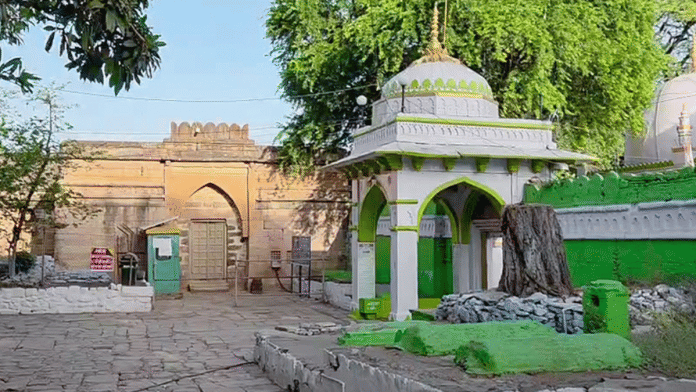


New Delhi: The Supreme Court declined to restore the status quo ante in the Bhojshala matter to allow both Muslims and Hindus perform their respective prayers on designated days.
However, a three-judge bench led by Chief Justice of India (CJI) Surya Kant worked out an interim arrangement by which Muslims would be allowed to offer their weekly Friday prayers at an open space adjacent to the disputed complex.
“This is to balance equities and would be without any prejudice to each other and possible contentions of modification in future,” the bench said Tuesday, while asking the Madhya Pradesh government to make arrangements.
The timings for the namaz would be between 1pm and 3 pm.
This arrangement will be ad-hoc in nature and subject to the final outcome of the matter, which will be heard after three weeks.
The court’s order came on a batch of appeals, challenging the Madhya Pradesh High Court judgement that declared Bhojshala-Kamal Maula complex site in Dhar district as a Saraswati temple. Delivered 15 May, the HC had unsettled a 23-year-old arrangement that allowed both Hindus and Muslims to access the religious site for their prayers.
One of the directions in the HC judgement to the Centre was to bring back the original Saraswati idol, which is now in a museum in London.
“Let us not pass any order which can cause tension,” the bench said, turning down the plea to revert to the practice that existed before the 15 May HC decision.
Instead, the bench said, the court will fix a date and earmark the matter to a bench that will hear it until it gets concluded.
“If it’s not before this bench, then it will go to another bench and we will make a request to hear the case without any break,” the CJI said.
Accepting the plea of Muslim parties, the bench directed the Archaeological Survey of India (ASI) to ensure no structural changes are made to the Bhojshala. Any work undertaken at the site, it said, shall be subject to the court’s prior permission.
The Muslim parties opposed the HC judgement at the outset, arguing it came on a writ petition, filed by the Hindu side, which was not maintainable.
The HC, they said, disturbed the status quo that existed for about 800 years and altered a balanced arrangement that was made by the ASI in 2003, which allowed both Hindus and Muslims to worship on designated days.
Senior advocates A.M.Singhvi, Huzefa Ahmadi and Meenakshi Arora, appearing for the petitioners, submitted that the site was an excellent example of communal harmony, as they argued strongly for an interim order.
However, Solicitor General Tushar Mehta, who appeared for Madhya Pradesh, requested the court not to intervene at the moment. He said the state had taken certain steps to maintain law and order in the area. Any order reversing the present status could lead to administrative problems and create tension, according to him.
Given that the petitioners had approached the court belatedly, waiting for a few more days would not harm them in any way, Mehta told the bench.
This suggestion was opposed, with the petitioners clarifying that some of them had moved the top court within four-five days of the HC judgement. Their matter was not listed due to the summer break in the top court, they added.
Ahmadi persuaded the bench for a status quo ante order, saying the HC too had accepted the fact that the site was being used as a mosque for centuries. This showed that the balance of convenience lay in favour of his prayer, he told the bench.
Senior advocate Guru Krishnakumar, appearing for the Hindu side, opposed the status quo ante prayer. Granting it would mean allowing the petitions effectively, he contended.
Singhvi raised concerns over reopening of historic disputes on religious sites and cited the recent Allahabad High Court order issuing notice on a plea related to Taj Mahal.
The senior counsel pointed out the pending disputes over religious places was despite the Places of Worship (Special Provisions) Act, 1991. He beseeched the bench to hear the petitions that challenge the 1991 Act and settle the issue once for all, instead of letting courts below to keep digging into the layers of history.
The 1991 Act disallows conversion of place of worship and mandates maintenance of such a place as it existed on 15 August, 1947. It, however, exempts archaeological sites from its ambit
One of the primary contentions raised by the petitioners before the HC is that the judgement has internal contradiction and self-defeating reasoning.
While the HC repeatedly observed that it was not adjudicating title to the disputed property, its operative part proceeded to indirectly adjudicate title and religious status of the property, they said.
(Edited by Tony Rai)
Also Read: Basant Panchami on a Friday at a temple-mosque complex: A look at Bhojshala dispute amid SC order