





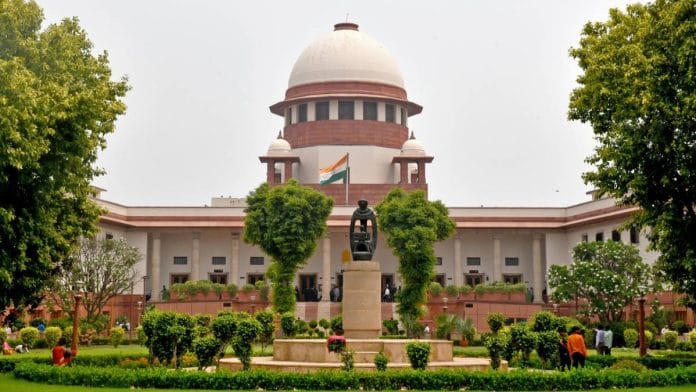


New Delhi: In damning condemnation of the Odisha state judiciary, the Supreme Court has quashed several “odious” and “humiliating” bail conditions that required accused persons—primarily from marginalised Adivasi and Dalit communities—to perform manual cleaning tasks at police stations. Terming it a “colonial mindset”, the top court Monday declared these bail conditions “null and void”, adding that they are a direct violation of human rights and constitutional dignity.
“We are deeply disappointed and disheartened and express our strong disapproval at the way Odisha judiciary has expressed regressive mindset which is ex facie violative of human rights which strikes at the dignity of the accused,” said the top court Bench of CJI Surya Kant and Justice Joymalya Bagchi.
The Bench added, “The most inalienable gift by people through the Constitution was a casteless society through substantive equality. The judiciary is expected to protect such rights. In the 75 years of constitutional journey, judiciary has ensured that the might of the state cannot undermine the rights of the people.”
The SC order noted that the nature of the condition forcing an accused person to clean a police station was “abhorrent, degrading, and unknown to law”. The Bench further remarked, “The nature of the condition… carries the potential to cast a serious aspersion, suggesting that the Odisha judiciary is afflicted by a caste-based bias.”
The SC emphasised that imposing such a “sentence” before a trial has even concluded is founded upon a “presumption of guilt”, which is totally impermissible in Indian law.
The controversy erupted following a report 27 April by journalist Nikita Jain that was published in the independent digital news organisation Article 14 regarding a series of bail orders issued by the Orissa High court and various district courts in the state. The Supreme Court took suo moto cognisance of the matter after it was revealed that courts had imposed “unprecedented” conditions between May 2025 and January 2026 on protesters involved in anti-mining demonstrations.
Detailing the specific orders that provoked the Bench’s ire, the Supreme Court highlighted the case of Kumeswar Naik v. State of Odisha. In this case, while granting bail to an individual accused of various offences under the Bharatiya Nyaya Sanhita, the high court directed: “The petitioner shall clean the premises of the Kasipur Police Station in the morning hour (between 6 am and 9 am) for two months from the date of his actual release… Kasipur Police Station shall provide the cleaning articles like broom, phenyl and other items to the petitioner so that he can clean the said premises.”
A similar order was passed by the Additional District and Sessions Judge Rayagada in the case of Laxman Naik v. State of Odisha, where the petitioner was subjected to identical conditions. The Supreme Court noted that at least six other such orders were passed by the trial courts in Odisha between May 2025 and January 2026.
Anti-mining protests
The legal battle stems from prolonged protests that began in 2023 by landowners and settlers in Rayagada and Kalahandi districts of Odisha. These individuals were protesting against land acquisition by the Vedanta Group for a bauxite mining project.
The demonstrations, led largely by Adivasi and Dalit communities, occasionally turned violent, leading to the registration of multiple FIRs and the arrest of approximately 40 individuals. While the SC clarified it was not currently adjudicating the legality of the land acquisition itself, it expressed deep concern that the relief of bail for these protesters was being conditioned upon performative, degrading labour.
“We are of the considered opinion that any other state judiciary shall not use such conditions of caste colour which can generate social friction. Thus, let this order be made available to all judicial officers across the country not to impose such conditions,” the Bench said, adding it was particularly “disappointed and disheartened” by what it perceived as an “underlying, albeit unarticulated bias” within the state judiciary. The court observed that such conditions appeared to be reserved for members of marginalised communities, while “privileged sections of society” were granted bail without such burdensome requirements.
Constitutional vision vs. colonial mindset
The SC reminded the courts that the Constitution, through Articles 14, 15, and 17, unequivocally dismantles the barriers of caste and untouchability. The court positioned itself as the “sentinel on the qui vive”, entrusted with protecting the most vulnerable citizens from the “might of the state” and arbitrary judicial actions.
The ruling criticised the Odisha judiciary for regressing to a mindset that strikes at the very dignity of the accused. By treating equality as “antithetical to arbitrariness”, the Bench re-established that any procedure established by law must be just, fair, and reasonable.
In an omnibus direction, the SC ordered all courts across Odisha to immediately delete these offending conditions from existing bail orders. It further directed that no analogous requirements be substituted in their place.
The Registrar General of the Odisha High Court is required to file a compliance report, with the next hearing on 11 May.
To prevent a replication of such “caste-coloured and oppressive conditions” in other states, the SC Registry has been directed to circulate the order to all high courts across India. Every judicial officer in the country is to be served with a copy of the order to ensure that such conditions are not imposed “under any circumstances” in the future.
(Edited by Viny Mishra)