





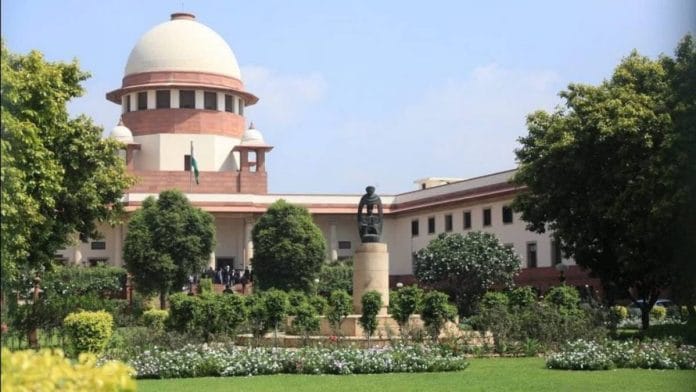

New Delhi: The Supreme Court Wednesday recognised Centre’s power to grant post-facto environmental clearances (EC), but through a valid statutory notification under the Environment (Protection) Act, 1986, and not an administrative office memorandum (OM).
The top court gave this crucial ruling as it quashed the Centre’s 2021 OM that provided a window to infrastructure and development projects to seek environmental clearance after commencement of the work.
However, Wednesday’s verdict would not apply retrospectively, the court said. This protects all those projects that did not take prior environmental approval before starting the work, but had sought it under the 2021 OM.
A three-judge bench led by Chief Justice of India Surya Kant pronounced the order on a review petition raising concern over a November 2025 ruling judgement that recalled a May 2025 verdict by the top court in the Vanashakti case.
A bench comprising Justice (retired) Abhay S. Oka and Justice Ujjal Bhuyan had, in May 2025, barred the grant of post-facto environmental clearances in future. However, on applications seeking clarity on whether this decision would impact those files that were pending consideration with the Centre when the May 2025 verdict was delivered, a three-judge bench led by then CJI (retired) B.R. Gavai had recalled the Vanashakti judgement. Justice Bhuyan, who sat on the bench that heard the case for the second time, however, dissented.
A batch of writ petitions and review petitions were filed in the SC against the November 2025 verdict. The CJI Surya Kant-led bench, also comprising Justices Joymala Bagchi and Vipul Pancholi, had reserved its verdict on 1 April, 2026.
While pronouncing the decision Wednesday, which came following a third round of litigation on the issue, Justice Bagchi said that the prior environmental clearance regime that was brought into effect through a 2006 notification is mandatory. This notification, the bench said, can only be amended through a statutory notification.
Importantly, the bench said ECs already granted would remain valid unless individually challenged in accordance with law, and barred the government from entertaining applications under the 2021 OM.
It even restrained the Centre from creating a post-facto clearance mechanism on the administrative side. But it said that the court can grant such approvals under its Article 142 power to do complete justice.
The bench also dealt with the petitioners’ argument that the November 2025 decision was contrary to judicial precedents and the government cannot issue post-facto approvals. To this, the bench said that the judgements relied upon by the petitioners were rendered in the context of the then prevailing law. They, it clarified, do not prohibit the Centre to frame “narrowly tailored amnesty scheme” in appropriate cases.
“They do not put a clog on the power of the Centre to issue a narrowly tailored amnesty scheme in the supervening public interest,” the court said.
On the 2021 OM, the bench declared: “The 2021 OM is an administrative order, and envisages perpetual regime for grant of EC for projects undertaken without prior EC. The 2021 OM supplants an earlier executive regime through an administrative order, which is impermissible.”
Striking down the OM, the bench said it failed the constitutional test and was ultra vires of the 1986 law.
“Given these circumstances, the 2021 OM does not satisfy the test of proportionality and reasonableness and is violative of Articles 14 and 21 of the Constitution. Thus, the 2021 OM is quashed, but with prospective effect, keeping in mind the prevailing confusion with regard to the validity of the impugned instruments and supervening public interest,” the court said.
The administrative order envisaged a perpetual regime for the grant of ECs to projects that began without prior clearance. It not just altered the nature of enquiry, but even the criteria for the grant of EC under the 2006 Notification. “The 2021 OM thereby supplants an earlier delegated legislation through an administrative instruction, which is impermissible in law,” the bench said.
Also Read: Supreme Court to help 1,000 vulnerable girls complete school with Rs 50,000 annual scholarships
Praiseworthy. In the global index on environmental protections, India is second from the bottom. It is as if, while approving development projects, some very large, like the four laning of the Chardham highways or the proposed mammoth development at Nicobar, the environment does not exist. See what is happening with forest fires in Spain and France. Europe routinely tiuching 40 degrees Celsius in summer, analagous to 50 degrees in India.