



The hearings in the case are underway.
In their responses to the top court’s contempt notice, all 3 of them have tendered their unconditional apologies and defended their actions (restricted services) as something done to “preserve public order and safety”, while seeking discharge from contempt proceedings.
But how often does the Supreme Court end up convicting one of civil contempt for willful disobedience of their orders? The top court’s record shows how more often than not, the court ends up taking the unconditional apology offered and does not pronounce any punishment.
In India, there are two types of contempt proceedings under The Contempt of Courts Act, 1971—either civil or criminal.
For civil contempt, a petition can be filed directly for willful disobedience of any judgment, decree, direction, order, writ or other process of a court or willful breach of an undertaking given to a court.
However, a criminal contempt case can be filed only via the written consent of the Attorney General or Solicitor General for “scandalising or lowering the authority of the court”. These are cases of words spoken or written or by signs or by visible representations of any matter or any act which might prejudice or interfere with the due course of any judicial proceeding or with the administration of justice.
Significantly, contempt is far beyond casual words or criticism of the court. It is about willingly disrupting or lowering the court’s authority. In landmark judgments, the SC has held that honest, temperate, and respectful criticism of a judge’s judicial acts or final judgments—focused on the reasoning or interpretation of the law—is a valid exercise of free speech under Article 19(1)(a).
As per Section 12 of the Act, contempt can be punished with simple imprisonment for up to six months, a fine up to Rs 2,000, or both. But this has rarely been imposed.
Importantly, actions for civil contempt must be initiated within one year of the alleged violation, limiting the number of petitions that survive judicial scrutiny.
Data on how cases of civil contempt end
As per Parliament data, 1,852 contempt cases are pending before the Supreme Court as on 20 March 2025. These include civil and criminal cases. Union law minister Arjun Ram Meghwal, while responding to a question in Lok Sabha in March 2025, said that the reasons for non-compliance with court orders in these cases are not maintained by the government.
According to the data maintained by The Professeer’s Courts DataLab (a dedicated litigation analytics and business intelligence project focused on the Indian judiciary), a total of 5,566 civil contempt cases are pending/dealt with in the top court. These include 5,533 petitions filed by parties and 33 cases initiated suo motu by the top court. Of the 5,566 cases, 1,647 cases are pending while 3,901 (70 percent) have been disposed of.
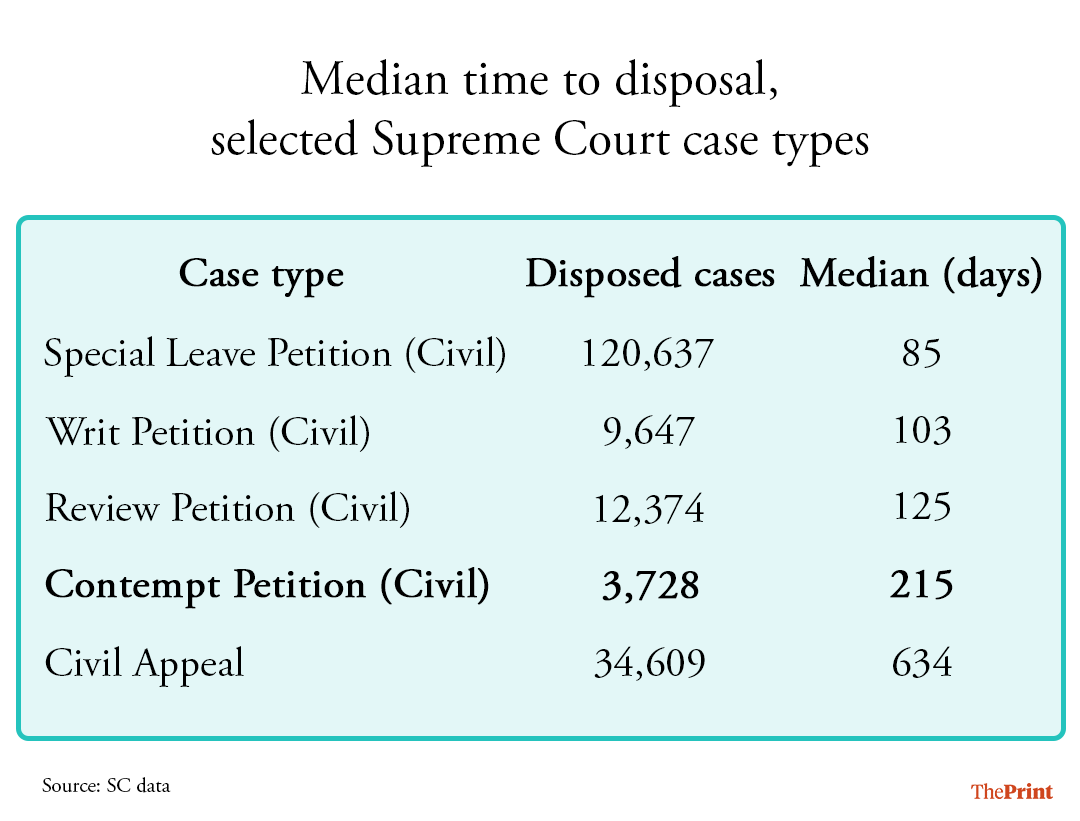
Their data also shows that the median time to dispose a case is 215 days from filing—that’s about seven months. However, the average is much higher, at 545 days, because the long tail of cases takes several years. Over a quarter of the cases are disposed of within 3 months, but 296 (8 percent) take more than 5 years.
The Professeer’s Courts DataLab also shows how civil contempt cases are not quick by the Supreme Court’s own standards. The typical contempt case takes about 2.5 times as long as a civil special leave petition and twice as long as a civil writ petition.
As per the SC’s own classification, about 50 percent of the cases are just ‘disposed of’, another 31 percent dismissed and less than 0.1 percent allowed.
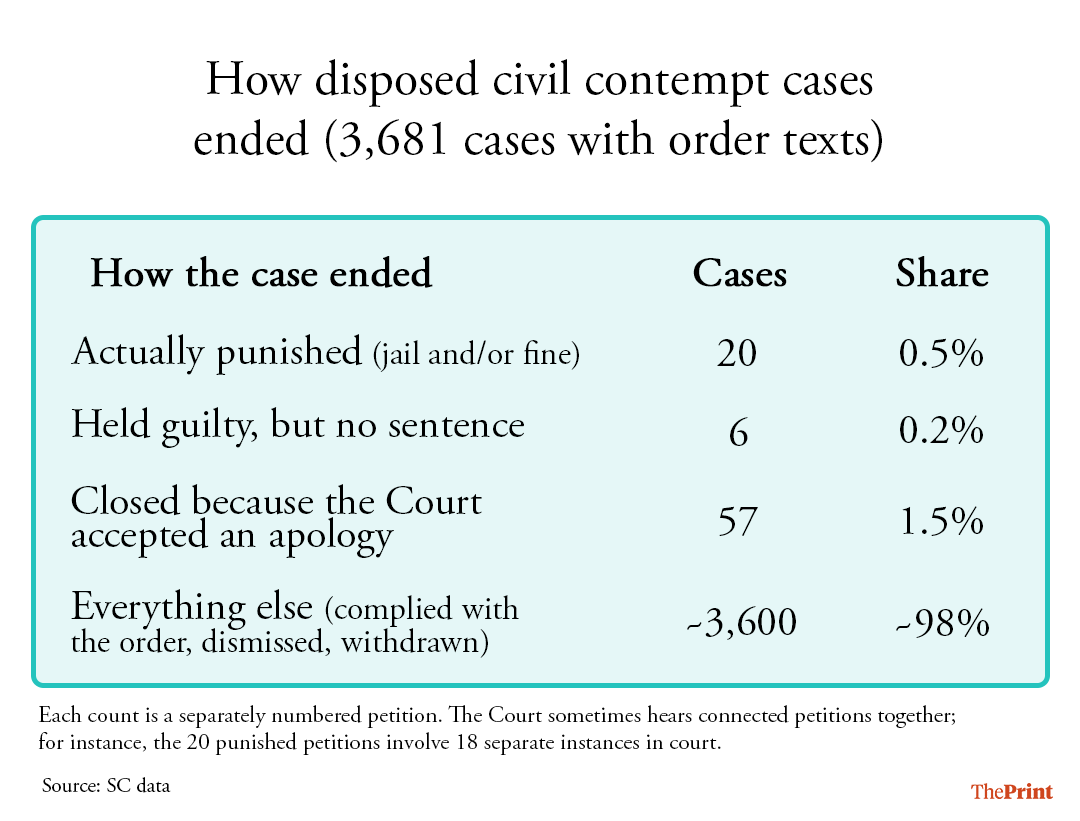
Of the 3,901 disposed cases, 3,681 had identifiable orders with order texts that allow for sufficient analysis. A reading of that shows that only in 0.5 percent cases (20 cases) the contemnor has actually been punished with imprisonment and/or fine.
In 0.2 percent cases (6), the contemnor is held guilty but no jail sentence given. 1.5 percent of cases were closed because the court accepted an apology, while 98 percent of cases (3,600) are cases where the contemnor complied with the order or the cases were dismissed or withdrawn.
Important to note that each count is a separately numbered petition. The court sometimes hears connected petitions together; for instance, the 20 punished petitions involve 18 separate instances in court.
Explaining why a large number of contempt petitions may not translate into punishments, Delhi-based practitioner Nipun Saxena noted how proceedings are often used to secure compliance, and cases may be dropped once substantial compliance occurs.
“People don’t wish to move the trial court for execution of their orders, which is why, if there is an order which is passed by the Supreme Court or high court, they would prefer moving in contempt to get it executed. And that also has been the traditional understanding to say that if you have substantially complied with the order at any point of time, then the contempt proceedings are instantly dropped, which explains why despite the institution of so many contempt petitions, in very few contempt petitions, there’s actually an order passed punishing somebody.”
About the intent of filing a contempt petition, he said: “In pragmatic application, contempt petitions are usually filed by those parties which seek a quicker, effective execution of the order.”
“With the docket explosion, nobody wants a new case. So, therefore, I have seen courts exercise tremendous amounts of restraint. And not just restraint, it is a tremendous amount of magnanimity—multiple opportunities to the parties to curate, to purge contempt. And it is only as a last resort that I have really seen courts initiating contempt. At least the Supreme Court,” Saxena said.
Interestingly, he also spoke about the element of purging in such contempt cases. He noted how in cases of contempt, one cannot go back in time and correct and remedy the wrong already done—hence, the element of purging is not really available to parties. He calls them “irreparable injury scenarios where the injury is already done”.
Famous cases of contempt convictions
On 24 April 2025, the Supreme Court held Shaji Augustine guilty of civil contempt for willfully failing to pay monthly arrears of use and occupation charges (Rs 28.60 lakh per month) for a property complex operated as a resort. He was sentenced to three months’ simple imprisonment and a Rs 20,000 fine for willful non-compliance with its order.
In November 2022, the Supreme Court imposed six months’ simple imprisonment and a Rs 12.5 lakh fine for contempt in a case involving deliberate disobedience of its orders. The court found a Kenyan citizen of Indian origin guilty of both civil and criminal contempt. The case arose from a child custody dispute where the father gave fraudulent “mirror orders (identical court order passed by a foreign court)” to take his son to Kenya and subsequently refused to comply with the court’s directives to bring the child back.
Only once has a sitting judge been held guilty of criminal contempt. When Justice C. S. Karnan, a sitting judge of the Calcutta High Court, made open allegations of corruption against several judges of the Supreme Court and high courts, the top court said he went as far as attempting to issue “orders” against Supreme Court judges without providing evidence.
A seven-judge bench of the Supreme Court found his actions to be the “grossest and gravest actions of contempt”, convicting and sentencing him to six months imprisonment, making him the first sitting high court judge in Indian history to be imprisoned for contempt.
In 2002, acclaimed author and activist Arundhati Roy filed an affidavit responding to an earlier case, in which she imputed malicious motives to the Supreme Court. She claimed the court was attempting to silence dissent and muzzle public criticism. The Supreme Court ruled that her statements crossed the line of fair criticism and “scandalised” the majesty of the court. For criminal contempt of court, she was convicted and sentenced to one day of simple imprisonment and a fine of Rs 2,000.
In 2020, advocate Prashant Bhushan published two tweets on social media—one criticised the role of the Supreme Court and the last four Chief Justices of India in the “destruction of democracy”, and the other commented on the Chief Justice riding an expensive motorcycle during a pandemic lockdown while the courts were physically closed.
The Supreme Court held that the tweets destabilised the foundation of the judiciary and shook public confidence in the administration of justice. Bhushan was convicted and sentenced to a symbolic fine of Rs 1, with a condition that failure to pay would result in three months of imprisonment and a three-year suspension from practice.
In 1991, when police officers in Nadiad, Gujarat had arrested, handcuffed, assaulted, and paraded a Chief Judicial Magistrate in public to extract revenge for his judicial rulings against local police administration—the Supreme Court took suo motu cognisance, ruling that assaulting a judge constitutes an attack on the absolute independence of the judiciary. Multiple police officials involved were convicted of criminal contempt and sentenced to terms of imprisonment ranging from a few months to up to one year.
(Edited by Viny Mishra)
Also read: India’s contempt law has three problems. Reform is difficult