



New Delhi: Found hanging in his Haridwar tea shop, Surendra Koli has been a name associated with cannibalism, rape, murder and the Nithari killings. From December 2006 to September 2026, two decades of Koli’s life followed an extraordinary arc through the country’s criminal justice system.
Branded the ‘darinda’ of Noida, Koli went from being arrested in December 2006 to being sentenced to death, coming within hours of being hanged in 2014, and finally being acquitted by the Supreme Court through a curative petition in 2025.
A probe has been ordered into his alleged suicide, with reports of his family being informed. This comes almost 10 months after the Supreme Court acquitted him in the case, after he had been on death sentence for nearly two decades.
Between 2005-2006, more than 50 young girls and young women had gone missing from Noida’s Nithari area and their parents repeatedly went to the police with missing persons reports. Skulls, dupattas and other human remains were recovered from outside the drain in Noida’s Sector 31—where businessman Moninder Singh Pandher lived at D-5.
Koli was employed as a domestic worker there. Pandher bought the duplex in February 2004, and hired Koli in July that year.
When a 20-year old girl’s mother outside D-5 identified the clothes and slippers of her daughter, who went missing three months earlier, she filed a complaint. The Noida Police booked Pandher and Koli in another case and arrested both in December 2006 on the charge of abducting, raping and murdering several children from the Nithari locality in Noida.
They were arrested on 29 December. Another case was registered against Pandher and Koli on the complaint of a couple who filed a missing persons report for their daughter, then 14, on 20 July 2005. A DNA test later confirmed their daughter was among the victims.
Less than a month after the recovery of human remains and other “incriminating” material from the drain outside D-5, the case was handed over to the CBI, which took both Pandher and Koli into custody.
In its chargesheet filed in one of the Nithari cases, the CBI alleged in 2007 that Koli suffered from ‘necrophiliac’ and ‘cannibalistic’ tendencies. The CBI, in all, registered 19 cases against Pandher and Koli. Citing lack of evidence, it filed closure reports in three.
Also read: In Noida’s Nithari, Koli’s acquittal reopens old wounds & theories. ‘It was organ trading’
At the Allahabad HC
A trial court in Ghaziabad handed them capital punishment on 13 February, 2009. The Allahabad High Court on 11 September, 2009 acquitted Pandher but upheld Koli’s sentence.
Koli’s death sentence was upheld by the HC in a single case of raping and murdering Rimpa Halder in 2009. The Supreme Court confirmed his death sentence in 2011.
Another bench of the HC acquitted Surinder Koli in 12 cases and his employer, Moninder Pandher, in two, citing a lack of evidence. The HC, in the ‘Victim A’ case judgment, relies heavily on Koli’s confession made in police custody, which it says was “taught” by investigation agencies.
In its ruling, the Allahabad HC poked several holes in the prosecution’s case, not only pointing to the lack of forensic evidence to support police claims of sexual motive and cannibalism but also casting doubts on the alleged weapons used in the offence.
The HC observed that the semen and the blood found on the victim’s clothes didn’t match the samples taken from Koli’s quilt. It also said that although a seven-member forensic team had visited D-5, barring a blood spot in the bathroom sink and pipe of unknown origin, no other biological or forensic material was found in the house.
In its ruling, the Allahabad HC also held that the discovery of limbs and skulls without torsos isn’t sufficient to support claims of sexual motive for the murders. This allowed Koli to question his conviction in the Haldar case.
He promptly moved a curative petition in the top court, asking it to cure the defect in its 2011 and 2014 decisions that ordered his hanging in the Haldar case.
The apparent contradiction—the same evidence producing two opposite SC-approved outcomes—remained unresolved until 2025 when a curative bench led by then Chief Justice B.R. Gavai set aside Koli’s conviction, declaring that “when proof fails, the only lawful outcome is to set aside the conviction even in a case involving horrific crimes”.
The two judgements stand out: one affirms guilt, the other embraces grave doubt.
Together, they form a striking chronicle of judicial reasoning shaped by different philosophies of criminal justice. The two judgements, read together, frame a cautionary tale in India’s death penalty jurisprudence.
Escaping execution by hours
Death was hours away for Koli in a Meerut jail in 2014 – after his appeal, review, and his mercy petition in the first case were rejected by the top court. The death warrant was sent, and his execution was scheduled for the morning of 8 September.
However, on the night of September 7, senior advocate Indira Jaising knocked the top court’s doors, setting up an emergency bench of Justices AR Dave and HL Dattu around 1 am.
The court stayed his hanging after midnight and the message was sent to Meerut early morning – eventually halting his execution.
This came just five days after the SC passed a landmark judgment that all review petitions filed by death-row convicts must be heard in open court by a bench of three judges, rather than being summarily decided in circulation within the judges’ private chambers. So now, the SC had to decide Koli’s application also the same way.
In January 2015, the Allahabad High Court commuted his death sentence to life imprisonment because of the delay in deciding his mercy petition.
A free man
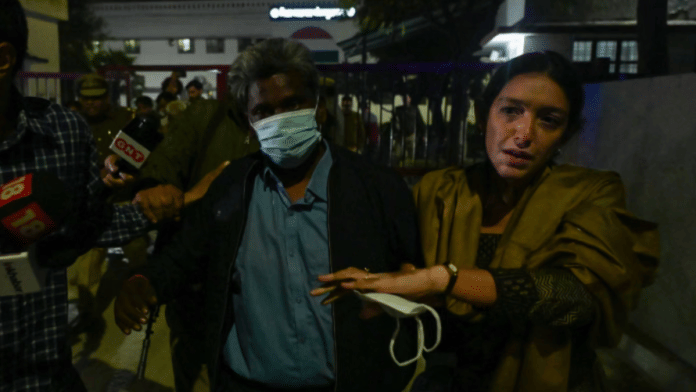
After his acquittal by the top court, he was released by the Noida jail authorities on 12 November 2025. He walked out of the jail, wearing a mask and keeping his gaze low with his lawyers protecting him and the media shouting questions at him.
Jail officials described Koli as quiet and calm, saying he mostly kept to himself and didn’t react much even after hearing Monday’s Supreme Court verdict, which set him free.
Advocate Payoshi Roy, one of his lawyers before the SC, had then told ThePrint that “both he and his family have been destroyed entirely, with the media playing a big role in this. In the initial years, he was called everything from a rapist to a cannibal to the ‘darinda of Noida’.”
Roy had told ThePrint that despite the relief “it is not a story with a happy ending. There is a deep hopelessness in all of them. He did his own cross-examinations, fought his own case for this moment.”
The ‘who-dunnit question was left open then as the highest court of law absolved the prime-accused in the murder cases of girls and women. The families of the girls and women who went missing and were killed are yet to find a closure.
(Edited by Ajeet Tiwari)
Also read: The great Nithari botch-up: How the probe tied itself up in knots