




New Delhi: The Uttar Pradesh government’s order to detain the alleged mastermind behind the 2024 Sambhal violence under the National Security Act (NSA) came a month after the Allahabad High Court granted him bail in one of the six FIRs registered in connection with the violence, case documents accessed by ThePrint show.
The bench of Justice Krishan Pahal granted bail to Mulla Afroz on 13 September, 2025, Sambhal District Magistrate (DM) Rajender Pensiya passed the detention order on 13 October. While granting him bail, Justice Pahal had observed that Afroz’s name was not mentioned in that particular FIR registered under sections for murder, criminal conspiracy and provisions of the Arms Act.
Afroz’s incarceration continued despite this bail order as police showed his involvement in five other FIRs registered in connection with the violence. He was eventually granted bail in the remaining five cases as well, in court orders passed after his NSA detention.
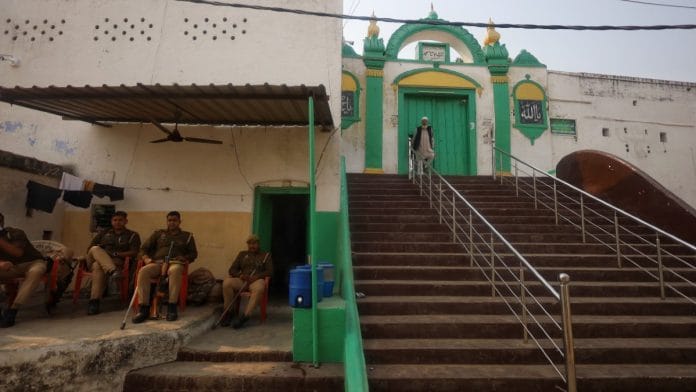
The clashes erupted near Sambhal’s Shahi Jama Masjid on 24 November, 2024 during a court-ordered survey of the 16th-century mosque. At least four people died and several others, including police personnel, were injured.
Documents related to the case show that Afroz was arrested 54 days after the incident.
While granting Afroz bail in one of the six cases, Justice Krishan Pahal had observed that his name was not mentioned in that particular FIR registered under sections for murder, criminal conspiracy and provisions of the Arms Act.
On the other hand, the DM’s detention order said the examination of facts and circumstances presented before him pointed to Afroz being “guilty of a heinous crime”. It said releasing Afroz on bail would adversely affect maintenance of public order in the area.
Notably, the detention order relied heavily on Afroz’s alleged confession recorded before the Uttar Pradesh police. The legality of the order is now being questioned by the Supreme Court with a Bench of Justices Dipankar Datta and Sheel Nagu asking Tuesday if the alleged confession statement of an accused can become the basis to detain them under the NSA.
A confession statement made to a police officer is inadmissible in a court of law.
The bench reserved its order on an appeal filed by Afroz who challenged an order by the High Court denying him relief.
Also Read: SC questions if custodial confession can form basis for NSA detention of Sambhal violence accused
DM’s order & High Court’s reasoning
In addition to Afroz’s statement, the DM’s order also took into account a report by a constable of the Sambhal police. According to the constable, on 30 August, 2025, he heard “people (in Sambhal) secretly discussing” that Afroz, among those jailed over the violence, applied for bail in the High Court and they would get relief soon.
In the order, the DM quoted the beat constable’s report and wrote, “Some of those who visited you also discussed that after your release from jail, you are planning to do something that will engulf Sambhal in the fire of major violence. According to the discussion, there is a strong possibility of public order being disrupted upon your release.”
According to the order, the information was investigated by the acting in-charge inspector of Sambhal police station, who found it to be correct.
It also mentioned Afroz’s bail application filed before the Allahabad High Court and noted, “You are continuously trying to get bail order from the Hon’ble High Court, Allahabad and come out of jail.”
It added, “There is a strong possibility that you, after being released on bail, will once again create an atmosphere of terror and fear in the area, inciting riots, and establishing your dominance.”
Notably, this detention order was issued after the Forensic Science Laboratory (FSL) report on the nature of injuries sustained by those killed in the violence was made available to the police. According to the police, a .32 bore pistol was recovered from Afroz, while the FSL report conclusively showed that the deceased died of .315 injuries.
By the time Uttar Pradesh Governor Anandiben Patel confirmed the DM’s detention order on 28 November, 2025, Afroz was granted bail in a second case where his involvement was alleged to invoke murder and criminal conspiracy charges.
Justice Pahal, who granted him bail in the first case, decided his plea in the second case as well. In the 15 November 2025 order, the judge emphasised on personal liberty and observed the state had not placed any material before it to suggest that Afroz will abscond upon his release on bail.
Subsequently, Afroz, over a period of time, secured bail in the other four cases as well. These bail orders came from different benches, despite the UP government’s vehement opposition. The third bail was granted in February this year by Justice Pahal’s bench. In the order, the judge observed Afroz’s name was not mentioned in that particular FIR and that there was no cogent evidence produced to show his involvement in the murder case.
A fortnight later, another bench of the High Court found it fit to release Afroz in a case that charged him with indulging in rioting. A bench of Justice Ashutosh Srivastava granted him bail, after observing that other co-accused were also granted the same.
On 16 March, a bench of Justice Vivek Varma allowed Afroz’s bail application in yet another case of murder linked to the violence. In this order, the judge gave prima facie opinion in Afroz’s favor. It said his name did not figure in that particular FIR and that it surfaced on the basis of information furnished by an informer. He also noted that there was no independent eyewitness to the incident.
The judge also referred to the FSL report. The High Court noted the discrepancy in the police statement on the weapon used during the violence and said there was no material to connect the weapon recovered from Afroz to the alleged offence.
On 15 May, a different bench headed by Justice Jitendra Kumar Sinha granted bail to Afroz in a riots case, while observing that no specific role was attributed to him. The court also noted that the co-accused in the case was already on bail and, therefore, relief should be extended to him as well.
This is an updated version of the report
(Edited by Chingkheinganbi Mayengbam)