



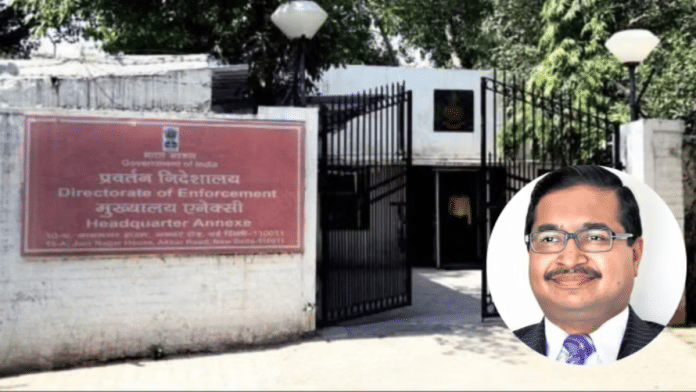
New Delhi: Granting regular bail to Punit Narendra Garg, a former Executive Director of Anil Ambani-led Reliance Communications Limited (RCOM), in a money laundering case investigated by the Directorate of Enforcement (ED), the Delhi High Court noted that he successfully satisfied the strict “twin conditions” mandated under Section 45 of the PMLA.
The case, which originates from a CBI FIR lodged in August 2025 against RCOM, Anil Ambani and others, alleges criminal conspiracy, cheating and loan fund diversion, allegedly resulting in a loss of Rs 2,929.05 crore to the SBI.
Now, under the PMLA complaint, the ED quantified the proceeds of crime directly linked to Garg at Rs 149.77 crore across three specific overseas transactions.
The agency alleged that Garg exercised effective control over foreign step-down entities and actively participated in handling funds from the sale of a luxury yacht named “Tian” (acquired by Ammolite Goldings Lts, associated with Reliance Capital Limited in 2008 for $18.548 million) and a Manhattan New York apartment (acquired in 2010 for $6.395 million by Bonn Investment Inc, an overseas step down subsidiary of the RCOM.
Furthermore, the ED cited remittances totaling $77,046.43 from overseas accounts allegedly toward the educational expenses of Garg’s daughters as evidence of personal benefit derived from money laundering.
Garg was arrested in January. But on Thursday, the High Court granted him bail, emphasising his rights under Article 21 of the Indian Constitution.
Reasonable grounds for believing non-guilt
According to Section 45 of the PMLA, the first mandatory condition for grant of bail requires the court to be satisfied on broad probabilities that there are reasonable grounds for believing the accused is not guilty of the offence.
Justice Sanjeev Narula concluded that the ED failed to establish the link, required under Section 2(1)(u) of the PMLA, between the acquisition of offshore assets and funds allegedly diverted with criminal conspiracy and cheating.
He highlighted that there was a clear chronological disconnect as both the yacht and the Manhattan apartment were acquired years prior to the 2013-17 period of the alleged loan frauds. The yacht was acquired in 2008 while the apartment in 2010.
The court rejected ED’s contention that subsequent refinancing of older debts with 2013–2017 loan facilities automatically converted pre-existing foreign assets into “proceeds of crime”.
The judgment noted that Garg had no role in the original 2008 and 2010 asset acquisitions, was not involved in securing or diverting the 2013-2017 bank credit facilities, and only became an Executive Director of RCOM in October 2017 during strategic debt restructuring.
While Garg participated in asset sale communications in 2021 and 2023, the court stressed that dealing with property constitutes money laundering only if the property itself is proven to be proceeds of crime, a link the ED could not establish.
Regarding payments of the educational fee, Garg produced correspondence from the time demonstrating that the payments were sought and approved by top management as an employment benefit, offering a plausible defense.
To satisfy the second threshold under Section 45, the court must be convinced that the applicant is not likely to commit any offence while on bail.
The HC noted that Garg is 61 years old, ceased holding any official position at RCOM in 2025, and has no prior criminal convictions. Because the primary documentary evidence, electronic records, and bank statements have already been secured by investigating agencies, the risk of evidence tampering is minimal,” the court was satisfied.
Beyond the statutory satisfaction under Section 45, the judgment heavily emphasised Garg’s constitutional right to personal liberty under Article 21. The prosecution’s scope expanded ‘exponentially following a supplementary complaint in August 2026, ballooning the trial record to 77,384 pages of documents, 56 witnesses, and multiple additional co-accused’, the court noted.
Citing landmark Supreme Court rulings such as V. Senthil Balaji v. Deputy Director, Enforcement Directorate, the High Court reiterated that where a complex financial trial has little realistic prospect of an early conclusion, statutory bail restrictions under Section 45 cannot justify indefinite pre-trial detention.
Garg was released on a personal bond of Rs 1 lakh.
The bail conditions imposed by the court include surrendering his passport, remaining in India, refraining from contacting prosecution witnesses, and explicitly prohibiting him from issuing any instructions regarding the transfer or investment of the subject offshore assets without prior permission from the Special Court. Convinced by these safeguards, the court held that the second condition was fully met.
(Edited by Ajeet Tiwari)
Also read: PMLA conditions not a ‘fetter’ preventing courts from granting bail, says SC