



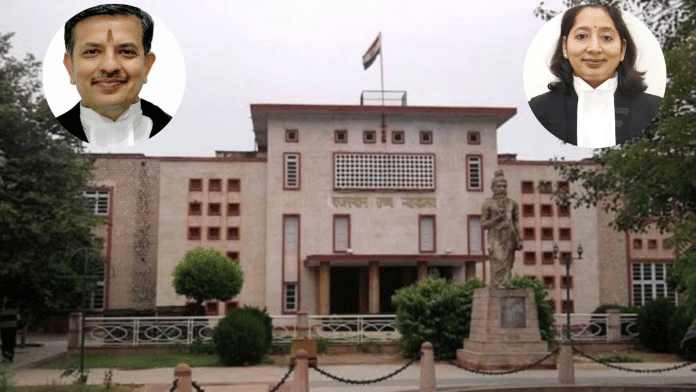
New Delhi: Same profession. Same household. Same high court judges. Same bench? Yes. In an unusual and winsome turn of circumstance, a husband-wife duo of the Rajasthan High Court, judges Pushpendra Singh Bhati and Nupur Bhati, were on a division bench and ordered 46-year pension arrears for a 79-year-old former Corporal of the Indian Air Force, Ratti Ram.
Justice Pushpendra Singh Bhati, 55, enrolled in 1992, was elevated as an additional judge of the high court in 2016 and made permanent in 2018—making him a senior judge in the HC now. Justice Nupur Bhati, also 55, enrolled as an advocate in 2003 and was elevated as a high court judge in 2023, when her husband had been a sitting judge there for the last seven years. Representing the Modi government before the Supreme Court, Additional Solicitor General Aishwarya Bhati is Justice P.S. Bhati’s sister.
Even though the couple made history by being judges in the same high court in 2023 after Justice Nupur Bhati’s elevation, according to the judgements and orders made public on the Rajasthan High Court website, they only shared a bench in early May this year.
This is most definitely a rarity—as India has seen few such couples on the same bench.
Forming a division bench, Justices P.S. Bhati and Nupur Bhati have delivered many orders since the last month—when they also shared the vacation bench.
Their latest judgement was last week, when they ordered restoration of the IAF veteran’s disability pension arrears dating back to 1980. The decision marks the end of a multi-decade legal battle for the officer, who was deprived of his entitlements for over 40 years.
Authoring the judgement, Justice Nupur Bhati noted that Ratti Ram was enrolled in the Indian Air Force in 1964 and discharged in 1979. Upon discharge, a medical board found him suffering from ‘bronchial asthma’—a condition assessed at 30% disability and deemed “attributable to and aggravated by military service”.
However, after an initial payment period, his disability pension was abruptly stopped in 1980 on the grounds that he failed to appear for a re-assessment from the medical board. The petitioner told the court that no communication regarding appearance before the medical board was ever served upon him, and that he spent years filing representations to restore his pension.
In 2014, the veteran approached the Armed Forces Tribunal (AFT), which eventually ordered a Re-survey Medical Board (RSMB) to assess his condition in 2019—which confirmed that his disability had remained constant at 30% since August 1980.
While the AFT allowed his claim in 2023, it restricted his arrears to only the period starting from November 19, 2019. Seeking the full arrears since the original stoppage, Ratti Ram filed a writ petition before the Rajasthan High Court.
The HC bench ruled that the AFT erred in fixing a 2019 cut-off for arrears. The court noted that the RSMB’s finding was retrospective, proving the disability existed continuously since 1980.
“Once the medical board has so recorded, there remains no legal basis to deny arrears from the date of actual stoppage,” the judges noted.
They further emphasised that pension is a right earned through service, not a gift from the state. Quoting Supreme Court precedent, the court stated: “The right to receive disability pension is a valuable right and once found due, the benefit of the same has to be given from the date it became due.”
Eventually, the HC modified the AFT’s order, directing the government to pay all pension arrears from 1980 until the date of actual payment, rounded up to a 50% disability rate. The authorities must compute and pay these arrears within four months, or face an additional 6% interest penalty.
(Edited by Nida Fatima Siddiqui)