



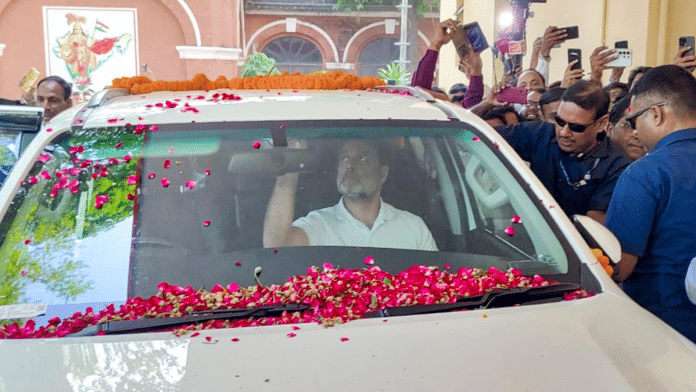
New Delhi: A court in Uttar Pradesh’s Sultanpur Monday acquitted Congress leader Rahul Gandhi in a criminal defamation case over his remarks against Union Home Minister Amit Shah during the 2018 Karnataka election campaign.
The Leader of the Opposition in the Lok Sabha was present in court when the verdict was pronounced.
Additional Chief Judicial Magistrate Shubham Verma of the special MP/MLA court dismissed the complaint, holding that the remarks were not defamatory in nature. The complaint’s dismissal brings an eight-year legal battle over the 2018 remarks to a close, giving Rahul relief in a case that began during a politically charged election campaign.
The case arose from remarks Rahul made at a press conference in Bengaluru in May 2018, when Shah was the Bharatiya Janata Party (BJP) national president. He had referred to Shah as a “murder accused”, prompting a complaint by local BJP leader Vijay Mishra.
Mishra, a former chairman of the district cooperative bank, filed the criminal defamation complaint on 4 August 2018 under Sections 499 and 500 of the erstwhile Indian Penal Code (IPC). He alleged that the remarks had hurt him and other BJP workers, arguing that Shah was discharged in the murder case being referred to.
Criminal defamation under Section 499 of the IPC concerns statements that harm a person’s reputation, subject to statutory exceptions. Section 500 prescribes the punishment for the offence. The court’s acquittal means Rahul has been cleared of the charges in this particular complaint.
The complaint was based on remarks that Rahul made during the heated campaign for the Karnataka elections, when the Congress and BJP were locked in a high-stakes political contest.
Rahul was referring to the Sohrabuddin encounter case in which Shah was acquitted by a Central Bureau of Investigation (CBI) court in 2014.
The proceedings continued for years before the Sultanpur court. Rahul appeared before it in February 2024 and secured bail in the case. The complaint remained pending until Monday’s verdict.
(Edited by Tony Rai)