





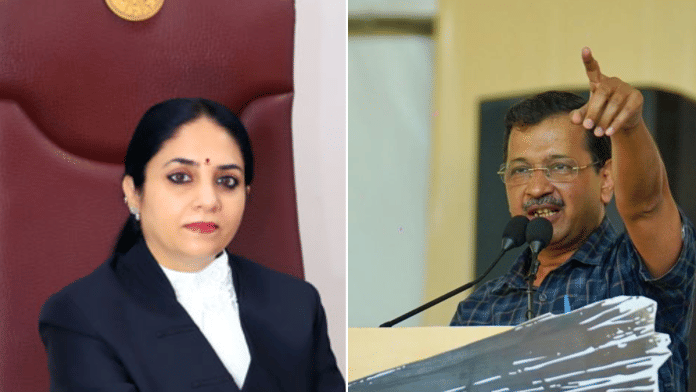


New Delhi: The Delhi High Court in a significant direction Thursday ordered social media platforms such as Meta, Facebook, Google and X to immediately take down videos of former Delhi Chief Minister Arvind Kejriwal arguing his case before the court for recusal of Justice Swarana Kanta Sharma from the excise policy case.
The videos in question have been circulating on social media since 13 April, after Kejriwal appeared, in person and on video-conference, before Justice Swarana Kanta Sharma to argue his recusal plea, alleging “an apprehension of bias” on her part.
On Thursday, the HC bench of Justices Kameswar Rao and Manmeet Pritam Singh Arora, while ordering the takedown of clips, sought responses from Kejriwal, journalist Ravish Kumar and others who had uploaded the content. They have to file replies within four weeks.
The court further issued notice to the Ministry of Information & Technology and asked them to file an affidavit.
Speaking to ThePrint, Delhi-based lawyer Vaibhav Singh, who had moved the plea against Kejriwal and others regarding the video recordings, said: “The court also asked the ministry to file an affidavit within a week with details on whether the takedown is in line with the Information Technology (Intermediary Guidelines and Digital Media Ethics Code) Rules, also known as the IT Rules, 2021.”
Singh’s plea, a copy of which is with ThePrint, argues that recording videos of courtroom proceedings violates the Delhi High Court’s Electronic Evidence and Video Conferencing Rules, 2025, which state that “there shall be no unauthorised recording of the proceedings by any person or entity”.
“I was compelled to file this petition when submissions were used to set a political narrative, the name of Adhivakta Parishad was invoked to sway a sitting judge, and the entire episode was turned into a public attack on the Delhi High Court,” Singh said, adding that settling of political scores by using the HC as a “prop” also motivated him to do so.
The Akhil Bharatiya Adhivakta Parishad is the legal arm of the Rashtriya Swayamsevak Sangh (RSS).
Also Read: Is Kejriwal vs Justice Swarana Kanta unprecedented? How recusals work in Indian judiciary
Vaibhav Singh’s plea
Stating that he is a “peace-loving citizen” of India and member of the Delhi High Court Bar Association, Singh says in his plea that he was seeking contempt proceedings against Aam Aadmi Party (AAP) politicians and members of other parties for unauthorisedly recording audios and videos of court proceedings before Justice Sharma.
On 13 April, Kejriwal had appeared before Justice Sharma to argue his recusal plea. He argued for around 45-50 minutes, Singh’s plea states while referring to a widely-circulated clip of the proceedings on different social media platforms.
“Retweeted and posted by various political leaders and the way it went viral smells (of) deep conspiracy by Mr Arvind Kejriwal,” Singh states, while labelling the clip as an attempt to mislead the common people into thinking that the judiciary is working at the behest of some political parties and under the pressure of the Centre.
The plea argued that AAP leaders along with other members of opposition parties had “intentionally and deliberately” tried to malign the court’s image.
These politicians were also trying to manipulate and misguide people while lowering the image of the court nationally and globally, the plea states.
Terming Kejriwal’s appearance as a “preplanned conspiracy and dirty strategy” hatched by him along with his party members, Singh’s plea adds that this was being done to win over public sentiment.
In support of his argument, Singh presented posts by Congress leader Digvijaya Singh hailing Kejriwal for his “courageous act”, and AAP MLA Saurabh Bharadwaj, who posted on X Kejriwal’s argument that Justice Sharma had attended four Abhivakta Parishad events.
Relying on Rule 5(vii) of the Delhi High Court video-conferencing rules, the plea states: “Unless expressly permitted by Court, no person, either at Court Point or at designated place or at Remote Point or Advocate’s Remote Point, shall record or publish the proceedings or any part thereof, conducted by video conferencing or other modes of audiovisual electronic communication”.
On 15 April, Singh had also filed a complaint with the Registrar General of the Delhi High Court and another one with Google, Meta and X for removal of the clip with immediate effect.
However, no action had been taken till now, his plea states, adding that this is why Singh had to approach the high court.
(Edited by Nida Fatima Siddiqui)
Also Read: CBI case against Kejriwal & Sisodia falls flat. What agency alleged in Delhi excise policy case