





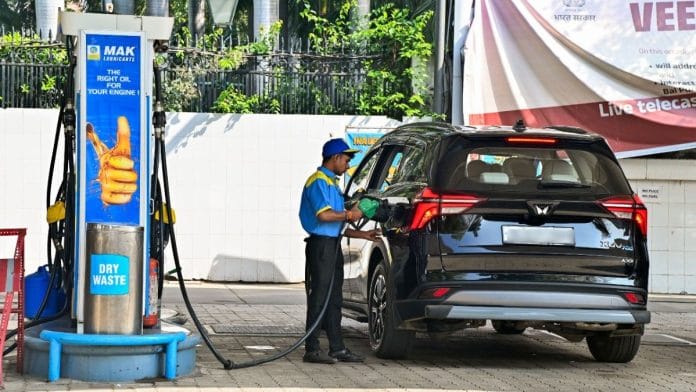


New Delhi: Observing that nearly 56 percent of vehicles on Indian roads are uninsured and plying in violation of the law, the Supreme Court Tuesday directed the Insurance Regulatory and Development Authority of India (IRDAI) and Ministry of Road and Transport and Highways (MoRTH) to develop a pilot project that can link vehicles with their insurance status at petrol pumps when they stop there for a refueling.
If the vehicle is not insured, its owner can be refused fuel at petrol pumps until a valid insurance is obtained, the court said.
A bench led by Justice Sanjay Karol was persuaded to make the suggestion in view of the high percentage of uninsured vehicles plying on Indian roads.
This pilot project, it suggested, can be implemented through the use of Automatic Number Plate Recognition (ANPR) cameras deployed on highways and roads.
According to the court’s proposed scheme, ANPR would be integrated with the Insurance Information Bureau of India database and the VAHAN portal—a national digital vehicle registry. This would enable automatic e-challans to uninsured vehicles, in furtherance of the Standard Operating Procedure for Electronic Monitoring and Enforcement of Road Safety.
Non-compliance of the law by a vehicle owner forces road accident victims to get drawn into prolonged litigation, the bench observed in its decision.
The suggestion was amongst a slew of directions the top court issued Tuesday, while deciding an insurance company’s appeal in a motor accident compensation case. The series of directions aim to ensure compliance with the mandatory insurance regime.
The court said the idea to develop a tool to provide current insurance status of the vehicle will have a two-fold benefit.
“Firstly, it will assist in identification of uninsured or unregistered vehicles. Secondly, it will prompt the owners of these vehicles to ensure that they have valid insurance status,” the bench said.
This, it said, would ensure “ground-level compliance with the statutory mandate of Section 146 of the MVA”. Section 146 of the Motor Vehicles Act, 1988 requires all vehicles to have valid third-party insurance.
“The object behind mandatory insurance under Section 146 of the MVA is not just that victims of road accidents are compensated, it is also that they are not drawn into prolonged litigation,” the court observed.
According to a Parliamentary report studied by the court, out of 30.48 crore vehicles plying on Indian roads 16.54 crore did not possess valid insurance. Involvement of uninsured vehicles in road accidents often compelled the victims to “run from pillar top post” for compensation.
Since there is no uniform mechanism in place with state police to verify insurance status on the ground, the bench also directed that state police be provided with “handheld devices or downloadable apps, linked with the data from insurance information bureau and VAHAN portal be supplied to the State Police”.
“This is to monitor real-time insurance status of vehicles and impose challans for violations, ensuring compliance with mandatory insurance on the ground,” the court said.
As the court laid emphasis on the need for a uniform motor-vehicle policy structure covering all occupants of the vehicles, in addition to the third-party risk coverage, it directed IRDAI to increase the term of third-party motor vehicle insurance to four years for new cars and six years for new two-wheelers.
At present, the term is three years for new cars and five years for new two-wheelers.
However, while noting that several vehicles continued to remain uninsured, despite an eight-year-old SC direction, the court increased the term for new policies. In doing so, the bench ignored the objections by the IRDAI and the General Insurance Council (GIC).
The insurance regulator was ordered to immediately issue necessary directions in this regard.
As agreed upon by IRDAI, the bench asked the authority to prepare a four-layer insurance structure for private vehicles. To update the consumer about the same, the bench said a customer-friendly information sheet should be prepared for the prospective customers, outlining the format.
This sheet must include details such as who is covered under mandatory and optional covers etc. “This would bring clarity to various policy options for the vehicle-owner so as to allow them to make an informed choice,” it said.
The four-layer structure discussed in the judgement is based on three broad points—third party-only policy; additional optional cover for the occupant(s)/pillion rider; and personal accident cover for the owner, driver and any occupant(s)/pillion rider.
Under the third party-only policy, the policy shall be a base policy and minimum cover as required by Section 146 of the MVA. The pricing will be fixed by a consultative process between IRDAI and the Centre.
The additional optional cover for the occupant(s)/pillion rider (other than owner, driver and family of the insured) will be an optional add-on available at an additional premium, covering occupant(s)/pillion riders of the insured vehicle. The pricing is to be determined by the respective insurance companies.
As for the personal accident cover for the owner, driver and any occupant(s)/pillion rider, this add-on will cover personal accident i.e. death and/or permanent disability of the occupant(s)/pillion riders of the insured vehicle including owner, driver and family of the insured. The pricing in this case, too, will be determined by the respective insurance company.
(Edited by Amrtansh Arora)