



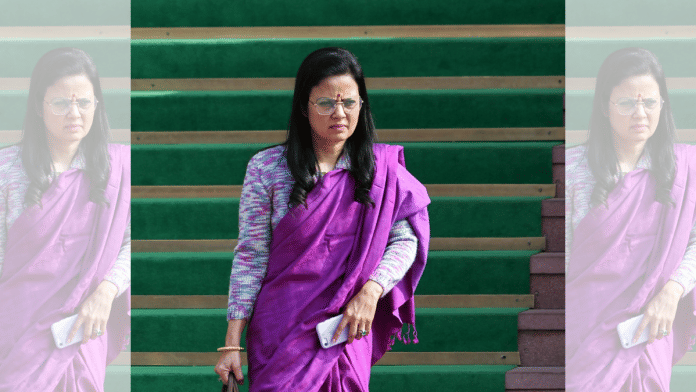
New Delhi: After a nearly 40-minute hearing, the Supreme Court Friday resolved TMC MP Mahua Moitra’s grievance over using government accommodation in West Bengal’s Krishnanagar, her Parliamentary constituency. The SC asked the BJP-ruled state to make available her accommodation in circuit house on one-day notice, rather than three-four days, as mandated in a 1 September notice by the district administration.
A bench of chief justice Surya Kant and justice Joymalya Bagchi told the state that accommodation in the circuit house should be made available to the Mamata All India Trinamool Congress (MAITC) MP as per the protocol and standard operating procedure (SOP) followed in the state, and asked Moitra to inform the authorities a day before her scheduled visit to the constituency.
The Parliamentarian had moved the top court on 15 August, a day after she was told by the Nadia additional district magistrate to vacate the circuit house there. Moitra had checked-in on the same day in the morning. She received the eviction notice past 10 pm.
In response to her claim, the West Bengal government disputed the allegation of harassment raised in the petition. Appearing for the state, Solicitor General Tushar Mehta Friday told the bench that as per the 1 September letter, MPs, MLAs and all officials have been told to give an advance notice of at least three to four days for availing the official accommodation facility.
Mehta insisted accommodation can be provided only if there is availability in the circuit house.
The bench, however, overruled Mehta’s suggestion that accommodation can be provided only upon availability. It even felt that the 1 September letter, seeking four days’ prior notice for circuit house accommodation, seemed “retaliatory”.
Twice, during the hearing, the bench observed that the top court was not meant to adjudicate the issues regarding accommodation raised in an Article 32 petition. Article 32 is invoked when there is violation of a fundamental right.
“All that is required is a standard operating procedure (SOP), outlining an advance notice and a nodal officer to whom some personal assistant of the MP can reach out,” the bench remarked.
Mehta too said that Moitra could have sorted it out amicably with the state administration.
At this the bench remarked: “If mutual decency and decorum is followed then these things wouldn’t have come here.”
The court categorically told Mehta that the state would have to withdraw the 1 September circular.
When Mehta insisted that the court specify in its order the availability of a place as a pre-condition to provide accommodation to Moitra, the bench told him that the circuit house is for official work and official work is graded.
“She will have a preferential right to stay there because she is the representative of that constituency. There have been instances and not unknown that people have been asked to vacate. We are not making a new law,” the bench said.
Mehta explained to the court that the 1 September letter was not meant only for Moitra but also included legislators of that district.
Moitra’s lawyer, senior advocate Gopal Sankaranarayanan, told the bench that Moitra, who has been in public life for close to 10 years, never faced problems with regard to accommodation. He said many times she has walked into the circuit house, without even sending any notice.
He pointed to West Bengal’s response to her petition and said four rooms were occupied in the same circuit house and none of the other occupants was asked to vacate. He said ideally at least one room should be reserved for the MP and MLA.
The judges too agreed, and told Mehta that in every circuit house one or two rooms are reserved for emergencies.
The court, however, did not entertain Moitra’s second issue with regard to local administration’s non-cooperation in her MP-LAD schemes. She said 18 projects are completely stuck and the district administration is not implementing them.
The bench asked Moitra to give a representation to the district administration and gave her liberty to move the high court there in case she receives no response.
(Edited by Ajeet Tiwari)