



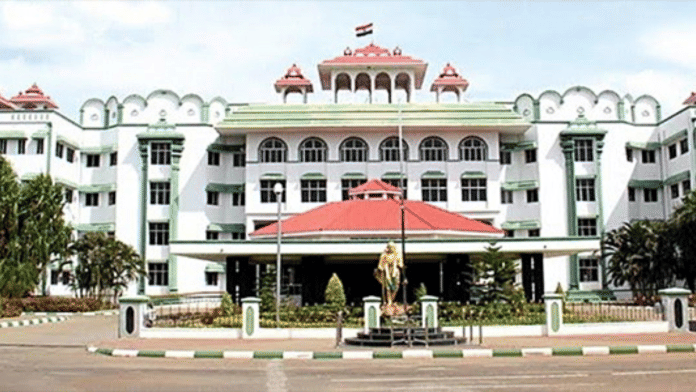
New Delhi: Unregulated transnational funds carry potential risks of destabilising social order and influencing national polity, the Madras High Court has said, holding that receiving foreign donations under the Foreign Contribution (Regulation) Act is subject to statutory regulation, rather than a vested or fundamental right.
Administrative authorities must be allowed “considerable leeway and unfettered discretion” in evaluating foreign contribution applications, the Madras High Court’s Madurai bench added.
The bench of Justices G.R.Swaminathan and M.D.Sumathi made these observations while hearing an appeal filed by Kanzeon Public Charitable Trust against the Ministry of Home Affairs’ (MHA) refusal to grant an FCRA registration certificate.
In a detailed conceptual discussion, the HC drew a sharp distinction between Abrahamic religions and inclusive spiritual philosophies, as well as between religious institutions and entities engaged in teaching Indian Knowledge Systems (IKS).
Analysing theological frameworks, the bench observed that “Christianity is a messianic religion” whose mission is “to bring everyone within the fold of Jesus Christ”. Contrasting this with “native Indian traditions”, the court stated: “Unlike Hinduism which is inclusive, the Abrahamic religions are inherently exclusive. The devout Jews, Christians and Muslims believe that theirs is the one true and complete revelation because that is what their Holy books say of themselves.”
Demarcating purely religious activities from educational and cultural institutions ‘engaged in disseminating traditional Indian knowledge’, Justice Swaminathan explicitly wrote that organisations engaged in the systematic teaching of texts such as Vedanta, the Bhagavad Gita, the Upanishads, and Yoga cannot be automatically branded as ‘religious entities’.
“An organisation primarily engaged in the systematic teaching of Vedanta, the Bhagavad Gita, the Upanishads, Yoga and allied Indian Knowledge Systems through structured classes, residential courses, publications, research and preservation of manuscripts cannot be classified as religious institutions. Indian Knowledge Systems would fall under the category of education or culture,” he wrote in the judgment.
Highlighting the National Education Policy (NEP), 2020, which recognizes IKS— specifically philosophy and yoga—within academic curriculum, the bench emphasised that the FCRA framework should operate in tandem with national educational policy rather than misclassifying civilisational preservation as a religious activity.
The court clarified that “persons and organisations engaged in upholding the civilisational heritage of India have to be classified as educational or cultural”, whereas entities conducting worship, rituals, or specific religious programs belong to the religious category.
Emphasizing that central authorities possess broad discretion under Sections 11 and 12 of the FCRA to evaluate foreign funding risks, the High Court dismissed the trust’s appeal with no order as to costs.
The judgement, delivered 6 October, uploaded on the high court website on 7 October.
Also Read: Why Modi government’s FCRA Bill is facing pushback
Misrepresentation of religious nature
The legal dispute arose after Kanzeon Public Charitable Trust, operating a Zen Meditation Centre in Kodaikanal, applied for FCRA registration in June 2025, claiming its activities represent a non-religious Dhyana meditation tradition.
The Deputy Director (FCRA), MHA, rejected the application in November.
Examining Rule 9 of the Foreign Contribution (Regulation) Rules, 2011, and Form FC-3A, the bench pointed out that applicants must make a frank disclosure of their character – whether religious, cultural, economic, educational, or social. The court noted that while the trust projected itself as non-religious, its founder and main functionary Ama Swamy is an ordained Christian priest, and the trust subscribes to Zen Buddhist philosophy.
The HC relied on the Supreme Court’s decision in Commissioner, HR&CE v. Shirur Mutt, which classified sects and sub-sects as religious denominations, and held that Zen Buddhism, being a variant of the Mahayana Buddhist school, falls squarely under the religious classification umbrella.
Consequently, the trust committed misrepresentation by marking itself as non-religious in Form FC-3A. “One cannot keep any card up one’s sleeve. This is no game of hide and seek,” the court said, reprimanding the trust for failing to make full disclosure. “That is why, the respondent authority had to say ‘Illa Samy’ (No Sir, in Tamil) to Rev. Fr. Ama Samy (which literally translates as ‘Yes’)”.
Quoting extensively from the Supreme Court’s ruling in Noel Harper v. Union of India, the High Court noted that “there is no vested right, much less an absolute right to accept foreign donation”. “This is because there is no right as such to receive foreign contributions. It can at best be a privilege,” it said, elaborating on the constitutional and statutory rationale.
Citing academic authority and legal precedents, the court observed that unscrutinized foreign assistance can threaten democratic values, intellectual sovereignty, and national security.
The bench highlighted Section 12(4)(a)(ii) of the FCRA to emphasise that foreign contributions cannot be deployed for religious conversions that threaten social harmony.
The above-mentioned section mentions that an applicant seeking registration or prior permission to accept foreign contributions must not have been prosecuted or convicted for indulging in activities aimed at conversion from one religious faith to another, either through force or inducement.
Describing India as a pluralist “salad bowl” rather than a melting pot, the court affirmed that the FCRA statutory regime exists to subserve secular democratic objectives.
The court concluded that while genuine religious organisations whose activities preserve social amity are entitled to apply for registration upon candid disclosure, any misrepresentation or involvement in conversion activities warrants outright rejection.
(Edited by Tony Rai)