



New Delhi: Back in 2012, in the backdrop of raging protests against nuclear reactors in Tamil Nadu’s Koodankulam, then Prime Minister Manmohan Singh made a statement that turned heads both inside and outside India.
Singh blamed US-based NGOs for engineering the protests. The statement had come at a time when several NGOs were under investigation for violation of the rules under Foreign Contribution (Regulation) Act (FCRA), 2010.
In an interview to Science Magazine, Singh blamed such NGOs for holding back India from building the nuclear reactors it needs to meet fast-growing energy needs, saying, “The atomic energy programme has got into problems because these NGOs, mostly I think based in the United States, don’t appreciate the need for our country to increase the energy supply.”
“There are NGOs, often funded from the United States and the Scandinavian countries, which are not fully appreciative of the development challenges that our country faces,” he said.
Cut to March this year, Union Minister of State for Home Affairs Nityanand Rai asserted that the Narendra Modi government “will not tolerate” any misuse of foreign funds and will take strong action against such “elements”. The remark was made when Rai was introducing the Foreign Contribution (Regulation) Amendment Bill, 2026.
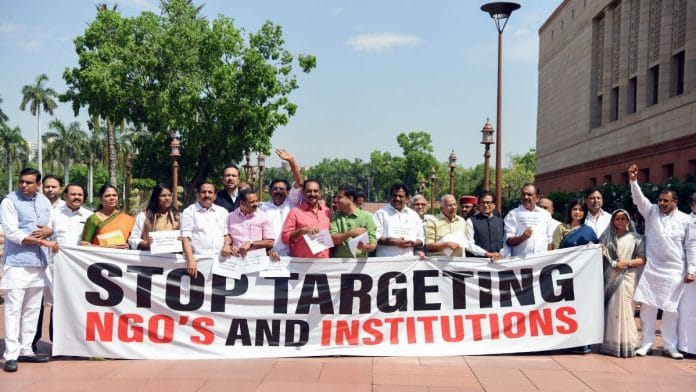
Foreign funding to NGOs has often been blamed by the government, no matter the party in power. And the new Bill has been the latest flashpoint between the government and the Opposition for days now. Amid the logjam in Parliament and Opposition’s demand that the Bill be withdrawn, the FCRA Bill was referred to a Joint Parliamentary Committee Wednesday. The panel has to submit its report in Lok Sabha by the last day of the first week of Winter Session 2026.
The 2010 law regulates the acceptance and utilisation of foreign contributions or foreign hospitality by certain individuals or associations or companies, prohibiting such contributions for any activities “detrimental to national interest”. Those with a definite cultural, economic, educational, religious or social programme can receive foreign contributions after obtaining permission or getting registered with the Centre.
A major source of concern for the opponents of the new Bill is the provision related to the proposed “designated authority” for management and disposal of foreign funds and assets created by an NGO, or any other association or organisation, whose registration is cancelled, surrendered or ceases under the law.
Congress MP Manish Tewari alleged that it gives “wide and unguided executive control over property”.
The TVK government in Tamil Nadu led by Chief Minister C. Joseph Vijay also passed a resolution in the state assembly Tuesday, urging the Union government to withdraw the Bill in its current form. Minister for school education, Tamil development, information and publicity A. Rajamohan, who moved the bill, flagged the provisions linked to transfer, management, disposal and sale of assets of organisations whose registration is cancelled, surrendered or ceases under the law. The Bill, they say, could affect educational institutions, elderly care homes and hospitals run by minority organisations and others.
‘Designated authority’
Under the existing FCRA law, Section 15 states that if an organisation’s registration is cancelled, the foreign funds it holds, and assets created from those funds, would vest in an authority prescribed by the government. This authority could manage the organisation’s activities in public interest, use the foreign contribution, or dispose of assets if funds were insufficient. If the organisation was later re-registered, the authority would have to return the funds and assets.
The 2026 proposed amendment replaces this provision with a new Chapter IIIA, which sets out a detailed framework for vesting, supervision, management and disposal of foreign contributions and related assets by a “designated authority”, when an FCRA certificate is cancelled, surrendered or ceases to exist.
The proposed Section 14B clarifies when a certificate will be treated as ‘ceased’. This includes cases where an organisation does not apply for renewal, when its renewal request is rejected, or when the certificate is not renewed before its expiry.
Delhi-based lawyer Deepak Joshi explains that the Bill gives extremely wide powers to the designated authority in terms of vesting and appropriating properties and assets.
As an example, he refers to Section 16A, which says that foreign contribution and assets shall vest provisionally in the “designated authority” if the certificate under FCRA has been cancelled or surrendered or has ceased. If the organisation fails to get a fresh certificate, or get it renewed or restored within a specified period, the foreign funds and assets will become permanently vested in the authority.
The proposed section adds that an asset shall vest in the “designated authority whether created or acquired partly from foreign contribution and partly from other sources”.
“That’s a concern because ideally, you should have called for the accounts of the NGO, trust or whosoever is the beneficiary of the foreign contribution, and then sort through how much of it is actually resulting in creation of an asset. If the split is very nominal, where the foreign contribution has been deployed only to the extent of 20 percent of the total value of the asset, it makes no sense why the whole of the asset is being vested,” Joshi says.
“It may be an administrative building. It may be a very crucial asset for the working of the NGO, the trust, or any other organisation.”
Section 16A(6) of the Bill would also allow the “designated authority” to order transfer of assets permanently vested in it to “any ministry, department, authority or agency of the central government or of a state government or any local authority”. It would also allow the authority to dispose of such assets through sale or any other appropriate process, and credit the sale proceeds together with any unutilised foreign contribution to the Consolidated Fund of India.
The ‘minority’ conundrum
Concerns have also been raised highlighting the supposed impact of the Bill on minority religious institutions.
For instance, the Catholic Bishops’ Conference of India (CBCI) alleged that it could “threaten the operational survival” of minority and civil society organisations. Deputy Secretary General of the body, Father Mathew Koyickal, was quoted in media reports as objecting to the provision relating to takeover of assets, saying that it “empowers the central government to deny licence renewals and subsequently assume control over the institutions, funds, properties and assets of minority organisations and NGOs”.
The proposed Section 16A(7) further says that if an asset permanently vested in the “designated authority” is a place of worship, it shall “entrust the management or operation of such asset or portion thereof to such person, in such manner and on such terms and conditions as may be prescribed and ensure that the religious character of such place of worship is maintained”.
Joshi explains that the concern stems from the responsibility given to the “designated authority” for supervision, management, safeguarding, preserving or maintaining the assets vested in it.
Calling the concerns raised by minority institutions “valid”, he explained, “Most of the minority institutions and charities also have administrative assets or places of worship functioning under that trust or organisation which receives the foreign contribution. If, for any reason, their registration is suspended or canceled, all the assets are then vested with the government, and the government has the powers to undertake the administration,” he says.
For religious minorities, the Constitution provides the protection that the religious denomination has control over the management of minority rights and its own affairs, he points out, but adds, “If you go by a literal reading of the proposed provision in the Bill, there is no exception. It is purely controlling in effect, because it says that the functions will be entrusted to a party, which may be designated authority or a person nominated by the designated authority. It doesn’t even say that the control will be by a person who is of the same denomination.”
So the religious character, which is sacrosanct for these institutions, may be diluted, Joshi asserts.
Retrospective application
Section 1(2) of the FCRA Bill says that “it shall come into force on such date as the Central Government may, by notification in the Official Gazette, appoint”.
Delhi-based lawyer Nipun Saxena asserts that the Bill would have retrospective application.
“‘Retroactively’ would mean that it would also apply to those previous licences which are already applied, but have not yet been renewed or those that are pending renewal. A lot of ironing out would have to be done via the Rules. There will have to be sunset clauses, which would take a specific date by which all the NGOs would have to get the necessary compliance done,” he told ThePrint.
Joshi agrees, saying that the wording of the provision is “very clear” on retrospective application. “What is problematic there is that the consequence and the nature covered by the retrospective amendment, or that clause, is completely different because earlier what used to happen was that there was a hearing, and then if the matters were closed, they would remain closed. But with this retrospective effect, it reopens the closed matter under the old or the pre-amendment act.”
Joshi also highlights that another consequence of this would be an asset permanently vesting in the designated authority after a prescribed period. “This was not envisaged in the pre-amended version. In fact, in the pre-amended version, if the assets were vested, after the subsequent registration, they were to be returned. But there is no mechanism for this,” he adds.
(Edited by Mannat Chugh)
Also Read: Why the FCRA Bill is an asset grab in disguise