





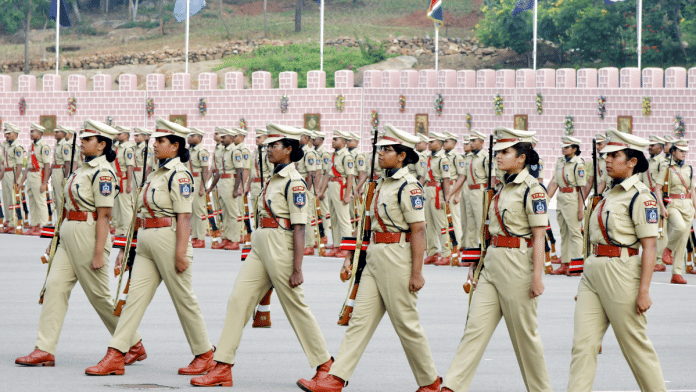


New Delhi: Should an archaic office memorandum be invoked to prohibit pregnant women IPS officers from participating in probationers’ training programme? Or, should modern science form the basis for such a decision, allowing them to make choices based on medical assessment?
These questions, which raise principles of substantive equality, have been brought before the Supreme Court in a petition that questions a 1993 office memorandum (OM) from the Ministry of Home Affairs prohibiting a pregnant IPS officer from undergoing the training programme during the probation period.
Issued on 23 August 1993, the OM calls for strict discipline and advises women IPS probationers to take necessary precautions to ensure they do not conceive during their training period.
And, in case an officer gets pregnant, then her training has to be stopped with immediate effect. The OM further mandates that the officer shall be on a one-year break from training, which will re-commence only after the completion of one year from the date of delivery.
The period of absence from training, it says, will be treated as extraordinary leave and won’t affect the seniority of such an officer.
The petition focusing on the blanket exclusion of pregnant women IPS probationers during training was filed by a Madhya-Pradesh cadre officer, whose request to include her for the training programme that commenced 22 June was declined.
The officer had delivered in September last year and sought permission to re-join Phase-II of her training on the ground that she is medically fit to do so.
However, in response, the director of the Sardar Vallabhbhai Patel National Police Academy refused to accommodate her, citing the 1993 OM.
Urvashi Sengar, a direct recruit IPS officer of the 2023 batch, was told that she could only commence her training programme with the next batch, which would be next year.
She joined the academy in November that year for her Phase-I training programme that includes physically intensive components such as passing-out parade, horse riding, etc.
In April 2025 when she was undergoing her phase-II training, which comprises academic modules, classroom sessions and institutional attachments, she conceived and accordingly informed her reporting manager about it. Subsequently, Sengar was asked to discontinue her training programme and told to re-join a year after her delivery.
She then approached the Central Administrative Tribunal (CAT), which, in an interim order on 27 May, allowed her to participate in the Phase-II training. This was, however, subject to fulfilment of medical requirements and other formalities.
Before the CAT, Sengar cited two past cases where exceptions were made for women officers, permitting them to get trained despite not fulfilling the 1993 OM’s mandate of a one-year break after delivery.
Notably, on 16 June, the police academy issued a letter to Sengar to join the training. However, within two days it was withdrawn and on 20 June, an appeal was filed before the Delhi High Court against the CAT’s interim order.
Incidentally, the HC on 22 June, when the training was about to commence, stayed the CAT order. In its order, the court observed that the OM was framed keeping in view the welfare of both IPS probationer and the infant child.
In her plea before the SC, Sengar has said the 1993 OM fails to draw a distinction between the two training phases. It fails to reflect the contemporary realities of modern training design, phased modules, availability of reasonable accommodation, and constitutional norms of substantive gender equality.
A significant question posed is whether a blanket exclusion can be imposed upon a woman IPS probationer solely on account of childbirth, without any individualised assessment of medical fitness, capability or assessment.
Sengar’s petition, settled by advocate Avinash Sharma, pointed out that a similar exclusion existed for women IAS probationers. However, in 2004, the Department of Personnel and Training’s (DoPT) amended it, giving the IAS women officers discretion to complete the training.
The new policy replaced the old one, a blanket prohibition, with a fitness-based, individualised and reasonable accommodation approach, she said.
However, an outdated OM is being followed, in its rigid form, for IPS women officers, even though the Phase-II training programme primarily comprises academic academic modules, classroom sessions and institutional attachments, including attending classes in Indian Institute of Management.
Since it is not physically strenuous, largely choice-based, which includes activities such as yoga and swimming, recommended in pregnancy subject to medical advice, it makes sense in the present times to continue with the OM, the officer has submitted.
(Edited by Tony Rai)
Also Read: Beyond glass ceiling: Redesigning gender rules for India’s economic future