


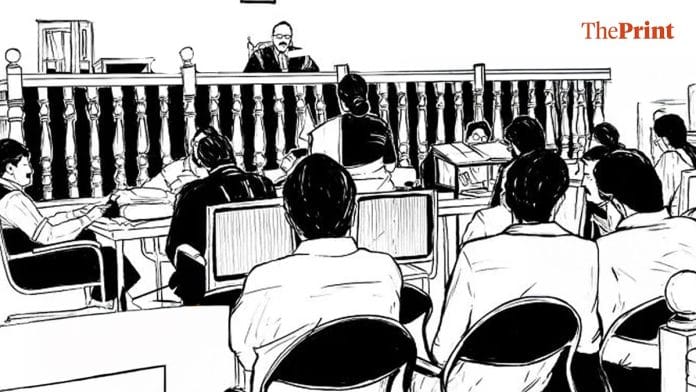
New Delhi: The Supreme Court, this week, issued notice to the Centre and the Election Commission of India (ECI) on petitions challenging the law that protects the Chief Election Commissioner (CEC) and Election Commissioners from civil and criminal proceedings for acts linked to their official duties.
A bench of Chief Justice Surya Kant, and Justices Joymalya Bagchi and V. Mohana has sought responses within four weeks. The petitions, filed by Rashtriya Janata Dal MP Manoj Jha and activist Arun Agrawal, were tagged with an earlier challenge to the provision, and listed for hearing on 18 December.
The matter gains special significance as the poll body faces public scrutiny in light of protests by the Opposition, Cockroach Janta Party and other civil society members against CEC Gyanesh Kumar and alleged irregularities in Special Intensive Revision exercise.
At the centre of the challenge in court is Section 16 of the Chief Election Commissioner and Other Election Commissioners (Appointment, Conditions of Service and Term of Office) Act, 2023. It says that no court shall entertain or continue civil or criminal proceedings against anyone, who “is or was” a CEC or Election Commissioner for any act, thing or word done or spoken while, or in the course of, acting or purporting to act in the discharge of official duties.
The Section goes beyond protecting commissioners during their tenure. By extending to those who “are or were” in office, it continues to cover former commissioners as well. It bars both civil and criminal proceedings for acts linked to official duties, without expressly requiring that such acts were carried out in good faith.
The ECI takes decisions that can have far-reaching political consequences from scheduling elections and enforcing the model code of conduct, to dealing with complaints against parties and candidates. The argument for protection is that commissioners must be able to perform these functions without the threat of retaliatory litigation every time a decision displeases a political party or candidate.
The petitions, however, question the extent of this protection. They ask whether it can also prevent legal proceedings, when an official decision is accused of involving corruption, abuse of power or mala fides. Section 16 does not specifically exclude such allegations from its ambit.
The Supreme Court will now have to examine whether the provision can be interpreted so widely, and whether such protection is constitutionally valid.
How protection differs for judges & constitutional heads
Judges also receive protection for acts connected with judicial functions under the Judges (Protection) Act, 1985. Section 3 of the Act bars courts from entertaining or continuing civil or criminal proceedings against a person, who is or was a judge, for an act, thing or word done while acting, or purporting to act, in the discharge of official or judicial duty.
But Section 3(2) expressly preserves the power of the Centre, state governments, Supreme Court, High Courts and other competent authorities to take appropriate action, including criminal or departmental proceedings, against a serving or former judge.
In K. Veeraswami vs Union of India (1991), the Supreme Court also held that judges of the higher judiciary can be prosecuted for criminal offences, including corruption, while prescribing safeguards for initiating such cases.
The President and Governors have a separate constitutional protection under Article 361. Clause (1) says they are not answerable to courts for the exercise and performance of their official powers and duties, or for acts done or purportedly done in that capacity. Unlike the provisions dealing with criminal proceedings, this clause does not expressly limit the protection to their term in office.
Clauses (2) and (3), on the other hand, provide protection against criminal proceedings and arrest, or imprisonment, only for the duration of the President’s or Governor’s tenure.
In Rameshwar Prasad vs Union of India (2006), the apex court ruled that a Governor cannot be personally called to account before a court, even when allegations of mala fides are made. However, this does not place the government’s actions beyond judicial scrutiny. While the Governor enjoys personal protection, the decisions taken by the government can still be challenged in court.
Ministers & legislators not beyond criminal law
The Prime Minister, Chief Ministers and other ministers do not enjoy an equivalent of Article 361. They can be investigated and prosecuted for criminal offences while in office, or after leaving it. But it would be wrong to say that every prosecution can proceed without a procedural safeguard.
Section 197 of the Code of Criminal Procedure (CrPC), now replaced by Section 218 of the Bharatiya Nagarik Suraksha Sanhita (BNSS), may require prior sanction before a court takes cognisance of an alleged offence by a public servant that has a sufficient connection with official duty. In R. Balakrishna Pillai vs State of Kerala (1995), the Supreme Court recognised that a minister could claim this protection, where the alleged act was connected with the discharge of official functions.
MPs and MLAs have a different, limited privilege. Articles 105(2) and 194(2) protect them from court proceedings in respect of anything said or any vote given in Parliament or a state legislature, including their committees. The protection continues after they leave the House, but it applies to legislative speech and voting, not to unrelated criminal conduct.
In Sita Soren vs Union of India (2024), a seven-judge Constitution Bench held that legislators cannot invoke parliamentary privilege to escape prosecution for bribery connected with a speech or vote. It overruled the contrary position in P.V. Narasimha Rao vs State (CBI) (1998).
Separately, Section 135A of the Code of Civil Procedure gives legislators limited protection from arrest or detention under civil process during specified legislative meetings and the 40 days before and after them. It does not prevent civil suits or protect against criminal arrest.
CVC protection depends on good faith
The Central Vigilance Commissioner and Vigilance Commissioners are protected under Section 15 of Central Vigilance Commission Act, 2003. It bars suits, prosecution or other legal proceedings for anything done or intended to be done in good faith under the Act.
Unlike Section 16 of Election Commissioners Act, the CVC law clearly says that protection applies only to acts done in good faith.
These laws provide different levels of protection to different public officials. While some are protected for decisions taken in office, others enjoy limited protection based on their role or nature of the act.
The Supreme Court’s decision on Section 16 will clarify how far such protection can go without affecting the accountability of election commissioners.
Aditya Edara is an alum of ThePrint School of Journalism, currently interning with ThePrint.
(Edited by Mannat Chugh)
Also Read: 24-hr deadline to produce accused before a magistrate starts from detention, not formal arrest—SC
There cannot be lifetime immunity for any public servant. Not even POTUS. Or Pakistan’s army chief.
There cannot be lifetime immunity for any public servant. Not even POTUS.