


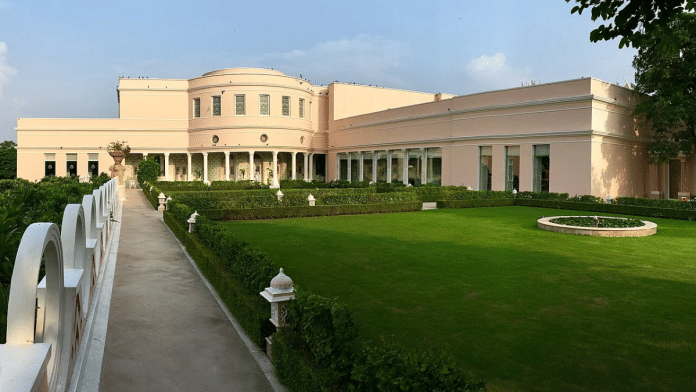
New Delhi: The Jaipur bench of the Rajasthan High Court has dismissed an appeal by the state of Rajasthan and Jaipur Development Authority (JDA) in the decades-old dispute over Man ji Ka Bagh, also known as Raj Mahal Palace, and adjoining land, upholding a 2011 decree in favour of the erstwhile royal family of Jaipur.
In his 6 November judgment, Justice Ashok Kumar Jain dealt with questions ranging from the 1949 Covenant (post-Independence covenant governing Jaipur’s integration into Rajasthan) and Article 363 of the Constitution to limitation, civil-revenue court jurisdiction, land acquisition and the production of new evidence at the appellate stage.
The litigation had earlier drawn the Supreme Court’s criticism, which blamed the State’s “laxity” for dragging the other side “all the way” to the top court and directed the High Court to decide the appeal within four weeks.
The High Court was also critical of the State for prolonging the litigation, observing that its conduct suggested it sought to drag the erstwhile royal family through litigation so that the decree-holders could not “enjoy the fruits of the decree”.
Background of the dispute
The present dispute, brought before the civil court in 2002 by the erstwhile royal family of Jaipur, essentially concerned the ownership of the remaining land after the first acquisition, which the erstwhile royal family claimed as private property, but the State and Jaipur Development Authority (JDA) subsequently sought to treat as government land.
The suit culminated in a 2011 decree in the erstwhile royal family’s favour, which was subsequently challenged by the State of Rajasthan and JDA before the Rajasthan High Court.
The dispute concerned Raj Mahal Palace and its adjoining land in Jaipur, forming part of an estate measuring approximately over 120 bighas.
The erstwhile royal family traced its claim to former Jaipur ruler Maharaja Sawai Man Singh II.
Following Independence, Jaipur merged with other princely states to form Rajasthan in 1949. The 1949 Covenant governing this integration also identified certain properties that would remain the ruler’s private property.
The erstwhile royal family relied on this arrangement to contend that the property historically known as Raj Mahal had been recognised as Sawai Man Singh II’s private property. The property was subsequently transferred to his son Sawai Bhawani Singh through a registered gift deed executed in 1957 on which the erstwhile royal family based their claim.
What complicated the State’s later claim was its own acquisition history. In 1973, acquisition proceedings under The Rajasthan Urban Improvement Act, 1959 were initiated for development of the Raj Mahal area, ultimately resulting in acquisition of approximately 65 bighas from the 120-bigha estate and leaving about 54 bighas with the family.
This was significant because State had then proceeded on the basis that they were acquiring privately held land.
The position changed in the second acquisition. A 1992 notification under the Land Acquisition Act 1894 covered parts of the remaining land, but in 1995 the Land Acquisition Officer treated those parcels as government land and awarded no compensation, resulting in a “zero award”.
Sawai Bhawani Singh also approached the then chief minister in 1995, alleging that the Raj Mahal land had wrongly been recorded as government land and seeking correction of its revenue entries.
The Article 363 question
The State invoked Article 363, arguing that deciding whether Raj Mahal was recognised under the 1949 Covenant would require interpretation of the Covenant, which courts are barred from adjudicating. Article 363 bars courts from adjudicating disputes arising out of pre-Constitution Covenants entered into with rulers of erstwhile princely states.
The High Court rejected the objection, noting that the suit sought to enforce an already-recognised property right, not reinterpret the Covenant. It therefore held that “the defence raised by the State is not only malicious but it is an illusory defence so that court may consider bar under Article 363 of Constitution in an emotional way and just accept the appeal of the State”. Article 363 did not prohibit adjudication of this suit, it concluded.
The 53-year delay argument
The State argued that the suit was barred by Article 58 of the Limitation Act 1963, which allows three years for declaratory relief. According to them, limitation began with the 1949 Covenant, or at the latest with the 1958 revenue settlement, making the 2002 suit about 53 years late.
The High Court disagreed, holding that limitation runs from actual denial or a threat to title, not merely from an adverse revenue entry. Since the authorities continued treating the property as privately held until the 1993 acquisition, the dispute arose only later.
Bhawani Singh thereafter pursued correction before the government and the revenue court, which returned his plaint in 2002 for lack of jurisdiction.
The court excluded the time spent pursuing that remedy and held the civil suit to be within limitation. The Limitation Act permits time spent bona fide pursuing a remedy before a court that lacks jurisdiction to be excluded in appropriate circumstances.
Also Read: Days after Justice Mehta’s letters to CJI, Collegium picks Sanjay Agrawal as Rajasthan Chief Justice
The significance of abadi land
The State argued that the dispute should have been decided by the revenue court rather than the civil court. However, Bhawani Singh had already approached the revenue court in 1997 for correction of the entries. In 2002, the revenue court returned the plaint after finding that the property was abadi land (land used for residential or other non-agricultural purposes).
Since the dispute concerned ownership of non-agricultural land rather than agricultural or tenancy rights, the High Court rejected the objection that jurisdiction lay exclusively with the revenue court under The Rajasthan Tenancy Act, 1955.
The family could not first be denied relief by the revenue court because the dispute was civil in character and then be told that the civil court also lacked jurisdiction because the matter belonged before the revenue court.
Litigation conduct, withholding evidence
The State of Rajasthan remained ex parte before the trial court, filing neither a written statement nor evidence. During the appeal, the State sought to introduce documents relating to the 1995 award under Order 41 Rule 27 of the Code of Civil Procedure (CPC), despite admitting that these documents had already been within their knowledge and possession but were not produced due to officials’ negligence.
The High Court refused to permit additional evidence to fill gaps in the case, describing the attempt as one to “cover up the case and create a new defence” and “only to frustrate the decree in favour of the respondents-plaintiffs”. It further observed that the State’s conduct suggested an attempt to “drag the respondents (the erstwhile royal family) into litigation and prolong it” so that the decree-holders could not enjoy the fruits of the decree.
The High Court was equally critical of the failure to produce original records of the first acquisition, which could have shown how authorities earlier treated ownership of the property. When records were said to be untraceable, the High Court applied the principle that “evidence which could be and is not produced would, if produced, be unfavourable to the person who withholds it,” and drew an adverse inference against the State.
The judgment ultimately turned on the consistency of the State’s own conduct. Having earlier treated the Raj Mahal land as privately held for acquisition purposes, the authorities could not displace the erstwhile royal family’s claim merely through contrary revenue entries and belated defences. The ruling also sends a clear procedural message: an appeal cannot become an opportunity to repair a case that was not properly pleaded or proved at trial.
(Edited by Nardeep Singh Dahiya)
Also Read: Rajasthan High Court’s rare husband-wife bench orders 46 years of pension arrears for IAF veteran