





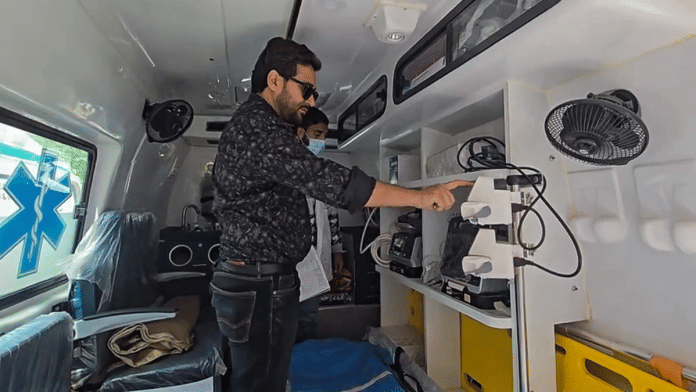


New Delhi: The Supreme Court last week issued interim directions to states to overhaul trauma care for road accident victims across the country, including creating a unified emergency response system, fixing ambulance standards and operationalising cashless accident treatment.
A bench of Justices J.K. Maheshwari and Atul S. Chandurkar said that Article 21 of the Constitution, which guarantees the protection of life and personal liberty, included the right to timely trauma care while adding that the speed of response in such accident cases was critical. “In such a situation, every minute spent without medical intervention or urgent care significantly narrows the scope for survival. Swiftness is quite literally like medicine,” the court said.
The order, passed in the SaveLIFE Foundation v. Union of India case on 26 May, is the latest step in a decade-long effort by the petitioners for improved road safety and a rights-based approach to emergency care.
Road safety organisation SaveLIFE Foundation filed the petition in 2024, arguing that the right to trauma care was an integral part of the right to life under Article 21, and that the Union and States had consistently failed to build the infrastructure to fulfil that right.
The petition pointed to gaps in the emergency response chain, such as the absence of a single, integrated emergency number, the lack of GPS tracking in ambulances, the lack of state trauma registries, uneven paramedic training, and the near-total absence of cashless treatment for accident victims.
Previously, a petition by the organisation in 2016 had resulted in the ‘Good Samaritan’ judgment in SaveLIFE Foundation v. Union of India, which endorsed the Ministry of Road Transport and Highways’ guidelines on civilian responders to road accidents. Those guidelines were subsequently enacted as Section 134A of the Motor Vehicles Act (MVA).
In 2024, the foundation returned to court arguing that the legislative commitment had not translated into ground-level implementation. The court then built on its 2016 judgment in the latest order.
Emphasising the need for urgency in road accident response, the court observed that “the initial response and first aid being perhaps the most crucial… A robust mechanism for trauma care, therefore, must take a bottom-up approach, which accounts for various stakeholders”.
“From the responses of the States and UTs, there appears to be willingness to progressively implement the schemes and policies of the Union and bring about uniformity in respect of trauma care, yet implementation is fragmented and its status differs from one place to another,” the court said.
“A uniform and robust system of trauma care, steps towards its progressive realisation and increasing public awareness are well- intentioned and may turn out to be absolutely critical in reducing preventable deaths,” it added, issuing nine directions.
Also Read: Kanpur Lamborghini crash: Pan masala baron’s son booked, day after FIR against ‘unidentified person’
The nine directions
Helpline integration in three months: All states and UTs must complete full technical and operational integration of all emergency and ambulance helplines—100, 101, 102, 108, 1033, 1091, and others—into the universal emergency number 112. Concurrent mass-media publicity of 112 must be undertaken.
Good Samaritan grievance redressal in three months: Functional grievance redressal systems, both physical and digital, must be established, with nodal authorities designated at the state and district level. Monthly meetings must be held and minutes uploaded on relevant government portals.
National medical rescue protocol with three months for issuance, and a further three months for operationalisation: The Union must issue a standardised medical rescue protocol covering the response chain from the crash site to hospital transfer. States must operationalise it within three months of its notification.
Ambulance standards and GPS integration in three months: All ambulances, public and private, must achieve full compliance with Automotive Industry Standard 125 (AIS-125). GPS and Vehicle Location Tracking Devices must be fitted and integrated in real time with helpline 112. Periodic structured audits covering response times, quality of care, equipment, and patient outcomes must be conducted and reported to a designated Union-level authority.
EMT curriculum adoption in three months: The National Commission for Allied and Healthcare Professionals has already notified a standardised curriculum for Emergency Medical Technicians. States must now adopt it, align their training institutions, and certify personnel under it.
State Trauma Registries with eight weeks for Union guidelines and then four months for state registries): Ministry of Health and Family Welfare (MoHFW) must issue data-format guidelines for a national Trauma Registry. States must then establish their own registries in conformity, covering all medical facilities and link them to a Coordinated Trauma Registry.
Hospital grading in three months: States must grade and designate all medical facilities, public and private, for trauma readiness in accordance with MoHFW guidelines. The court expanded the geographic scope of this exercise beyond National Highways to State Highways, Major District Roads, and urban and peri-urban areas.
PM RAHAT operationalisation in eight weeks to three months: The court treated the Union’s PM RAHAT (Cashless Treatment of Road Accident Victims) Scheme, 2025 as the answer to the petition’s plea for cashless treatments. States must fully operationalise it within the specified timeline, with the court warning that non-compliance would amount to a statutory violation.
Mass-media campaigns in one month: The Union and all states must run sustained, structured, multilingual campaigns to educate the public about the 112 helpline, Good Samaritan protections, the grievance redressal system, and the PM RAHAT scheme.
The federal issue
The case also raised a constitutional question about public health, hospitals, ambulance services, police, and public order, which fall under List II (State List) of the Seventh Schedule.
Attorney General R. Venkataramani argued that the Union had already acted as an enabler by framing national policies and schemes, including PM RAHAT, the Rah-Veer scheme, Good Samaritan rules, the National Ambulance Code, the NELS curriculum, ERSS-112 and MoHFW trauma guidelines, but that implementation across states and UTs had been “scanty and fragmented”.
He suggested that the court direct states to implement what the Centre had already put in place, with time-bound compliance reporting. The court’s directions broadly follow that model, treating the Union as a standard setter and the states as the primary implementers.
To ensure compliance, the court directed that the order be sent to the chief secretaries of all states and Union Territories. The matter has been listed after four months for further directions based on compliance reports.
The Attorney General was requested to collate incoming compliance reports and present structured suggestions to the court on pathways to effective national implementation so that the “public cause as espoused may be ventilated in right earnest”.
The bench thanked the Attorney General and the petitioners’ counsel for assisting the court in what it described as “a pro bono cause which has massive public interest implications”.
Saumya Sharma is an alum of ThePrint School of Journalism, currently interning with ThePrint.
(Edited by Sugita Katyal)
Also Read: Haryana youth died in road accident just before joining new job. Why HC tripled compensation to kin