





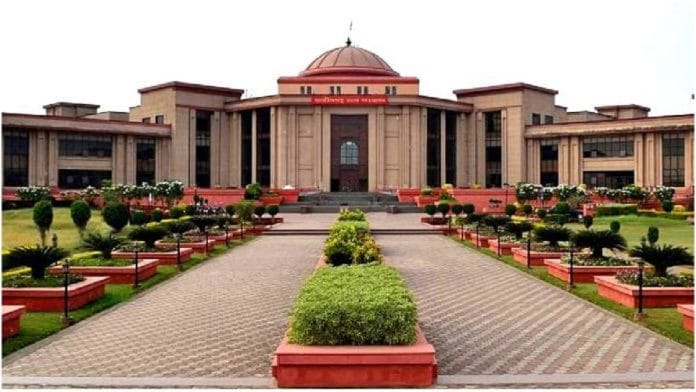


New Delhi: The Chhattisgarh school education department’s order of 12 June mandating daily recitation of mantras in government schools does not contain any coercive direction compelling students to act against their faith or conscience, the state’s high court has held.
The issue raised before the court was whether the order, issued to coincide with the 2026-27 academic session, infringed fundamental rights by compelling students from minority communities to participate in rituals associated with a particular faith.
Justice Amitendra Kishore Prasad observed that the directive, read in its entirety, disclosed no express requirement obligating students to participate in activities that would interfere with their constitutionally protected freedom of religion or freedom of conscience.
The petitioners, two former Cabinet ministers and a minority trust president, challenged the school education department’s directive mandating recitation of the National Anthem, National Song, Deep Mantra, Saraswati Vandana, Guru Mantra, Gayatri Mantra, Shanti Mantra, Rajya Geet, etc. in state‑funded schools.
They argued that compulsory chanting of mantras associated with Hindu traditions violated Articles 14, 21, 25, 28(1), 29 and 30 of the Constitution.
Their contention was that minority students would be compelled to participate in rituals alien to their faith, thereby infringing equality, liberty, and freedom of conscience and right to practice their religion. It was also argued that the direction is contrary to the constitutional mandate of secularism, and that such forced actions by the government cannot be allowed in a democratic country.
Article 28(1), which prohibits religious instruction in institutions wholly maintained by the State, was central to their challenge. They also invoked minority rights under Articles 29 and 30, arguing that the directive undermined cultural identity and educational autonomy.
The state countered that the directive was aligned with the National Education Policy (NEP) 2020, which integrates Indian knowledge systems to foster cultural awareness. It stated that it operationalised these national academic goals within its valid executive domain under Article 162 of the Constitution, and such policy measures cannot be labelled unconstitutional or communal.
It stressed that the order was not coercive: terms like “compulsory” and “ensure” related to school discipline, not religious compulsion. No punishment was prescribed for non‑participation and the academic session was running smoothly without any complaints or objection from any student, parent or teacher.
It relied on Article 51A, which obliges citizens to preserve composite culture, to justify the policy.
What HC said
The court noted that Article 28(1), “in state funded institutions, bars teaching of religious customs, rituals, and worship, but does not prohibit moral or cultural instructions which remains an essential part of training in citizenship, maintenance of law and order in the state and growth of social cohesion.”
It emphasised that petitioners failed to place any relevant material on record to show violation of any fundamental rights as no individual or direct injury has been shown.
“The contents of the order do not disclose any express requirement obligating students to participate in any activity that would interfere with their constitutionally protected freedom of religion or freedom of conscience,” it added
The writ petition was dismissed as premature. The court, however, reserved liberty for the petitioners to file a fresh petition with cogent material if actual coercion or violation arises in future.
Alfreza Ahmed is an alum of ThePrint School of Journalism currently interning with ThePrint.
(Edited by Nardeep Singh Dahiya)
Also Read: Online gambling an organised crime with serious impact on economy & society—Chhattisgarh High Court
Recital of Hindu mantras in Govt aided schools
runs contrary to plurality and individual religious right as enshrined in our constitution and the nod from judiciary is unhealthy.