



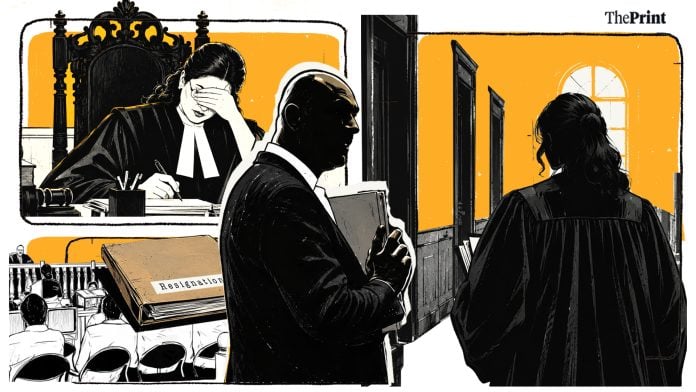
New Delhi: In July 2022, when Odisha Judicial Officer Ipsita Mohanty was transferred to Hindol in Dhenkanal district, she could not find any autism healthcare facilities and trained therapists for her son, who suffers from complex neurological issues, speech inability, and self-harming behaviour. In September that year, she sought a posting at Bhubaneswar headquarters for two-and-a-half years for his treatment, where she could provide him continuous therapy and treatment at specialised centres.
Her representation was eventually deferred by the High Court Standing Committee, with no communication on any decision.
Mohanty submitted a letter on 29 November, requesting permission to resign. However, following medical advice that her son required long-term therapy, and amidst her marriage dissolution proceedings, she formally withdrew her resignation on 21 December. Her withdrawal was submitted well in time, but the Governor of Odisha approved a Full Court’s recommendation days later to accept her resignation, and the Law Department relieved her from service.
While the Odisha High Court has now reinstated her, saying that there was no valid resignation for the Governor to accept, her case is a window into the struggles women judicial officers often face.
Women judges have often found themselves negotiating with—and sometimes fighting—the very institution they serve: over motherhood, childcare, transfers, performance assessments, and termination. This begs the question: What happens when a woman judicial officer’s life collides with the institution’s administrative rules?
And while the scrutiny they are subjected to can sometimes lack gender sensitivity, allegations and reports of harassment—sexual or mental—are not rare, and are often accompanied by the pressure to ‘prove’ them.
‘Sexual harassment’, and an illegal transfer
In 2014, an Additional District and Sessions Judge in Madhya Pradesh approached the Supreme Court alleging sexual harassment and surveillance by a sitting judge in the MP High Court, Justice S.K. Gangele. With 15 years of experience as a lawyer in Delhi, she qualified for being a judge in 2011.
She was invited to the 25th marriage anniversary party of the high court judge, which she went to with her two daughters. There, she alleged, Gangele was “eager” to dance with her to an “item-song”. When she “politely refused”, he “came close to her and whispered in her ear, that he missed the opportunity of viewing her sexy and beautiful figure dancing on the floor”, she said.
In a different marriage party three months later, Gangele allegedly told the woman judge, in the presence of her 16-year-old daughter, “Your work is very good, but you are far more beautiful than your work… one does not desire, even to blink one’s eyes.” All this, with his hand on her back, according to the woman judge’s petition.
This was followed by intense “surveillance” on her courtroom and herself by the Gwalior District Judge—during work, during lunch hours and even post working hours at times—which, she claimed, was being done “only to harass” her as she did not give in to Justice Gangele’s advances.
The petitioner judge was transferred mid-session in July 2014—while all other transfers were done in March-April—to Sidhi, where she said it would be difficult for her to work as it was a remote naxal-affected town in the state at the time.
Under the transfer policy, a judicial officer must be transferred from Category ‘A’ city to Category ‘B’ city, from ‘B’ to ‘C’, ‘C’ to ‘D’, and ‘D’ to ‘A’. However, the petitioner was directly transferred from Gwalior (Category ‘A’) to Sidhi (Category ‘C’).
A day after receiving her transfer notice, she gave a representation to the Registrar General of the High Court, seeking an eight-month extension as her daughter was to appear for her Class 12 board examinations that year.
Having submitted the representation, she pleaded with Justice Gangele himself in his capacity as Administrative Judge of her Sessions Division that her transfer be deferred for the sake of her daughter. However, she alleged in her petition, the judge “mockingly” reacted to her request, saying that she “had not fulfilled his desires”, or “visited his residence alone to meet him even once”, which is why she had been transferred. He allegedly warned her he “would finish her career completely”.
With her representations rejected by the Transfer Committee and her transfer approved by the Chief Justice of the Madhya Pradesh High Court, she tendered her resignation, with no reference to the alleged sexual harassment, and only citing her daughter’s exam.
Then Chief Justice of India R.M. Lodha found out about the nature of the allegations via a report by The Times of India, after which she wrote to him.
A Supreme Court bench of Justices Jagdish Singh Khehar and Arun Mishra were fully satisfied that the usual ‘in-house procedure’ strictly by involving the High Court Chief Justice would not serve any purpose in fairness there, leaving it to the CJI to determine what needed to be done as no other procedure had been established by law.
The CJI ordered a preliminary inquiry by then Chief Justice of Karnataka High Court, after which he constituted an in-house Committee led by then Chief Justice of Allahabad High Court that submitted its report in July 2015.
Meanwhile, a Notice of Motion for the removal of the accused HC judge was moved by 58 MPs in Rajya Sabha. A Judges Inquiry Committee (JIC) came to be constituted, which submitted its report in December 2017. Justice Gangele was cleared of the sexual harassment charge, with the JIC concluding that the specific accusations were “not proved beyond reasonable doubt”. The report did although note that he was “ambivalent and evasive about facts which are within his knowledge”, referring to his failure to make a “clean breast of the situation” regarding what he knew about the overall workplace interactions and environment.
However, the JIC found that the petitioner woman judge’s transfer to Sidhi was irregular and made it unbearable for her to continue in service, leading to her resignation. Therefore, in the interest of justice, it said, the petitioner should be reinstated if she intended to rejoin.
In 2022, another bench of the top court heard her case, where her transfer order being illegal and mala fide was argued, not the sexual harassment allegations. The Supreme Court directed that she be reinstated, observing that her resignation could not be construed as voluntary, and setting aside the acceptance of her resignation.
Also Read: How CJI Surya Kant’s new gender sensitivity handbook differs from DY Chandrachud’s
‘Dirty secret’
Just last month at a public lecture, senior advocate Indira Jaising, who represented the woman judge before the apex court in 2022, described sexual harassment in the judiciary as a “dirty secret” that few are willing to discuss.
Speaking to ThePrint, she noted the judiciary’s internal hierarchy itself could leave judicial officers vulnerable because the same judges who exercise supervisory authority can also influence their careers. “The structure is built into our regulatory system. The high court is in charge, and this supervisory power can be a great threat to the well-being of judges. Their annual confidential reports are written by these very judges.”
Adding that she had repeatedly seen cases where the judge responsible for writing a judicial officer’s Annual Confidential Report (ACR) was also in a position to harass or otherwise exert pressure on the officer, Jaising said, “In the case that I represented, which we ultimately succeeded in, the unfortunate part was that the mindset of putting down women judges ran across the Full Court.”
She noted that in this case, the Full Court had twice opposed the woman judicial officer’s return to service, pointing to a “pattern of solidarity among male judges that comes through very clearly”.
The senior advocate further said there was also a reluctance within the judiciary to acknowledge sexual harassment by one of its own. “They seem to experience some kind of threat perception if they allow even a single person to be acknowledged as having faced sexual harassment. That is almost the pattern.”
On the mechanisms for dealing with sexual harassment complaints by judicial officers, Jaising said the committees constituted within judiciary had not always provided an adequate remedy. In the MP judicial officer’s case, she recalled how she challenged the committee set up by the high court because it consisted only of judges of the very high court. “We went to the Supreme Court, and the Supreme Court said that the three-judge committee should include judges from outside the High Court.”
The argument that finally succeeded in court was that a woman cannot be compelled to choose between her work and her child, her duty to self and to child, she said. “That false choice made it a forced resignation.”
However, according to her, even that did not necessarily solve the problem. “Again, we drew a blank. Justice D.Y. Chandrachud held that she was not able to prove [the sexual harassment allegations]. I don’t know what he meant by ‘prove’.”
On a possible solution to the deeper institutional problem, Jaising said, “Perhaps what you need is an outsider who is not a judge, similar to Vishaka”.
Vishaka guidelines were issued by the Supreme Court in 1997 on addressing sexual harassment at workplace. An independent member outside the judiciary should be part of the mechanism, Jaising suggested, drawing a parallel with the Vishaka framework.
A letter seeking permission to end life
In December 2023, a woman civil judge in Uttar Pradesh wrote an open letter to then CJI D.Y. Chandrachud, calling the Sexual Harassment of Women at Workplace Act, 2013 (or the POSH Act) “a big lie”. She sought permission to end her life after an inquiry into her complaints against a district judge and his associates “saw little headway in over a year”.
Advising working women in India to “learn to live with sexual harassment”, she wrote, “I have been sexually harassed by one particular district judge and his associates. I was told to meet the district judge at night. I complained to the Honourable Chief Justice of Allahabad High Court and the administrative judge (High Court judge) in 2022. No action has been taken till date. No one even bothered to ask me ‘What happened, why are you distressed’.”
After the CJI sought a status report on the same from the Allahabad High Court regarding this, she filed a writ petition before the top court seeking fair administration of her case.
But the top court dismissed her plea noting that the proceedings under the Internal Complaints Committee of the high court were already underway.
Also Read: Bias, burnout & lack of infra: SCBA survey lays bare struggle of women lawyers in India
‘Ache of betrayal’
In 2025, Aditi Gajendra Sharma, a judge in Madhya Pradesh, had resigned after her senior district judge—who she had accused of caste-based discrimination and mental harassment—was elevated for high court judgeship.
Naming the judge, Justice Rajesh Kumar Gupta—who currently holds the Gwalior Bench—Sharma had declared that she was resigning with the “ache of betrayal—not at the hands of a criminal or an accused, but at the hands of the very system I swore to serve”.
In her letter, she had described being subjected to “unrelenting harassment, not merely of the body or the mind, but of my dignity, my voice, and my very existence as a woman judge who dared to speak up”.
She had served representations opposing his elevation before the President, the Supreme Court Collegium, the Ministry of Law and Justice and even the Chief Justice of the MP High Court (part of the Collegium which had appointed Gupta). “Let this letter haunt the files it enters. Let it whisper in the hallways where silence once reigned,” she had written.
In 2023, six female judicial officers were terminated from service by the Madhya Pradesh government based on the recommendations of the High Court’s Administrative Committee, based on their ACRs, assessment charts, and “consistent poor performance” of the officers. The recommendations were approved by the Full Court. Sharma was one of them.
Three of the officers, including Sharma, had challenged the termination order by writing to then CJI Chandrachud, who took suo motu cognisance of the matter.
The top court requested the High Court Full Court to reconsider, after which four of the officers were reinstated. Sharma and another judge still stood terminated, who then came before the Supreme Court, which eventually found that Sharma’s miscarriage during service in 2021 had had a negative impact on her case disposal numbers. Also, in this period, she was assigned a vacant court, where the disposal rate in civil matters is naturally low because judicial officers must restart proceedings from scratch, sometimes from the notice issuance stage.
In 2025, the Supreme Court had finally set aside the termination of the two officers, ordering the MP government to reinstate them within 15 days, but adding that they would not be entitled to any back wages for the period they were not in service, and monetary benefits for the same would only be calculated notionally for pensionary benefits.
In the order, Justice B.V. Nagrathna’s bench had also highlighted how a gender-sensitive environment is required for women judges.
“Some women judges even have to take painkillers just to be able to work all day during certain times of the month,” Justice Nagarathna had said. “Psychological consequences (of a miscarriage) include an increase in the risk of anxiety, depression, post-traumatic stress disorder, sometimes leading to suicides…the psychological and social effects may be more severe and long lasting. A miscarriage affects a person’s identity, leading to disappointments and challenges to motherhood identity and role, stigma and isolation, amongst other aspects.”
Former district judge-turned-advocate Kamini Lau noted how the decision stressed the need for a sensitive working environment for women judicial officers. First practicing as an advocate, Lau had become an Additional District Judge, retiring from Delhi Higher Judicial Services (DJHS) in 2024 after serving for 32 years.
“The informal culture matters equally,” she told ThePrint, adding that maternity, childcare or family responsibility should never translate—explicitly or subtly—into an assumption that a woman is less committed or less suited for demanding assignments. Motherhood, Lau said, cannot become an invisible adverse entry in a judicial officer’s career.
But Sharma’s resignation came anyway, just months after reinstatement.
Difference between simple termination & stigmatic action
Rajasthan judicial officer Pinky Meena, who comes from the Scheduled Tribes community, had overcome significant societal hurdles and fought illness—lymphadenopathy tuberculosis—to qualify for the judicial service. With degrees in B.A., B.Ed., LL.B., and LL.M., she had completed her judicial training “with flying colours”. However, her service was abruptly terminated in May 2020 during probation over administrative allegations surrounding non-disclosure of her prior teaching job.
In 2025, the Supreme Court quashed the discharge order, ordering her immediate reinstatement with full consequential benefits.
While the Rajasthan High Court had treated the termination as routine discharge of a probationer, the apex court held that terminating an officer based on alleged misconduct without a fair inquiry was punitive and stigmatic.
Explaining the difference between simple termination and stigmatic action, the bench of Justices Nagarathna and S.C. Sharma said, “Stigma is indicative of a blemish, disgrace indicating a deviation from a norm.” Denying her a proper hearing violated the principles of natural justice and constitutional protections, they ruled.
Highlighting the broader mandate of gender representation, the Supreme Court emphasised that women judges enhance judicial decision-making and break gender stereotypes. Praising her determination, the court noted that she had “shown great perseverance by fighting societal stigmas and gaining a rich education that will ultimately benefit the judicial system and the democratic project”.
When a Jharkhand judicial officer sought childcare leave
In Jharkhand, Additional District Judge Kashika M. Prasad, a single mother, had sought Child Care Leave (CCL) for roughly six months to support her son, who was preparing for his Class 12 examinations. When the Jharkhand High Court initially did not grant the full leave, she approached the Supreme Court.
In June 2025, the bench led by Justice B.R. Gavai asked the high court to reconsider the request “favourably”, observing that it acts as a parent to judicial officers.
The high court subsequently granted her 92 days of CCL, after which she raised further grievance before the Supreme Court, alleging that adverse ACR remarks had been made after she had approached the court over childcare leave. The top court issued a notice on that additional grievance.
On childcare and the difficulties faced by women working in the legal system, Jaising said the issue went beyond leave policies. The senior advocate, who had filed and successfully defended a petition in the Supreme Court for a creche in 2015, said, “Childcare is huge. It’s really huge”.
Recounting how the petition came to be, she said that one of her juniors had brought her child to court because she had no alternative arrangement. Her domestic help and the child had to sit under a tree.
The Supreme Court initially identified a small space for the facility, but the judges later rejected it after inspecting the proposed site, Jaising said. Ultimately, Justice Ranjan Gogoi, along with his colleagues, ensured that an adequate space was provided within the Supreme Court premises. She said the facility is now being used not only by lawyers, but also by Supreme Court staff, who are “very grateful for the effort”.
Back in 2000, in case from Lucknow’s district court, the Allahabad High Court had decided that denying maternity leave to a judicial officer just because of the temporary/ad hoc nature of her appointment would amount to sex discrimination.
On supporting infrastructure and inclusivity, Lau told ThePrint that there has been improvement, particularly in metropolitan cities and newer court complexes, but the experience of Delhi or other major cities cannot be the benchmark for the country. The real test, she said, is the district judiciary in smaller towns and remote areas—safe washrooms, residential accommodation, security, transport, childcare and basic working facilities.
She asserted that the concern is not anecdotal, pointing to the Centre’s reply in Rajya Sabha in February 2025, when the government was specifically asked about female-friendly district court infrastructure. The government had acknowledged that no district-wise data on female-friendly infrastructure was available at the Centre, leaving these matters primarily to states and respective high courts.
Lau highlighted that the Supreme Court constituted a Judicial Infrastructure Advisory Committee on 12 May this year to work towards a “unified infrastructural ecosystem on a pan-India basis”. “That is welcome, but it is also noticeable that there is no woman on the Committee as presently constituted. When we speak of inclusive infrastructure, women should also have a voice in designing it”, she remarked.
She called for a pan-India gender audit of judicial infrastructure, minimum standards for sanitation, security, residential accommodation and childcare, equitable work allocation, contextual rather than purely numerical performance assessment, timely and transparent ACRs, mentoring and greater participation of women judicial officers in institutional decision-making.
“Having spent around 32 years within the district judiciary, I believe the issue is ultimately quite simple. Women are not asking for lowered standards or preferential treatment. They are asking for an equal institutional environment in which they can work, be assessed on merit and progress. Equality must not stop at the doors of metropolitan court complexes. It must reach the woman judicial officer serving in the smallest and most difficult district posting in the country”, she said.
(Edited by Mannat Chugh)
Also Read: Women have entered Odisha district courts in good numbers. Problem is the promotion pipeline