


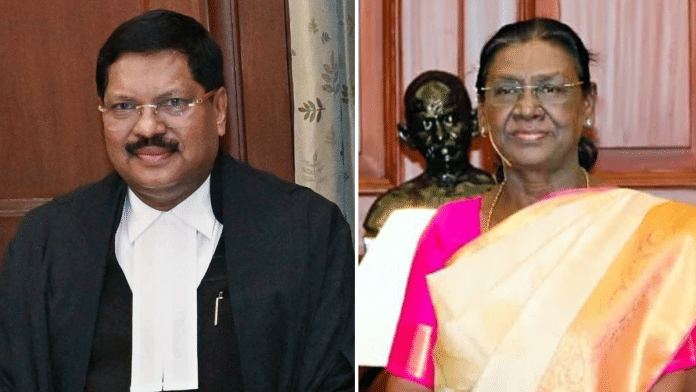
New Delhi: Former Chief Justice of India (CJI) B.R. Gavai has written to President Droupadi Murmu over what he calls a “worrying trend” in judicial elevations and transfers that compromises diversity, inclusion and merit in India’s higher judiciary.
Sending the unprecedented and pointed communication to Rashtrapati Bhawan as a “concerned citizen”, Justice Gavai—who previously led the judicial appointment body—declared that the functioning of the Supreme Court Collegium is “now questionable”. In a three-page letter dated 27 November 2026, with copies marked to Prime Minister Narendra Modi and Law Minister Arjun Ram Meghwal, the former CJI stated he writes not in anger, but out of a sense of responsibility regarding recent developments that disregard equitable representation.
The second Dalit and first Buddhist CJI, Justice Gavai served from 14 May 2025 to 23 November 2025, a tenure of over six months.
A single community making up under 5 per cent of the population in India secured over 40 per cent of Supreme Court judgeships, Justice Gavai said in the letter, without specifying any one community. The former CJI believes that candidates from one particular section of society are being favoured to the detriment of marginalised groups, including Scheduled Castes, Scheduled Tribes, Other Backward Classes, minorities, and women, as well as other forward sections.
During his own tenure heading the collegium, Justice Gavai has noted how he strictly adhered to diversity and inclusion, striving to strike a balance among all sections of society. Circumstances now point to recommendations made with a primary focus on “appeasing and rewarding a single community”, he said.
Citing parliamentary records from March 2025, he noted that out of 715 High Court judges appointed since 2018, only 22 belonged to Scheduled Castes, 16 to Scheduled Tribes, 89 to Other Backward Classes, and 37 to minorities. Further, between January 2021 and January 2026, forward communities accounted for nearly 80 per cent of appointments, whereas OBCs—comprising almost half the population—received under 14 per cent.
Highlighting arbitrary high court transfers, Justice Gavai revealed that hard-working judges have faced punitive transfers to smaller courts, while others were rewarded with prominent postings based on community ties rather than merit. Referencing Professor George Gadbois’s landmark study which showed that one community held over a third of all Supreme Court judgeships between 1950 and 1989, he warned that unexamined ideas of who “looks like” a Supreme Court judge continue to persist.
Request for presidential intervention
Turning to constitutional provisions, Justice Gavai pointed out that Article 124(2) explicitly vests the appointment of Supreme Court judges in the President of India. He stressed that while judicial interpretations over recent decades have made collegium recommendations decisive, this “has not made the collegium unaccountable, nor it has relieved your high office of the President of the Republic of India of its duty to preserve protect and defend the Constitution”.
In his direct plea to Rashtrapati Bhawan, the former CJI clearly specified what action he expects from the President. Justice Gavai wrote: “I earnestly request you to acknowledge the issue at hand and intervene in the matter as you may deem appropriate to ensure all are reminded of constitutional duty of equal representation in one of the most significant pillar of Indian democracy.”
Reaffirming that the executive and legislature are equal stakeholders in judicial appointments, he urged immediate intervention to uphold equal representation across constitutional courts.
(Edited by Nardeep Singh Dahiya)
Also Read: Days after Justice Mehta’s letters to CJI, Collegium picks Sanjay Agrawal as Rajasthan Chief Justice
Excellent. This is what we want. Bravo CJI Gavai!
The Indian judiciary must get embroiled in a civil war – turn on each other and tear themselves to bits.
That would give the current government an easy time – at least for the next five years. The SC has been a thorn on it’s side for far too long.
Idiots like Sibal, Jaisingh, Singhvi and others have used their legal connections and networks to repeatedly create problems for the Union govt. And to protect Opposition ruled State governments from SC reprimand and scrutiny.