




New Delhi: Can a non-Indian Hindu, also an Overseas Citizen of India (OCI) cardholder be denied registration of marriage under the Hindu Marriage Act (HMA) through an executive order?
This question of law was raised before the Delhi High Court Wednesday by a 29-year-old woman—an OCI card holder based in Sweden, who is demanding registration of her marriage with a fellow Swedish man in Delhi. She has argued that her spouse had embraced the Hindu faith and their marriage was solemnised according to Hindu rites in her family’s presence.
However, Delhi government rules for marriage registration under the Hindu Marriage Act (HMA) require at least one spouse to be an Indian citizen.
At the heart of the legal battle are the revenue department guidelines and the Delhi (Compulsory Registration of Marriage) Order, 2014. According to her petition, these executive instructions mandate that for a marriage to be registered, at least one of the parties must be an Indian citizen and have permanent residence within the jurisdiction of the concerned marriage officer.
The woman has challenged these Delhi government guidelines arguing that the executive cannot impose citizenship conditions absent in the Hindu Marriage Act (HMA), 1955.
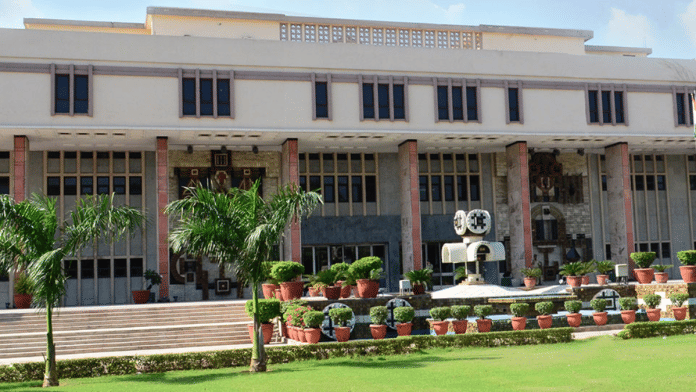
A division bench of Chief Justice D. K. Upadhaya and Justice Tejas Karia Wednesday heard the case and reserved their order.
During the hearing, counsel for the petitioner, advocate Shasha Jain contended that these requirements are nowhere to be found in the parent legislation, the Hindu Marriage Act.
The petition states: “Once a marriage satisfies the statutory requirements of the Hindu Marriage Act, 1955, the executive cannot, by issuing administrative guidelines, introduce additional substantive eligibility conditions requiring that one of the parties must be an Indian citizen.”
It further argues that these restrictions are “wholly alien to the statutory scheme” and have the effect of excluding a valid class of marriages from legal recognition.
The opposing counsel stated a remedy: The Special Marriage Act (SMA)—which has no guidelines regarding nationality. However, advocate Jain noted that under SMA, both parties are compelled to stay in India for 60 days. And in this case, the petitioners did not wish to do that, leaving them “remediless”.
At this juncture, the court noted that “not all fundamental rights are available to foreign nationals”, before reserving their order.
The petitioner argues that the executive guidelines are ultra vires (beyond the legal power) of the parent Act because the HMA does not distinguish between citizens and non-citizens. She states that the HMA focuses on the “faith of the parties” (governing marriages between two Hindus) rather than their nationality.
Once a marriage satisfies the essential conditions of the HMA, the executive cannot introduce “additional substantive eligibility conditions” like citizenship via administrative instructions.
The petitioner contends that since her marriage fulfilled the requirements of Sections 5 and 7—which are the necessary ceremonies and rites for solemnisation—she is legally entitled to registration under Section 8, which governs the registration of marriages, without the added burden of citizenship or local permanent residency requirements.
Technological barriers and Aadhaar requirements
The petition highlights a significant practical hurdle: The online marriage registration portal maintained by the Delhi government permits access only through Aadhaar-based authentication, a credential the petitioner, as a foreign national, cannot obtain.
The petition describes this as a systemic failure, emphasising how this technological limitation leaves foreign nationals “effectively denied access to the statutory process” despite being legally entitled to seek registration.
Despite repeated representations before the SDM and the fact that the marriage was validly solemnised in Delhi, the petitioner claims that authorities have failed to provide an alternative registration mechanism, such as a “DEO Login” or video conferencing for appearance.
Beyond her individual case, the petitioner is seeking a comprehensive overhaul of how the Delhi government handles marriages of non-citizens. Her plea seeks a declaration that citizenship and permanent residence requirements in the revenue department guidelines and the 2014 order are “arbitrary, discriminatory, ultra vires and unconstitutional”. Plus, a direction to authorities to facilitate and complete the registration of her marriage.
(Edited by Viny Mishra)
Also read: Union of ST couple married with Hindu rituals falls under Hindu Marriage Act. What Delhi HC said