





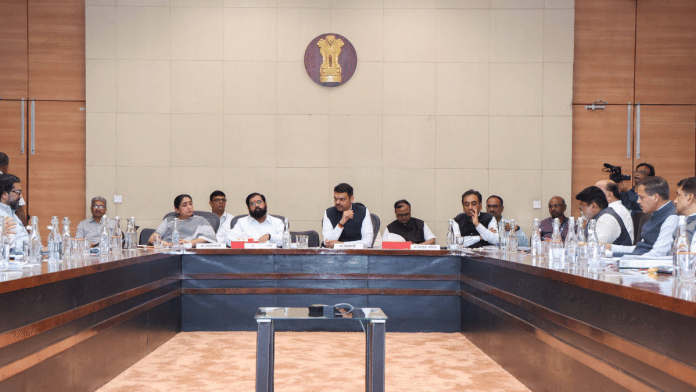

New Delhi: Nearly three years after the Bombay High Court ruled that the chief minister cannot review or modify a decision taken by a minister under the Rules of Business, the Maharashtra government has framed new rules enabling the CM to override any decision, provided that the action is in public interest and the reasons are recorded in writing.
This development comes in the backdrop of the state government’s General Administration Department notifying on 14 August the Maharashtra Government Rules of Business 2026.
Essentially, the 2026 Rules seek to replace the erstwhile Maharashtra Government Rules of Business 1975, which came into force on 1 July 1975, with the objective of governing the classification, distribution and transaction of state administrative and ministerial work.
More importantly, however, Rule 13(5) of the amended rules states that the chief minister can intervene in any minister’s decisions, as long as he provides reasons for the intervention in writing and considers it necessary in the public interest. The only exception has been carved out for judicial matters.
Will it work?
However, legal experts are divided over whether the provision is constitutionally sustainable, with some arguing that it could alter the balance of power within the Council of Ministers, while others say the new Rules merely fill a gap identified by the Bombay HC.
According to legal and constitutional experts ThePrint spoke to, the amended rules could potentially allow Fadnavis to override any decision taken by any minister. Former Lok Sabha Secretary General PDT Achary told ThePrint that while the chief minister cannot unilaterally change a decision made by the Council of Ministers, “he still has the power to modify or alter individual decisions of a minister”.
Former civil judge-turned-lawyer Bharat Chugh took a different view. The CM is the head of the Council of Ministers and “not an appellate authority sitting over it”, he said. “Under our scheme, a minister’s decision in an allotted subject is in law a decision of the government, not of that individual, and the constitutional device for correcting it is reference to the Council of Ministers, which alone is collectively responsible to the House under Article 164(2).”
According to him, Article 167(c) provides that where a minister has decided a matter that the Council has not considered, the remedy is to place it before the Council. A Rule of Business framed under Article 166(3), he said, can reserve classes of cases for the CM, or require files to be routed through him, or reallocate business. But it cannot “convert a Cabinet system into a chief-ministerial one by making one minister’s personal satisfaction the final word on the whole field of executive business”.
Chugh said Rule 13(5) could survive a challenge only if it is read down as a power to recall and stay a minister’s decision and place the matter before the Cabinet, rather than allowing the chief minister to substitute his own view for that of the government.
Also Read: Preity Zinta vs Google, Meta, X: Why Bombay High Court’s nod to her AI deepfake suit matters
‘Not neccessarily unconstitutional’
Advocate on Record at the Supreme Court Vikram Hegde, however, said the rules cannot necessarily be viewed as unconstitutional, merely because they give the CM overarching authority over individual ministers. “Rules of business which give an overarching power to the chief minister over and above Cabinet ministers are not necessarily illegal or unconstitutional,” he said.
Hegde said the principle of collective responsibility means “that each minister is responsible for every decision of the government”, and that “depending on the circumstances, the chief minister, as the primus inter pares (first among equals), may have to step in to ensure uniformity and cohesiveness in the decision-making process”.
While Article 166 of the Constitution empowers the Governor to make rules for the smooth transaction of government business and for the allocation of business among ministers, experts say the amended rules appear to be a direct response to a 2023 ruling of the Bombay HC, where a two-judge bench quashed an 2002 order passed by then CM Eknath Shinde staying the Chandrapur District Central Cooperative Bank’s (DCCB) recruitment process.
Hegde also pointed to the significance of Article 166 in assessing the new rules. “Article 166 provides for making rules which make for convenient transaction of business.”
In doing so, the court had held that the Governor has the power to allocate business among the ministers, on the chief minister’s advice, and the concerned minister would be in charge of that particular department. “There is no dispute that portfolio of co-operation has been assigned to a separate minister, meaning thereby, that the said department was not retained by the chief minister,” the court clarified in setting aside the 2022 order.
Commenting on the high court ruling, Delhi-based lawyer Arpit Goel said the new rules appear “to be a direct response to the Chandrapur Bank case”, where the court said that the chief minister has no independent power to review or modify the decision taken by the minister in charge of a particular portfolio.
“Rule 13(5) of the new rules purports to give the CM the power to override any minister’s decision ‘in the public interest’, barring judicial matters, with reasons recorded in writing. This is constitutionally unsustainable,” Goel told ThePrint.
“Article 163(1) of the Constitution also vests executive power in the Council of Ministers, with the CM at the head, first among equals, not a super-minister with an independent veto over colleagues.”
On the other hand, Article 166(3), which is the source of the rule-making power invoked here, only permits rules for the more convenient transaction and allocation of government business among ministers. It does not, in any manner, state that the chief minister can be conferred with special powers through rules made by the government, he said.
Goel also argued that Rule 13(5) is liable to be struck down as unconstitutional to the extent that it confers an independent overriding power on the chief minister and exceeds the rule-making authority under Article 166(3).
Hegde, however, said the existence of a hierarchy in the transaction of government business does not by itself make the arrangement unconstitutional.
“There have been occasions where the Supreme Court has quashed government orders for not being in compliance with the rules of business so they are not trivial,” he said. “If, say, the finance ministry of a state is required to be consulted on all expenditure incurring decisions of other ministries, we would not call it an unconstitutional or illegal hierarchy.”
Other constitutional lawyers also disagreed that the provision is unconstitutional, merely because it gives the chief minister broader powers.
‘Unusual in its breadth’
Shubham Kumar, a lawyer and public policy professional working on public law, institutional accountability and Centre-State relations, said the provision is “unusual in its breadth”, but difficult to say that it is unconstitutional merely because it makes the CM more powerful.
Article 166(3), he said, permits Rules for allocating and transacting the business of the state, while the Supreme Court has recognised that a chief minister may, in appropriate circumstances, call for a file belonging to another minister and take a decision on it.
The 2023 Chandrapur DCCB judgment, Kumar said, “almost points towards this solution”. The Bombay High Court struck down the chief minister’s intervention because the Maharashtra Rules then contained no express power permitting it. The court specifically said that such subordination would have to be created expressly by statute or the Rules of Business. “The 2026 rules appear designed to fill precisely that gap.”
Kumar, however, drew a distinction between overriding an individual minister and overriding a decision of the Cabinet itself. Rule 13(5), on its wording, authorises the chief minister to override a decision of “any minister” and does not expressly confer a personal veto over decisions of the Council of Ministers, he said.
Hegde similarly emphasised that the practical effect of such a hierarchy need not necessarily translate into a constitutional infirmity. “But the government would have flexibility in the hierarchy between ministries, and for that matter ministers.”
Swapnil Tripathi, a constitutional lawyer, also pointed to the Supreme Court’s 1995 ruling in Gulabrao Keshavrao Patil v. State of Gujarat, arguing that the CM’s position as head of the Council of Ministers gives him powers beyond merely being “first among equals”.
According to Tripathi, the Supreme Court held that the CM’s powers are broad enough to call for a file relating to a decision taken by another minister and have it examined. Importantly, he said, the court linked this power to the principle of collective responsibility of the Council of Ministers and held that an order passed by the CM, even on a matter pertaining to another minister’s portfolio, would be deemed to be an order of the council for which ministers would be collectively responsible.
“In other words, the chief minister’s intervention would not be treated as the exercise of an independent or external authority, but as authority exercised in their capacity as the head of the Council of Ministers,” Tripathi told ThePrint.
For Hegde, the question ultimately turns on the legal character of the power and not simply on the political consequences of giving the chief minister greater authority. “It might have a political fallout but not necessarily a legal one.”
Also Read: HC notes pvt firm no ‘State’, but orders disablity panel proceedings against company for denying pay
Situation in other states
Tripathi added that several states have reflected this position in their business rules. Rajasthan and Gujarat, for instance, vest a residuary power in the chief minister to call for papers and pass orders in cases involving a policy or a matter of urgent public importance.
Similar provisions exist in Andhra Pradesh and Karnataka, although the extent of the power varies. In Andhra Pradesh, Tripathi said, the chief minister is expressly empowered to pass orders or modify decisions already taken on matters allocated to another minister.
The new Maharashtra Rules, according to Tripathi, effectively address the specific shortcoming identified by the Bombay High Court by expressly conferring this power on the chief minister. “In that sense, they remove the ambiguity that previously existed under the Maharashtra Rules and put the chief minister’s power to override a decision of another minister on an express legal footing,” he said.
What Bombay HC ruled
The main challenge in this case was about the competence of then chief minister Eknath Shinde to stay the staff recruitment process of the Chandrapur District Central Cooperative Bank, which was not funded by the government in any manner, by passing an order in November 2022.
Although the bank had an approved staffing pattern and sanctioned strength of 885 employees, with the passage of time, several employees retired, which led to the reduction of its strength to 525. The situation was so bleak that 393 posts were vacant, and there was an acute shortage of staff, causing its board of directors to initiate the recruitment process.
However, in May 2022, the recruitment undertaken by the bank was stayed or put on hold by the Divisional Joint Registrar (Co-operative Societies), leading the bank to approach the minister of cooperation, who lifted the stay. In November that year, however, Shinde stayed the recruitment process once again by passing an order on 29th.
According to the 2023 judgment, the bank “learnt” that certain persons made complaints to Shinde, on which, without an inquiry or hearing the bank, the stay order was granted.
The bank also argued that the complaint was “politically motivated” and made at the behest of a local minister. Seeking to quash the November 2022 order, the bank approached the Bombay High Court.
One of the key observations that the court made was that it was unable to see any rule in the 1975 Rules that would allow the CM “to intermeddle with the business of a department assigned/allocated to another minister”.
“Admittedly, the chief minister was not the head of the cooperation department, but the said department was assigned to a separate minister,” the court said, adding that no power was vested in the chief minister under the 1975 Rules of Business to intervene in the department’s affairs and that the decision had to be taken by the minister in charge.
For Chugh, this indicates that the 2026 rules were the executive’s answer to a “lacuna” identified by the HC rather than necessarily a constitutional bar. “Whether it is a lawful answer or an overcorrection is what the courts will now have to decide,” he told ThePrint.
(Edited by Nardeep Singh Dahiya)
Also Read: ‘Perfect victim’ myth, apology emails & abuse of dominance—HC order convicting Tarun Tejpal