





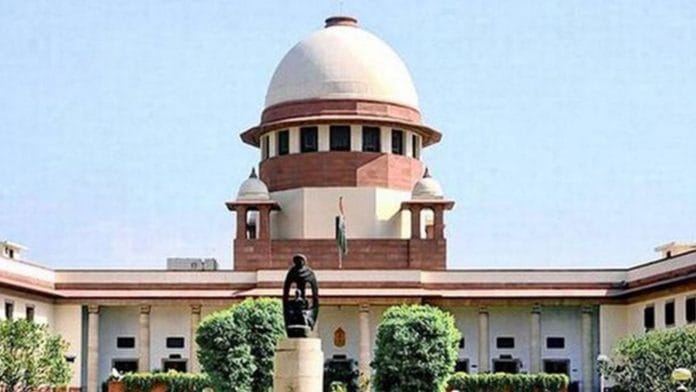


New Delhi: The Supreme Court on Tuesday allowed a 16-year-old minor accused of murder four years ago to be tried as an adult. In doing so, the court upheld an order passed by the Patna High Court in July last year, confirming the findings of the trial court which said that there was a need to try the minor as an adult in the case.
The case revolves around ‘X’, a Bihar-based minor accused in May 2022 of slitting the throat of a young boy who had gone missing from his house. The boy’s lifeless body was later found in a field. Among the grounds on which X challenged the high court decision to try him as an adult was that the Juvenile Justice Board (JJB), while conducting his preliminary assessment, had failed to take into account opinions from experienced psychologists and medical specialists.
The two-judge bench of Justices J.B. Pardiwala and Ujjal Bhuyan, however, noted that although appellate courts, where appeals lie, can call for assistance by experts, they “are not bound” by the reports of these experts placed before the JJB. Despite this, the court said that the board must independently apply its mind to all the material available before it, keeping in mind the four parameters under Section 15 of the Juvenile Justice (JJ) Act.
In 2023, the trial court had also asked the Juvenile Justice Board to transfer the case to the children’s court, which has been defined under Section 2(20) of the Juvenile Justice Act 2015, to mean courts under the Commissions for Protection of Child Rights Act 2005, or special courts under the Protection of Children from Sexual Offences Act 2012. These courts have the power to decide if a child should be tried as an adult. They can also conduct enquiries and pass orders relating to the child’s rehabilitation and follow-up.
Recalling the objectives of the JJ Act, the court said Parliament was aware of the rise in the number of juveniles in conflict with the law, and the inadequacy of the existing regime in addressing the complexities in such cases. “In such circumstances, the legislature thought it fit to treat the children between the age of 16-18 years as a separate class so as to balance the rehabilitative rights of the juvenile on one hand, and the broader interest of societal deterrence on the other,” the court noted.
The court also noted that in cases concerning heinous offences like murder, courts cannot impose any lesser sentence than life imprisonment. “The statute does not provide any discretion to the courts to award any punishment below imprisonment for life. Thus, life imprisonment is, by implication, the minimum punishment prescribed under Section 302 of the IPC,” the court noted.
In a 47-page ruling, the bench relied on Section 15(1) of the JJ Act, which entails the preliminary assessment of heinous offences by the board, and noted that there are certain factors which must be looked at while conducting such assessments. These include the child’s mental and physical capacity to commit the offence, and to understand its consequences. Another thing that is looked into during this assessment period are the circumstances under which the child committed the alleged offence.
Underlining that children today are exposed to complex information from an early age, including graphic content, which was inaccessible to previous generations, the court noted that there is no doubt that the proliferation of technology, and the influence of social media has affected the psychological development of children.
“The approach of courts, or the juvenile justice boards dealing with a child in conflict with law cannot remain stagnant since the legislation came to be enacted,” the court said while calling for a balanced approach.
Factors to be looked into
In a nutshell, the court said that although taking in the inputs or the assistance of the experts is optional for the Juvenile Justice Board, Section 15(1) states that the JJB must conduct a minor’s preliminary assessment taking into account the following factors.
First, is the mental capacity of the child in conflict with law to commit the alleged offence. Secondly, the child’s physical capacity to commit the offence is also looked into. The third parameter the board looks into includes the ability of the child in conflict with law to understand the consequences of the offence. However, the final thing to be looked at is the circumstances in which the child in conflict with law committed the alleged offence, the court noted.
“For the JJ Board to arrive at its conclusion at the end of the preliminary assessment, it is not bound by any opinion or recommendation and must independently apply its mind to all the material available to it. In order to arrive at a conclusion, it must assess all the material together, keeping in mind the four parameters stipulated under Section 15 of the JJ Act,” the court said.
How the case reached SC
After the investigation was complete, the accused claimed he was a minor. Section 9 of the JJ Act empowers the magistrate to declare an accused before them a child and forward the proceedings record to the Juvenile Justice Board.
The JJB then calculated the accused’s age as 16.4 years on the day the alleged crime was committed, declaring him to be a juvenile. Following this, the JJB called for the minor’s Social Investigation Report (SIR) and Social Background Report (SBR), which are important documents utilised in the juvenile justice process. While the SIR provides an in-depth psychosocial evaluation to guide rehabilitation and care decisions, the SBR entails a child’s immediate circumstances and family history.
In the present case, the court also pointed out that the JJB’s final report should contain a reasoned decision on whether the child in conflict with law is to be tried as an adult, together with the reasons for accepting or rejecting the observations and recommendations contained in the SIR, the SBR, and the witness statements.
The two-judge bench also pointed out that the JJB, in the present case, had failed to consider the SIR, and the SBR, which constitute “pertinent inputs for the preliminary assessment” of the accused child.
“The board makes no mention whatsoever of the SIR or the SBR. It erred in failing to consider the SIR and the SBR, more particularly, the antecedents and recommendations made by the Probation Officer and the CWPO, respectively. We underscore or rather emphasise that the SIR and the SBR reports are not supplementary material; they constitute pertinent inputs for the preliminary assessment,” the court said.
The case records showed that the minor was caught as he was trying to flee, along with the weapon which was used to slit the throat of the deceased. After analysing the counselling report and SIR, the JJB’s majority opinion was that the minor did not have the mental and physical capacity to commit the alleged offence. However, the presiding magistrate disagreed with the majority and said the minor was capable of understanding the act, and should be tried as an adult.
The minor then moved a Chapra court, which in December 2023 set aside the JJB’s earlier order and said that X should be tried as an adult. Challenging the 2023 ruling of trial court, the minor moved the Patna High Court, saying that the trial court had failed to take assistance from experienced psychologists and medical specialists. On 24 July last year, the court dismissed X’s appeal, and he moved the Supreme Court.
(Edited by Nardeep Singh Dahiya)
Also Read: Why Madras HC set aside death sentence of man convicted of raping minor daughter