



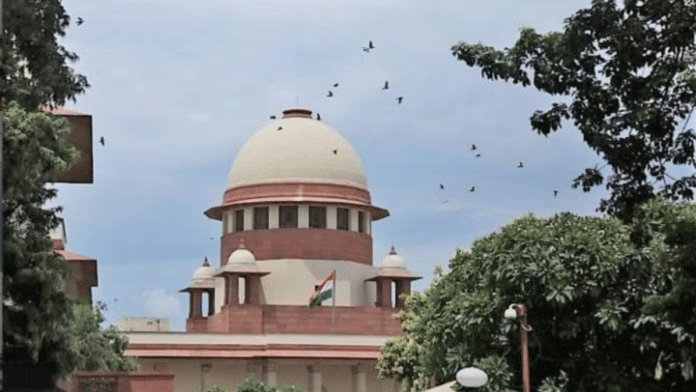
New Delhi: Setting aside the death sentence given to the main accused in the 1996 Samleti bus bomb blast case, the Supreme Court has ordered a fresh trial after finding that he got no legal representation during crucial stages, making the trial “constitutionally infirm”.
Abdul Hameed, now 64, was convinced and given the death sentence by a trial court in 2014. The sentencing was upheld by the Rajasthan High Court in 2014.
While ordering a fresh trial for him, the court also acquitted another accused, named Pappu alias Salim, of all charges, ordering his immediate release after he had already spent more than 23 years in prison.
The court also confirmed the innocence of six other men, including Javed Khan and Raees Baeg whose acquittals by the lower courts were challenged by the state.
“The legitimacy of a judicial verdict rests not merely upon the outcome reached, but equally upon the fairness, transparency, and integrity of the process by which that outcome is achieved,” the top court bench of justices Vikram Nath, Sanjay Karol and Sandeep Mehta said in a 183-page verdict.
The bench was adjudicating the case that originated on 22 May 1996, when an explosion ripped through a Rajasthan Roadways bus near Samleti village while it was traveling from Agra to Bikaner. The blast claimed 14 lives and left 37 seriously injured.
The investigation, initially conducted by the state police and later by its specialised investigative wing CID (Crime Branch), suggested the blast was part of a pre-planned conspiracy intended to disrupt the electoral process in Kashmir through terror.
Authorities alleged the blast was a joint work of the Jammu and Kashmir Islamic Front (JKIF) and Harkat-ul-Ansar, reportedly masterminded by Bilal Ahmed Baeg in Pakistan with the support of ISI and Tiger Memon. Forensic experts concluded that approximately 2.5 kilograms of RDX had been planted beneath seat numbers 17 and 18.
Also Read: SC issues directions for mitigating, aggravating factors to be followed in death penalty cases
Legal battle spanning 3 decades
Over the course of nearly three decades, the prosecution produced a voluminous record including travel logs, hotel registers, and confessional statements. In September 2014, a trial court in Rajasthan’s Dausa convicted Abdul Hameed sentencing him to death, while giving life imprisonment to 6 others.
The Rajasthan High Court, in 2019, affirmed Hameed’s death sentence, but acquitted six co-accused, including Raees Baeg and Javed Khan, citing a lack of substantive evidence.
The High Court had also noted that the convictions of these co-accused were largely based on derivative evidence or confessions from other cases that lacked independent corroboration.
Hameed, meanwhile, remained in prison on the death row, having served nearly twenty-nine years behind bars by the time his appeal reached the Supreme Court.
SC jail interaction & right to fair trial
When the case reached the SC in 2019, its primary concern was not immediately the evidence, but whether Hameed received a fair trial. During the proceedings, the court conducted a video conference interaction with Hameed, who is currently lodged in Central Jail, Jaipur.
In this interaction, Hameed unequivocally stated that “no advocate had represented him during the trial proceedings”, and that the trial court never provided him with legal aid.
The Bench also found that the legal record supported Hameed’s claim – showing that he was compelled to cross-examine witnesses on his own despite facing capital charges. The Court remarked, “The right to effective legal representation… is not a mere procedural formality” but a substantive guarantee that distinguishes the rule of law from public opinion.
The judgment stated that the trial court was under a “constitutional obligation” to ensure Hameed was provided competent legal assistance, which it failed to do.
The Hameed case
Rather than acquitting Hameed outright, the Supreme Court balanced his rights against the impact of the crime on society. The court observed that because the offense shocked the “collective conscience of society” it would be a failure of justice if the prosecution was not taken to a logical, fair conclusion.
“To sustain the conviction on the basis of a record created in the absence of effective legal assistance would render illusory the constitutional guarantee of a fair trial,” the court said while setting aside Hameed’s conviction and death sentence and remitted the matter for a de-novo (fresh) trial.
The top court requested the Acting Chief Justice of the Rajasthan High Court to designate a Special Court in Jaipur to conduct a trial daily, and conclude proceedings within a year.
Importantly, the court ordered that the state must provide Hameed with a lead defense counsel having at least 10 years of standing at the Bar.
“The right to effective legal representation… is not a mere procedural formality. They are substantive guarantees that distinguish the rule of law from the rule of public opinion,” the court said.
Acquittal after 23 Years
In a separate section of the judgment, the court dealt with accused Pappu alias Salim, who had been convicted based on confessional statements that were later retracted. The court found these confessions to be “woefully wanting” and having serious legal infirmities.
The bench noted that there was no recovery of incriminating material such as explosives, weapons, or documents linking Salim to the conspiracy.
The court declared that Salim’s conviction could not be sustained solely on the basis of his own confessional statements whose voluntariness was in doubt. After having served more than 23 years of incarceration in the Jaipur Central Jail, Salim was acquitted of all charges and ordered to be released immediately.
State’s appeals against other acquittals
The Rajasthan government had challenged the High Court’s acquittal of six other accused individuals, including Javed Khan and Raees Baeg. The Supreme Court, however, upheld the acquittals, stating that the state failed to produce “cogent, reliable and legally admissible evidence” connecting them to the Samleti blast.
The court noted that mere association or travel with other accused persons is insufficient to establish participation in a specific criminal conspiracy. It reaffirmed the “double presumption” of innocence that favors an acquitted person, concluding that the HC’s view was not only reasonable but the “only permissible view” based on the record.
(Edited by Ajeet Tiwari)
Also Read: Why Supreme Court hasn’t confirmed a single death sentence in the last two years