





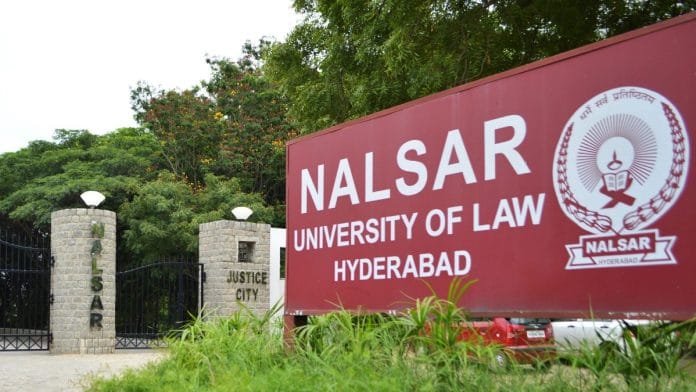


New Delhi: The Bar Council of India (BCI) has withdrawn its six-page order issued earlier in the day directing all state bar councils not to enrol 2026 graduates of the NALSAR University of Law, Hyderabad. The withdrawal followed widespread criticism of the earlier order in which the Bar Council cited an ongoing inquiry into what it termed an organised campaign to oppose participation of CJI Surya Kant at the law school’s convocation.
The first order was issued after 450 outgoing students of the National Academy of Legal Studies and Research (NALSAR) sent an email to the Vice-Chancellor requesting that the CJI not be invited to their convocation.
Their opposition stemmed from the Chief Justice of India’s refusal to grant early hearing to a letter petition demanding a probe into alleged police excesses in Delhi during the ‘Sansad Chalo’ protest march called by Cockroach Janta Party (CJP) on 20 July.
In its second order, issued Thursday evening, the Bar Council said after thorough discussion members were of the unanimous view that “vast majority of the students of NALSAR (2026 pass out students) are innocent and they were not inclined to take part in the move of disrespect”. It added, “Accordingly, the Council modifies the order of Chairman with regard to the ban on the enrolment of the NALSAR Students with the State Bar Councils. All the students will be entitled to get enrolled with the State Bar Councils of their choice.”
The order also said, “It has been further reported by some reliable sources that a handful of teachers and outsiders were instrumental in instigating the innocent students.”
NALSAR ranks third among law schools in India, according to the National Institutional Ranking Framework (NIRF).
BCI chairman and BJP MP Manan Kumar Mishra had via the earlier directive given the NALSAR Vice-Chancellor three days to submit a detailed report identifying the students, student leaders, and faculty members behind the alleged campaign.
A final decision on suspension of enrolments was to be taken by the regulator on 19 August, 2026, after reviewing the university’s submissions, according to the earlier order.
In a dramatic regulatory intervention, the BCI’s earlier order instructed state bar councils: “Till further orders, no student of NALSAR University of Law, who has obtained the Law Degree in the year 2026, shall be enrolled by any State Bar Council as an Advocate.”
Citing the Supreme Court’s 2003 ruling in Ex-Capt. Harish Uppal v. Union of India, the regulatory body reiterated that legal professionals and those entering the field must maintain a respectful attitude toward courts and avoid strikes or boycotts, which tarnish the image of the profession. It warned that completing enrolments while an active statutory examination of student conduct was underway would create a fait accompli, rendering the regulatory process ineffective. For students whose names are highlighted in the upcoming inquiry, any pending enrolment applications will remain deferred, it had said.
Vikas Singh, senior advocate and president of the Supreme Court Bar Association (SCBA), had written to the BCI chairman earlier in the day, strongly condemning the earlier order and urging for its withdrawal. Calling it ‘arbitrary, illegal, disproportionate and fundamentally unsustainable’, Singh wrote that the earlier order amounted to an attempt to “intimidate law students for exercising their fundamental right to freedom of speech and expression. Universities are meant to be campuses of free thought and fearless debate”.
“Let me make it clear that I do not support any act of disrespect towards the highest constitutional authority of the country…The directive also seriously affects the graduates’ fundamental right under Article 19(1)(g) to practise a profession of their choice,” he wrote.
Also Read: No court reels, memes: Bar Council draws red lines on social media use by lawyers, law students
Campus politics and instigation allegations
In its earlier order, the Bar Council had taken a stern view of the opposition to the invite, writing that law students who show disregard for the highest judicial offices are “not expected to be a responsible or sensible Advocate, Teacher or a Judge” and would become a “liability on the profession”.
“As per some reliable sources, there exists groupism and dirty politics among some of the academic staff and they have played very active role in misleading, instigating and misguiding the students. This is a very serious matter. The teachers, instead of involving themselves in their teaching job, are doing nasty politics in the campus. Bar Council of India, being the regulator of Legal Education cannot be a mute spectator of such a serious situation,” the six-page order stated.
It emphasised that while legal education encourages reasoning, debate, and analytical criticism, a clear line must be drawn. Further, it asserted that a “material distinction between legitimate expression and conduct which involves organised intimidation, coercion, personal vilification, disruption, obstruction or an organised call for boycott” targeting a constitutional functionary or an institutional programme.
The Bar Council had in its earlier order directed NALSAR to furnish complete copies of the representations, petitions, or memoranda submitted to university authorities concerning the convocation invite, along with the full list of signatories. A separate list identifying the principal organisers of the alleged campaign, including student committee representatives, student union office-bearers, faculty members, research scholars, alumni, or outsiders was also sought. In addition, factual details were sought on whether permission was requested or granted for demonstrations and if campus discipline rules were invoked.
The Bar Council had, however, in its earlier order clarified that it does not immediately record any person as disqualified under Section 24A of the Advocates Act, 1961. Instead, it said it would assess the verified facts from the Vice-Chancellor’s report before determining individual roles and taking further statutory action.
This report has been updated to reflect a second order issued by the Bar Council of India on the same day, withdrawing the earlier order.
(Edited by Amrtansh Arora)
Also Read: Kasab, Kathua & now Ayodhya boycott: Can Bar Associations refuse an accused? What lawyers say