







Past cases show that while courts often step in to declare such boycotts illegal and appoint legal aid counsel for the accused, lawyers who swim against the tide to represent the accused often face threats and attacks, and have had to even approach the courts for protection.
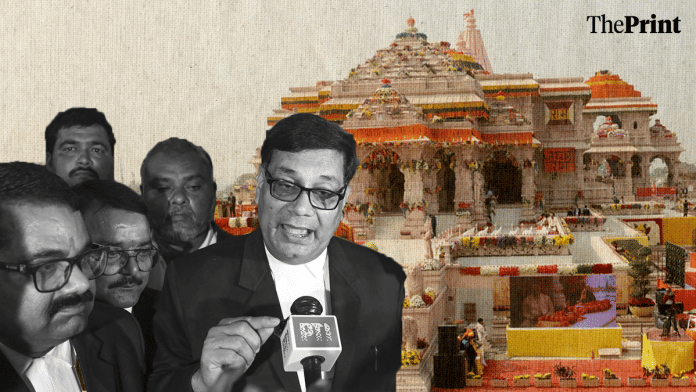
The most recent addition to this trend is the Ayodhya Bar Association’s decision that no lawyer will represent the accused in the Ram Temple donation theft case—and that if an advocate decides to take up the case, the association would impose a Rs 5 lakh fine.
However, experts say that such boycotts go against the constitutional principles of free and fair trial, and also violate the Bar Council of India Rules on the duties of advocates.
Supreme Court Advocate on Record Talha Abdul Rahman says that Bar Associations have in the past decided not to represent the accused, especially in terrorism cases.
“Such responses, however understandable in moments of public outrage, do not represent the finest traditions of the Bar. The duty of the legal profession is not to endorse the alleged conduct of an accused, but to ensure that every person receives the fair trial that the Constitution guarantees,” he told ThePrint.
Rahman asserts that defending an unpopular accused requires courage. “It is in moments such as these that both the legal system and the character of the legal profession are tested. This is the true stress test of the rule of law,” he added.
#WATCH | Ayodhya, Uttar Pradesh | alleged Ram Mandir donation embezzlement case | Kalika Prasad Mishra, President, Ayodhya Bar Association says, "No lawyer will represent the accused in the case and if anyone does, a fine of Rs 5 lakh will be imposed on them" https://t.co/6qBJejQvzj pic.twitter.com/uqZqaLDnKu
— ANI (@ANI) June 29, 2026
Who represents the accused
A prominent example of lawyers refusing to represent an accused emerged after the 2008 terror attacks in Mumbai, when bar associations passed resolutions boycotting legal representation to the accused, Ajmal Kasab, the lone militant arrested for the attacks.
When the case reached the Bombay High Court for confirmation of the death sentence handed to Kasab, criminal lawyer Amin Solkar, who had been appointed by the court to defend him, had to be provided round-the-clock security. A constable with an automatic carbine accompanied Solkar, after he received messages threatening him against representing Kasab, according to news reports.
Farhana Shah, who was assisting Solkar in his defence of Kasab, also faced such threats. Her brother-in-law’s dental clinic was attacked with stones.
Similarly, Girija Shankar Mehta, president of the Udaipur Bar Association, announced that no lawyer would represent the accused in the 2022 beheading of tailor Kanhaiya Lal in Udaipur.
However, the probe was transferred to the National Investigation Agency (NIA), and the trial also proceeded in the special NIA court in Jaipur. That’s how Jaipur-based advocate Syed Saadat Ali represented the accused in the case.
“Here, the resolution was passed by the Udaipur Bar Association; so it didn’t apply to me,” Ali told ThePrint.
However, this wasn’t the first time he had taken up such a case. A similar resolution was passed by the bar association in the 2008 Jaipur blasts case. At the time, the court appointed senior lawyer Paker Farooq as an amicus to represent the accused, and Ali was in the team.
“When such a case happens, lawyers who represent the accused face pressure. But we didn’t come under pressure. We used to walk together, as a team. We used to ensure we’re always in a group while entering the court,” he recalled.
Lawyers who had to approach courts
Courts have also, time and again, interfered with such resolutions. For instance, in 2019, the Kotdwar Bar Association passed a resolution directing all association lawyers not to represent the accused in the murder of advocate Sushil Raghuvansh.
Advocate Kuldeep Agarwal, who wanted to represent the accused, had to himself approach the Uttarakhand High Court.
The Association had even declared that any lawyer representing the accused would lose their membership, but this warning was withdrawn subsequently.
Agarwal told the court that such illegal threats of expulsion violated the Bar Council of India Rules. He also said that he was being threatened orally to deter him from appearing for the accused and prevent him from discharging his duty.
In response, the high court emphasised Article 22(1) of the Constitution, to assert that every accused has a fundamental right to be defended by a legal practitioner of his choice. It ruled that the resolution passed by the bar association was “against all norms of the Constitution, the statute and professional ethics”.
The court added: “It is against the great traditions of the Bar which has always stood up for defending persons accused of a crime. Such a resolution of the Bar Association is null and void, and right-minded lawyers should ignore and defy such a resolution if they want democracy and the rule of law to be upheld in this country.”
Madhya Pradesh-based lawyer Noor Mohammed recollected a similar incident in a 2008 report of the ‘People’s Tribunal on the atrocities committed against the minorities in the name of fighting terrorism’.
Noor was representing two of the 13 people arrested from Indore in 2008, on the allegation that they were activists of the banned Students’ Islamic Movement of India (SIMI). The Dhar Bar Association, at the time, declared that no lawyer would represent the arrested men. He recalled being roughed up, not by lawyers but by outsiders, multiple times in court premises for defending the accused.
He alleges that he was attacked with shoes in the magistrate’s court while writing an application demanding security for the accused and transfer of the case to Indore.
“They did not even pay heed to the orders of the magistrate, who asked them to go out of the court. It seems that they had no respect for the sanctity of the court,” he recalled.
The ‘cab-rank’ rule
Courts have often observed that such resolutions strike at the core of the right of an accused to be represented by a lawyer of their choice.
Article 22(1) of the Constitution makes it clear that no person who is arrested “shall be denied the right to consult, and to be defended by, a legal practitioner of his choice”.
The Bar Council of India Rules on an Advocate’s Duty towards the client also say that a lawyer is “bound to accept briefs”.
“An advocate is bound to accept any brief in the courts or tribunals or before any other authority in or before which he proposes to practise. He should levy fees that are at par with the fees collected by fellow advocates of his standing at the Bar and the nature of the case. Special circumstances may justify his refusal to accept a particular brief,” it says.
Delhi-based lawyer Abhinav Sekhri also refers to the ‘cab-rank rule’, which places an ethical obligation on lawyers to accept any case within their area of expertise, provided they are available and paid their usual fee.
The rule traces back to the principle that taxi cab drivers must carry the first passenger who hails them and asks for a destination, as long as the passenger can pay for the service.
“There’s an entire conversation about whether you have the option to defend someone, especially in a criminal prosecution, when they come to you specifically seeking your legal assistance and the answer is pretty unequivocal,” Sekhri said.
Political creatures
What is the motivation behind bar associations passing such resolutions?
Sekhri asserted that it’s a very “complicated moral question” even though there’s a parallel state obligation to make sure that nobody goes undefended.
“I think there’s no question that it doesn’t have any backing in law, but at the same time, there’s a moralistic tone to it,” he said. “These resolutions are an expansion of a moral idea in the minds of the sponsors, that these persons are so morally abhorrent that there is no question of defending them.”
The Delhi-based lawyer asserted that it could be a tricky question if morals are introduced to the debate, but the question doesn’t remain tricky when the Advocates Act is considered.
“But obviously, life is not a shade of black and white and has tonnes of gray.”
Bar associations, according to him, are “highly political bodies”.
“They are extremely political creatures, and they are reflecting a political mindset in most of these calls for strikes, apart from strikes that are entirely linked to professional reasons—for instance, strike because of some issue in the courts. That’s also a boycott in a sense; they’re boycotting work at large, where every litigant suffers. In this scenario (where they boycott an accused), a litigant suffers.”
Mumbai-based advocate Aditya Mithe also believes that such resolutions usually “reflect a certain sentiment amongst a group of lawyers”.
“The resolutions end up becoming futile because generally everybody ultimately gets represented. So, this is just to usually make a statement. It is an expression of anger and outrage. It usually happens in high-profile cases involving a lot of public sentiment.”
The transfers
The transfer of a case only because of a Bar Association’s boycott of the accused isn’t common. Several factors usually contribute to such a transfer.
Sekhri said several cases have been transferred from one state to another, or from one district to another, because no lawyer was ready to represent the accused. “So, they (such boycotts) can be very impactful.”
A prominent example of such a transfer is the Kathua rape and murder case of a minor. The Supreme Court on 7 May 2018 directed that the trial be shifted from Jammu and Kashmir to the District & Sessions Court in Pathankot, Punjab, to ensure a free and fair trial.
One of the key factors behind the transfer was an incident in which lawyers in Kathua allegedly stopped the police from filing the charge sheet against eight accused before the magistrate’s court.
While the apex court order did not dwell on the incidents, it noted that there have been “some unwarranted situations that have occurred in and outside the Kathua Bar Association, the locality in question, the involvement of many groups”.
It also referred to a report from the District & Sessions judge, saying that “there had been some obstruction by the Bar Association at Kathua.”
In 2017, the Supreme Court was approached by Francis Thomas, Ryan International School’s northern zone head, requesting the transfer of a trial in the murder case of a seven-year-old boy from Gurugram to Delhi.
The court was told that the Gurugram District Bar Association had passed a resolution not to represent the accused in the court. It later withdrew the resolution.
The bench then asserted that an accused, whatever the offence may be, has the “inherent right” to be represented by a counsel of his choice.
“The tradition of the Bar and the fundamental conception pertaining to access to justice does not permit any Bar Association to pass a resolution of the nature that had been done,” the court observed. It noted that the withdrawal of the resolution by the bar association was a “redeeming act”.
The court also directed that none of the lawyers shall create any impediment in the entry and exit of any counsel representing the accused.
Even the ‘wicked’ deserve lawyers
The issue was addressed early on in a 2010 court judgment, when the Supreme Court declared that such boycott resolutions are “wholly illegal, against all traditions of the bar, and against professional ethics”.
The ruling was in response to a Coimbatore Bar Association resolution that no lawyer would defend the policemen accused in cases arising from clashes between the police and the bar.
A bench comprising Justices Gyan Sudha Misra and Markandey Katju called such resolutions “wholly illegal, against all traditions of the bar, and against professional ethics”.
“Every person, however wicked, depraved, vile, degenerate, perverted, loathsome, execrable, vicious or repulsive he may be regarded by society has a right to be defended in a court of law and correspondingly it is the duty of the lawyer to defend him,” it asserted.
There’s also the question of the autonomy of lawyers who are members of such associations.
Sekhri said that when a bar association issues a boycott call, it takes away the choice of all lawyers who may be members of the association.
However, he added that joining bar associations is a practical reality for most lawyers.
“Most of us will be enrolled in some bar or the other, and when there is a strike for x, y, or z reason, you do end up honoring that strike, especially if you’re a member because the idea is that this is a collective bargaining process,” he said. “When you are in trouble, the bar will stand up for you. For instance, when lawyers get beaten up by the police.”
(Edited by Sugita Katyal)
Also Read: Life term for a 14-strong lynch mob: The order that made an MP judge the target of communal threats