



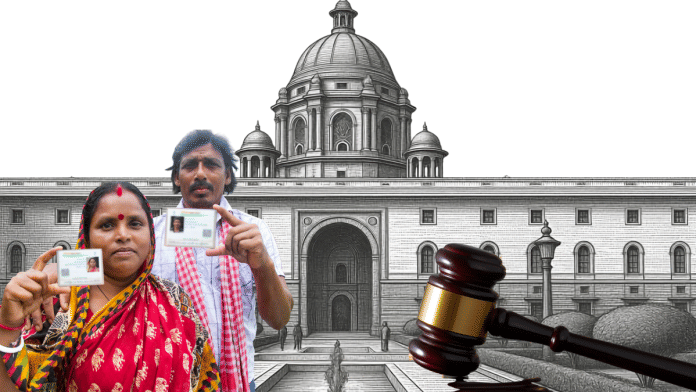

New Delhi: A plea alleging misuse of Aadhaar cards as proof of citizenship, domicile, and residential address has reached the Supreme Court. Citing national security concerns, the plea sought directions to restrict Aadhaar’s use strictly for identity verification.
A top court bench comprising CJI Surya Kant and Justice V. Mohana Tuesday sought response from the Centre, state governments, and UTs over the alleged misuse, based on the PIL filed by advocate and Delhi BJP leader Ashwini Kumar Upadhyay.
The petition contends that Aadhaar, issued by the Unique Identification Authority of India (UIDAI), is not only being used as a proof of age, citizenship and domicile for school admission, property purchase and to obtain birth certificate, ration card, driving licence but also in Application Form for New Voter Registration (Form-6) as proof of date of birth and residence.
Importantly, “infiltrators & illegal immigrants are obtaining various documents using the AADHAAR,” the plea states.
At the same time, pointing to Section 9 of the Aadhaar Act, 2016—which expressly states that “Aadhaar is not the evidence of citizenship or domicile”—and the UIDAI’s 22 August, 2023 notification—which states that “Aadhaar is proof of identity, not of citizenship, address or date of birth”—the petition maintains that the existing verification mechanism under Form-6 is ‘inadequate and might allow individuals without proper supporting documents to be included in the electoral database’, harming India’s electoral integrity.
The petition further states that the injury caused is amounting to “dilution of integrity/reliability of identification framework under the AADHAAR Act 2016, resulting in infiltrators and illegal immigrants availing subsidies, benefits, and services meant for citizens, particularly SC, ST, OBC and minority community”. This could, the plea argues, lead to diversion of public resources, exclusion of rightful beneficiaries, and violation of the principles of equality and fairness guaranteed under the Constitution.
It seeks directions from the top court to the central, state government and the Election Commission of India to ensure that Aadhaar is used only as proof of identity and not as proof of citizenship, domicile address, or date of birth.
Additionally, the petitioner has also sought a declaration that use of Aadhaar as a proof of date of birth and residence in the Form-6 is against Section 23(4)—which empowers Electoral Registration Officers to mandate that individuals furnish their Aadhaar numbers to establish identity for voter roll registration—of the Representation of the People Act and Article 14 of the Constitution; hence, void and inoperative.
Arguing that all residents, including foreign nationals, are entitled to obtain Aadhaar under the Aadhaar Act and a person becomes eligible after residing in India for 182 days in a year, the petitioner highlighted that Aadhaar can be obtained through enrolment centres on the basis of documents such as rent agreements and recommendations from local authorities. It further claims that illegal immigrants and infiltrators are thus able to obtain Aadhaar and subsequently secure other identity documents, including voter identity cards.
(Edited by Vidhi Bhutra)